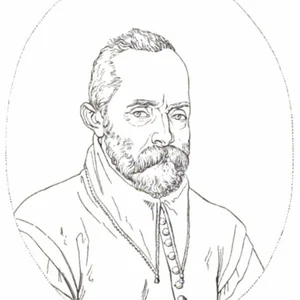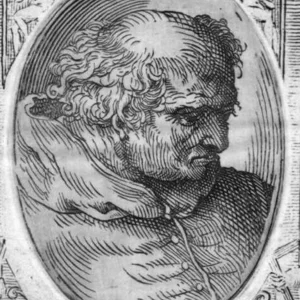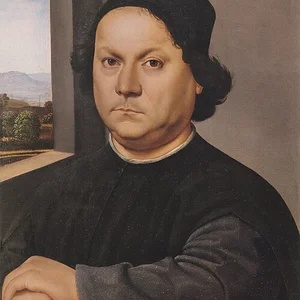

Italian painter of the Umbrian Renaissance (c. 1446–1523), Perugino is celebrated for his harmonious compositions featuring gentle, idealized religious figures. A pupil of Verrocchio, he contributed to the Sistine Chapel and became Raphael's master.
Perugino
Pietro di Cristoforo Vannucci, known as Perugino
9 min read
Frequently asked questions
Key Facts
- Born around 1446–1452 in Città della Pieve, in Umbria (Italy)
- Trained in Verrocchio's workshop in Florence around 1470, alongside Leonardo da Vinci
- Contributed in 1481–1482 to the decoration of the Sistine Chapel (fresco The Delivery of the Keys to Saint Peter)
- Accepted Raphael as an apprentice around 1495–1500; his influence was decisive on the young master's style
- Died in 1523 in Fontignano, active until the end of his life despite a declining reputation overshadowed by his own pupils
Works & Achievements
A monumental fresco in the Sistine Chapel depicting Christ entrusting the keys of Paradise to Saint Peter before a vast architectural space. A masterpiece of perspectival composition, it is considered Perugino's most ambitious work and one of the finest frescoes of the Renaissance.
A fresco cycle decorating the audience hall of the money-changers' guild in Perugia, depicting virtues, prophets, and sibyls. Regarded as Perugino's mature masterpiece, the frescoes showcase his complete command of his harmonious and serene style.
An altarpiece depicting the dead Christ supported by the Virgin and saints, commissioned for the magistrates' hall in Perugia. The work illustrates Perugino's ability to convey restrained grief and idealized grace even in the most dramatic religious scenes.
An altarpiece depicting the betrothal of Mary and Joseph before a round temple in the antique style, commissioned for Città della Pieve. This composition directly influenced Raphael, who produced a near-identical version in 1504 — a testament to the master-pupil transmission.
An altarpiece depicting Saint Bernard in ecstasy receiving the apparition of the Virgin surrounded by angels, now held at the Alte Pinakothek in Munich. This work embodies the quintessence of Perugino's style: gentle faces, serene expressions, and a luminous clarity of space.
A rare mythological subject in Perugino's output, depicting Apollo playing the lyre opposite Marsyas in a luminous Umbrian landscape. Held at the Musée du Louvre, this small panel attests to the master's versatility and his interest in classical Antiquity.
Anecdotes
Perugino was one of the painters chosen by Pope Sixtus IV to decorate the lateral walls of the Sistine Chapel between 1481 and 1482, alongside Botticelli and Ghirlandaio. His masterpiece in this ensemble is the fresco “The Delivery of the Keys to Saint Peter,” considered one of the most remarkable in the entire chapel. This titanic undertaking earned him an international reputation and opened the doors of the greatest courts in Italy.
Around 1500, a young teenager entered Perugino’s workshop in Perugia: his name was Raffaello Sanzio, whom posterity would know as Raphael. The master passed on his techniques of harmonious composition and his gentle way of idealizing faces. Raphael absorbed these lessons so quickly that he soon surpassed his teacher, to the point that some patrons could no longer tell the hand of one from that of the other.
Giorgio Vasari, biographer of Renaissance artists, reports that Perugino was renowned for his exceptional miserliness. It is said that he hid his money in his belt and refused to pay his apprentices properly. Paradoxically, this man whom his contemporaries considered hardly pious produced the most serene and moving religious paintings of his era.
Toward the end of his career, Perugino fell victim to a strange reversal: the very Florentine critics and patrons who had once adored him began to mock the repetitiveness of his compositions. His angelic figures, once admired, now seemed too uniform to an audience accustomed to the innovations of Leonardo da Vinci and Michelangelo. Yet the master continued to work until his death, remaining faithful to his inimitable style.
Perugino died of the plague in 1523 at Fontignano, a small village in Umbria where he was still working on a fresco for the local church. According to the tradition reported by Vasari, he refused the last rites of the Church before dying — an extremely rare and scandalous act for the time, especially for a painter whose entire body of work was devoted to religious subjects.
Primary Sources
Pietro Perugino […] fu nella sua gioventù molto povero, e attendeva alla pittura con gran fatica e disagio. Egli era tenuto avaro e di poca fede, e non si curava molto della religione.
Pietro di Cristoforo da Castel della Pieve, pittore, si obbliga a dipingere una tavola con il Cristo morto sorretto dalla Madonna, san Giovanni, Maria Maddalena e altri santi, per la sala dell'Udienza dei Priori di Perugia.
Mastro Pietro Vannucci da Perugia, eximio pictore, promette di dipingere la volta e le pareti della Sala dell'Udienza del Collegio della Mercanzia con figure di virtù, profeti e sibille, a sue spese e con suoi colori.
Desidero avere una pittura di mano di Pietro Perugino, il quale intendo essere excellentissimo maestro; et vorrei che fosse una figura di una madonna col puto in brazzo.
Key Places
A small Umbrian town, birthplace of Perugino, where he was born around 1446. Several of his early works are preserved there, notably in the cathedral and the Oratorio di Santa Maria dei Bianchi, and the town has paid tribute to him in several of its monuments.
It was in Florence, in the bottega of Andrea del Verrocchio, that the young Pietro Vannucci underwent his formative apprenticeship during the 1470s. There he worked alongside Leonardo da Vinci and absorbed the principles of spatial composition and perspective.
The city from which Perugino drew his nickname ("Perugino" meaning "the man from Perugia"), where he established his main workshop and trained Raphael. He created his greatest frescoes there at the Collegio del Cambio, and used the proceeds of his success to acquire houses and properties in the city.
Between 1481 and 1482, Perugino took part in the decoration of the lateral walls of the Sistine Chapel, commissioned by Pope Sixtus IV. His fresco *Christ Giving the Keys to Saint Peter* is among the most admired works in this monumental ensemble, and stands as a model of mastery in perspective.
A small Umbrian village where Perugino died of the plague in 1523, while still at work on a fresco for the local church. He was buried there under circumstances that contemporaries found controversial.
Typical Objects

Essential tools of the Renaissance painter, made from sable hair mounted on wooden handles. Perugino used very fine brushes to achieve the delicate contours and soft expressions characteristic of his Madonnas.

The traditional support for Italian painting before canvas became widespread, prepared with several layers of gesso (plaster and glue) to create a smooth, white surface. Perugino applied his tempera and later oil paints onto this surface.

The colors used in Perugino's workshop were made from ground minerals and plants: lapis lazuli from Afghanistan produced the deep blue of the Virgin's robes, while vermilion yielded vivid reds. Their careful preparation was entrusted to the apprentices.

A large drawing on heavy paper used to transfer a composition onto a wall or panel before painting. Perugino frequently reused his cartoons for different commissions, which accounts for the striking resemblance between some of his figures.

A hand-held wooden board on which the painter arranged and mixed his colors before applying them to the support. Its thumb-hole design is identical to the one still used by painters today.

A large painted panel placed behind the altar of a church, commissioned by confraternities, guilds, or noble families to display their piety. Altarpieces represented the main source of income for a painter like Perugino and required lengthy contractual negotiations.
School Curriculum
Vocabulary & Tags
Key Vocabulary
Daily Life
Morning
Perugino began his day early, before sunrise, to make the most of the natural light in his workshop (the *bottega*). He supervised his apprentices as they prepared pigments and supports, then tackled the most delicate passages of his paintings, reserving his full concentration for the morning hours when the light was at its most stable and gentle.
Afternoon
The afternoon was devoted to less demanding work: architectural backgrounds, drapery, and the vegetation of distant landscapes. Perugino often managed several commissions simultaneously, delegating secondary sections to his many apprentices. He also received patrons to negotiate contracts and discuss the progress of ongoing works.
Evening
In the evening, the master spent time on bookkeeping and workshop management — a task he took very seriously, according to contemporaries who criticized him for his miserliness. He ate modestly and retired early, in keeping with the habits of Italian craftsmen of the period, while remaining available to receive messengers bringing new commissions from distant clients.
Food
Like most prosperous Italian craftsmen of his era, Perugino's daily diet consisted of bread, vegetables, olive oil, and legumes. Meat was reserved for feast days and meals with patrons. Local Umbrian wine accompanied meals, diluted with water as was the medically recommended practice.
Clothing
In the workshop, Perugino wore a simple work apron over his everyday clothes to protect himself from paint and pigment splashes. When meeting patrons or calling on prelates and princes, he dressed in an elaborate garment of fine wool cloth — a mark of the elevated social standing he had earned through his artistic success.
Housing
In Perugia, Perugino lived in a comfortable house acquired through his artistic income, which he managed with the frugality his contemporaries held against him. His workshop, adjoining or close to his residence, was a communal space where his apprentices lived and worked, following the traditional model of the Italian Renaissance *bottega*.
Historical Timeline
Period Vocabulary
Liens externes & ressources
Références
Œuvres
Pietà (Pala dei Decemviri)
1495
Le Mariage de la Vierge
1501-1504
Vision de saint Bernard
v. 1490-1494
Apollon et Marsyas
v. 1490