
Philippa Roet (or Philippa Pan) was an English lady-in-waiting at the court of the Plantagenet kings in the 14th century. In the service of Queen Philippa of Hainault, she married the poet Geoffrey Chaucer, thus becoming a figure of the medieval English court milieu.
Philippa Roet(1346 — 1387)
Philippa Roet
6 min read
Frequently asked questions
Key Facts
- Around 1366: marriage to the poet Geoffrey Chaucer, author of The Canterbury Tales
- Lady-in-waiting to Queen Philippa of Hainault, wife of Edward III of England
- Received a royal pension in 1366, attesting to her position at court
- Sister of Katherine Swynford, mistress and later wife of John of Gaunt, Duke of Lancaster
- Died around 1387, during the reign of Richard II
Works & Achievements
Philippa was a lady of the chamber to the Queen of England, a position of trust at the heart of the royal household.
After the queen's death, she entered the service of John of Gaunt's second wife, strengthening the Chaucer couple's ties to the House of Lancaster.
This union linked Philippa to the greatest English medieval poet and placed their family within the most influential courtly network in the kingdom.
The pensions paid by the crown and by John of Gaunt attest to the recognition of her services at court.
This honour, shared with members of the House of Lancaster, reflects her integration into the religious and noble elite.
Anecdotes
Philippa Roet was the daughter of Sir Paon de Roet, a knight from Hainaut who had come to England in the retinue of Queen Philippa of Hainaut. Like the queen, she bore this first name, and it was no doubt because of this link to her native land that the sovereign took her on as a lady-in-waiting.
Her younger sister, Katherine Swynford, became the mistress and then the third wife of John of Gaunt, Duke of Lancaster and son of King Edward III. Through this marriage, Philippa Roet found herself connected by alliance to one of the most powerful families in the kingdom and to the future kings of the Lancaster dynasty.
Around 1366, Philippa married Geoffrey Chaucer, who would become the greatest English poet of the Middle Ages, author of *The Canterbury Tales*. Their union sealed the alliance of two servants of the court, and it is thought that some of their children went on to make careers of their own in the royal household.
In 1372, Philippa received an annual pension from John of Gaunt, a sign of the favour she enjoyed. The royal archives preserve the record of these pensions paid both to her and to her husband, attesting to the couple's place in court service.
Philippa's name disappears from the payment registers after 1387, which leads historians to fix her death at that date. Very little is known of her personal life: her existence is known only through the administrative documents of the court, which was the fate of most women, even those of high rank, in that era.
Primary Sources
Record of a royal annuity granted to “Philippa Chaucy” (Philippa Chaucer), a lady of the queen's chamber, in reward for her service.
Grant of an annual pension to Philippa Chaucer, attesting to the Chaucer couple's ties with the House of Lancaster.
Confirmation of the annuities paid to Geoffrey Chaucer and his wife Philippa for their services to the crown.
Admission of Philippa Chaucer into the fraternity of Lincoln, alongside members of the House of Lancaster.
Key Places
A region of the southern Low Countries from which the Roet family originated. It was from here that Queen Philippa and her Hainaulter servants came to England.
Residence and centre of power of the Plantagenet kings, where the court was held. Philippa served here as a lady-in-waiting to the queen.
A great English royal residence frequented by the court of Edward III. The queen's ladies stayed here as the royal household moved about.
The sumptuous London residence of John of Gaunt, Duke of Lancaster, the patron of the Chaucer couple. It was burned down during the Peasants' Revolt of 1381.
A great Gothic cathedral where Philippa was admitted to the confraternity in 1386. This place linked her family to the devotion of the House of Lancaster.
Typical Objects

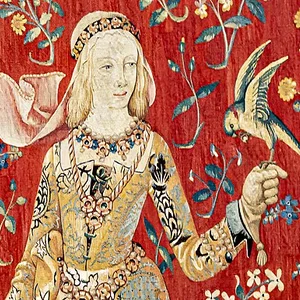
A close-fitting, long-sleeved garment worn by noblewomen in the 14th century. Its body-hugging cut and precious fabrics signaled the rank of the woman who wore it.

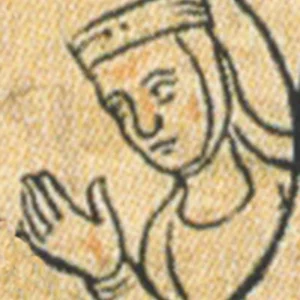
A piece of cloth framing the face and covering the head, worn by married women at the medieval court. It conveyed both modesty and status.

A sum of money paid each year by the crown or a great lord in reward for service. Philippa received several, recorded in the accounts of the Exchequer.

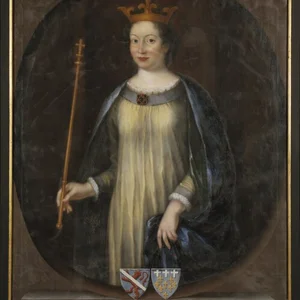
A jewel adorned with family coats of arms, given or worn by members of the court. It displayed membership in a lineage and the alliances that had been forged.

A richly illuminated collection of prayers intended for the private devotion of noblewomen. It was as much an object of piety as a testament to wealth.

A document certifying admission into a religious fraternity, which bound its members together spiritually. Philippa was received into it in 1386 alongside members of the House of Lancaster.
School Curriculum
Vocabulary & Tags
Key Vocabulary
Tags
Lieu
Daily Life
Morning
A lady-in-waiting's day began early, with mass or prayers in the royal chapel. She would then get ready to join the queen's chamber, where she helped her wash and dress.
Afternoon
The afternoon was spent in the service of the sovereign: accompanying her on walks, looking after her clothes and jewels, or keeping her company during audiences. The court was itinerant, and one followed the queen from one royal residence to another.
Evening
Evenings at court might be filled with banquets, music, dancing, or the reading of poems. A lady-in-waiting was expected to appear and take part in the social life of the royal household.
Food
At the court table, people ate white bread, roast meats, game, and fish on meatless days, seasoned with costly spices. Imported wine accompanied the meals of those of high rank.
Clothing
Philippa wore fitted gowns of fine cloth or silk, trimmed with furs, along with a headdress veiling her hair as befitted a married woman. The richness of the fabrics marked her membership in the royal entourage.
Housing
She lodged in the royal and noble residences — Westminster, Windsor, the Savoy — as the court moved about. The ladies of the household had chambers within the palace, near the queen's apartments.
Historical Timeline
Period Vocabulary
Liens externes & ressources
Références
Œuvres
Service auprès de la reine Philippa de Hainaut
vers 1360-1369
Service auprès de Constance de Castille
années 1370
Mariage avec Geoffrey Chaucer
vers 1366
Obtention de rentes royales et seigneuriales
1372-1374
Admission à la confrérie de la cathédrale de Lincoln
1386