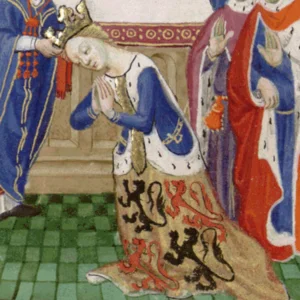

Arlette of Falaise, daughter of a tanner or leather-worker from Falaise, in Normandy, was the concubine of Duke Robert the Magnificent. From this union was born William, the future William the Conqueror, King of England. Born among the common people, she became the mother of a royal line.
Arlette(1010 — 1050)
Arlette of Falaise
duché de Normandie
6 min read
Frequently asked questions
Key Facts
- Born in Falaise (Normandy) in the early 11th century, daughter of a tanner named Fulbert according to tradition
- Becomes the concubine (frilla, a Danish-style union) of Duke Robert the Magnificent around 1027
- Gives birth around 1027-1028 to William, called the Bastard and later the Conqueror
- Later marries Herluin de Conteville, with whom she has, among others, Odo of Bayeux and Robert of Mortain
- Her son William becomes Duke of Normandy and then King of England after the victory at Hastings in 1066
Works & Achievements
By giving birth to William, Arlette became the mother of the man who conquered England in 1066 and founded a new royal dynasty.
Her son Odo became bishop of Bayeux and one of the most powerful lords of Norman England, the presumed patron of the Bayeux Tapestry.
Robert, another of Arlette's sons, became Count of Mortain and one of the greatest landowners in England after the conquest.
Of common birth, Arlette is the origin of the Norman dynasty that ruled over England, an exceptional achievement for a woman of low status.
Her marriage to a Norman viscount secured her the status of a lady and established an influential family in the duchy and later in England.
Anecdotes
According to the legend recounted by Norman chroniclers, Duke Robert the Magnificent caught sight of Arlette from the castle of Falaise as she was washing linen or dancing by the edge of a stream. Struck by her beauty, he is said to have summoned her to his side, and from this encounter William was born.
One tradition tells that, while pregnant with William, Arlette dreamed that an enormous tree sprang from her body and spread its shadow over all of Normandy and beyond the sea. With hindsight, the chroniclers saw in this a foretelling of her son's conquest of England.
Arlette never married Duke Robert: she was his concubine according to the custom of the “Danish marriage,” a union recognized among the Normans but holding no religious value. This is why her son William was long nicknamed by his enemies “William the Bastard.”
After her affair with the duke, Arlette was married to a Norman lord named Herluin de Conteville. From this marriage were born, notably, Odo of Bayeux, the future powerful bishop, and Robert of Mortain: her sons all played a major role in the conquest of England in 1066.
Even Arlette's name varies according to medieval sources: she is found called Herleva, Arlette, Arletta, or even Herleve. This uncertainty about her name and origins shows how poorly the lives of women of the common people, even mothers of kings, were recorded by the chroniclers.
Primary Sources
Duke Robert fathered by his concubine a son named William, who later became king of the English.
William was born of the union of Duke Robert with a young woman of low birth, the daughter of a craftsman of Falaise.
Herleva, mother of Duke William, was given in marriage to Herluin of Conteville, by whom she had Odo and Robert.
The duke, looking out from the castle, saw the young woman and was smitten with her; he had her summoned and by her had a son.
Key Places
Arlette's hometown and the birthplace of William the Conqueror. Its overhanging ducal castle is at the heart of the legend of her encounter with Duke Robert.
The seigneury of Viscount Herluin, Arlette's husband after her liaison with the duke. She lived there as a noblewoman and raised her sons Odo and Robert.
The principal town and center of power of the Dukes of Normandy in the 11th century. The ducal court frequently resided there in the time of Robert the Magnificent.
A monastery founded by Herluin of Conteville, where the family was traditionally buried. According to some sources, Arlette may have found her resting place there.
Typical Objects

The hides worked by Arlette's family, soaked in tanning baths, symbolize her humble, working-class origins. The tanner's trade was harsh and foul-smelling, yet essential to the medieval economy.

Tools for spinning thread, an everyday attribute of women of every rank in the Middle Ages. They embody the domestic women's work carried out by common-born girls like Arlette.

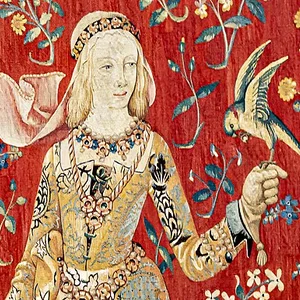
Married women wore a veil or wimple covering their hair, a sign of modesty and status. Arlette, having become the wife of Herluin de Conteville, would have worn such a lady's attire.

A wooden vessel tied to the legendary scene in which Duke Robert caught sight of Arlette washing laundry at the water's edge. It has become a symbol of her humble origins in tradition.

The ducal castle of Falaise, seat of Norman power and the setting for the meeting with the duke. Its stone silhouette dominates the town where William is said to have been born.

A clasp used to fasten a cloak or gown, sometimes decorated for women of rank. On becoming the lady of Conteville, Arlette would have worn such modest jewels.
School Curriculum
Vocabulary & Tags
Key Vocabulary
Daily Life
Morning
Before her rise in status, Arlette would get up at dawn like any craftsman's daughter, fetching water and helping with the tasks of the family tannery workshop. Work began early, in rhythm with the daylight, for lighting was scarce and expensive.
Afternoon
The afternoon was divided between spinning, preparing meals, and keeping house. Once she became Lady of Conteville, her days filled up with managing the seigneurial household and overseeing the servants.
Evening
As day fell, the family gathered around the fire for the evening meal, in the gloom lit by the hearth. They went to bed early, as soon as night came, to save on candles and tapers.
Food
Their diet was based on rye or barley bread, cereal porridges, vegetables from the garden such as broad beans and cabbages, and more rarely meat. Once she became a lady, Arlette gained access to a richer table, with meats, fish, and wine.
Clothing
As a young girl of common birth, she wore a simple wool dress and a linen veil. Once she became a lord's wife, she put on finer fabrics, a wimple covering her hair, and modest jewels marking her rank.
Housing
As a child, she lived in a craftsman's house with cob walls and a beaten-earth floor, near the tannery workshop. After marrying Herluin, she lived in a seigneurial stone dwelling, larger and better defended.
Historical Timeline
Period Vocabulary
Liens externes & ressources
Références
Œuvres
Naissance de Guillaume le Conquérant
vers 1028
Mère d'Odon de Bayeux
vers 1031
Mère de Robert de Mortain
vers 1031
Fondatrice d'une lignée royale
XIe siècle
Union avec Herluin de Conteville
vers 1030