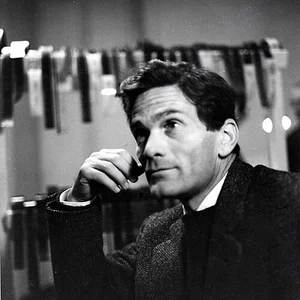

Italian writer, poet and filmmaker, a major figure of the politically engaged post-war intelligentsia. A heterodox Marxist and critic of consumer society, he left his mark on literature as much as on cinema before his murder in 1975.
Pier Paolo Pasolini(1922 — 1975)
Pier Paolo Pasolini
Italie, royaume d'Italie
6 min read
Frequently asked questions
Famous Quotes
« I am a force of the Past.»
Key Facts
- Born on 5 March 1922 in Bologna, he published his first collection of poems in the Friulian dialect in 1942
- Published the novel A Violent Life (Una vita violenta) in 1959, depicting the Roman slums
- Directed The Gospel According to St. Matthew in 1964, praised even in Catholic circles
- Released Theorem (Teorema) in 1968, a parable-film about the Italian bourgeoisie
- Murdered during the night of 1–2 November 1975 in Ostia, in circumstances that remain murky
Works & Achievements
His first collection of poems, written in the Friulian dialect, revealing his early talent and his attachment to a vernacular language.
A novel about the youth of Rome's poor outskirts, which caused a scandal for its rawness but made him famous.
A major poetry collection in which he blends Marxist political reflection with personal emotion.
His first film, which brings the world of the Roman borgate to the screen using non-professional actors.
An austere and deeply moving adaptation of the life of Christ, praised even by Catholic circles.
An enigmatic film about a bourgeois family thrown into turmoil by a mysterious visitor, a critique of consumer society.
A collection of polemical articles denouncing the conformism and homogenization of Italian society.
His final film, ultra-violent and provocative, released after his death, denouncing totalitarian power.
Anecdotes
At just twenty years old, Pasolini published his first collection of poems, *Poesie a Casarsa* (1942), not in Italian but in Friulian, the dialect of his mother's village. Choosing a rural, minority language for serious poetry was, at the time, a bold and provocative gesture.
A Marxist and a non-believer, Pasolini nevertheless made *The Gospel According to St. Matthew* in 1964, a film about the life of Christ that he dedicated to Pope John XXIII. He cast only amateur actors and gave the role of the elderly Virgin Mary to his own mother, Susanna.
A passionate football fan, Pasolini played as a striker in pickup matches with his film crews and supported the club of Bologna, his native city. He said that football was “the last sacred performance of our time.”
In 1974, in a sensational article in the Corriere della Sera, he wrote “I Know”: he claimed to know who was responsible for the attacks bloodying Italy, while admitting he had no proof. The text became the symbol of the intellectual who defies power.
On the night of 1–2 November 1975, Pasolini was brutally killed on a beach near Ostia, south of Rome. A young man, Pino Pelosi, confessed to the crime, but his contradictory statements have left doubt hanging over the true circumstances of his death to this very day.
Primary Sources
I know the names of those responsible for what is called a coup d'état. I know the names of those responsible for the massacres. But I have no proof. I do not even have any clues.
In the early 1960s, because of pollution and the transformation of the countryside, the fireflies began to disappear. For Pasolini, this was the sign of a deep and brutal change in Italian society.
A novel that plunges into the daily life of the young people of Rome's poor outskirts (the borgate), with their raw language and their poverty, far from the official, triumphant Italy.
A poetry collection in which Pasolini meditates at the tomb of the communist thinker Antonio Gramsci, torn between his Marxist reason and his passionate attachment to the vanishing world of the common people.
Key Places
City in northern Italy where Pasolini was born in 1922 and where he completed part of his studies. There he developed his love of literature and supported the local football team his whole life.
Village in the Friuli region that his mother came from and where he spent his youth. It was there that he wrote his first poems in the Friulian dialect.
The capital where he settled in 1950 and which became the setting for his novels and films. There he observed life in the poor outlying neighborhoods, the sub-proletariat.
A spot by the sea, south of Rome, where Pasolini was murdered during the night of 1–2 November 1975. A monument there keeps his memory alive.
Typical Objects

The central tool of his work as a filmmaker, with which he often shot handheld in the working-class streets of Rome. He favored simple framings inspired by early painting.

The everyday instrument of the writer, poet, and journalist that he was. On it he composed novels, screenplays, and polemical articles.

The object of his liveliest passion: Pasolini played regularly and saw football as a true collective ritual. He organized matches with his film crews.

The book of poems is the object through which Pasolini first became known, from the Friulian verse of his youth to “The Ashes of Gramsci.” Poetry remained a central activity for him throughout his life.

Pasolini loved to drive and roamed Rome and its surroundings at the wheel of his sports car. The vehicle is sadly tied to the night of his murder at Ostia.

The physical medium on which his films were recorded and edited before the digital era. Each reel held a few minutes of images carefully assembled during editing.
School Curriculum
Vocabulary & Tags
Key Vocabulary
Daily Life
Morning
Pasolini was a tireless and disciplined worker: he often devoted his mornings to writing, whether poems, screenplays, or articles. He liked the quiet for composing before heading out to film or meet people.
Afternoon
In the afternoon, he roamed Rome and its working-class neighborhoods, observing the life of the *borgate* that nourished his work. During shoots, he directed his actors, often amateurs picked from the street.
Evening
In the evening, he frequented cafés, his intellectual and artist friends, or went out to the city's outskirts. He would sometimes drive alone at night through the Roman periphery.
Food
Like many Italians of his time, he enjoyed simple, traditional fare, pasta and home-style dishes. He gladly shared modest meals with the residents of the neighborhoods he filmed.
Clothing
Pasolini had a sober, neat appearance, recognizable by his sunglasses and his fitted jackets, often made of leather. His elegant yet understated style became a famous image of the **1960s-1970s** intellectual.
Housing
After his difficult beginnings in Rome, he lived in apartments in the capital, for a long time with his mother, to whom he was deeply attached. Toward the end of his life, he also owned an old tower near **Viterbo**, out in the countryside.
Historical Timeline
Period Vocabulary
Liens externes & ressources
Références
Œuvres
Poesie a Casarsa
1942
Ragazzi di vita (Les Ragazzi)
1955
Les Cendres de Gramsci (Le ceneri di Gramsci)
1957
L'Évangile selon saint Matthieu
1964
Écrits corsaires (Scritti corsari)
1975