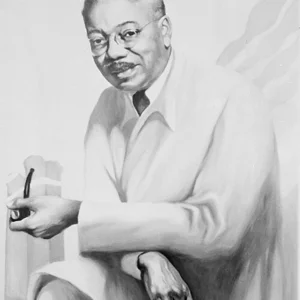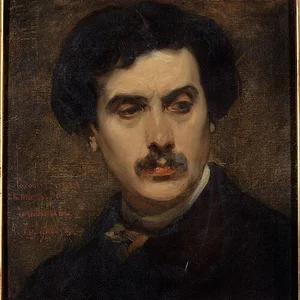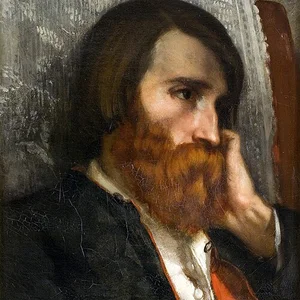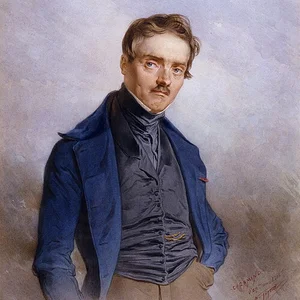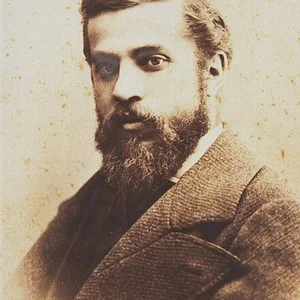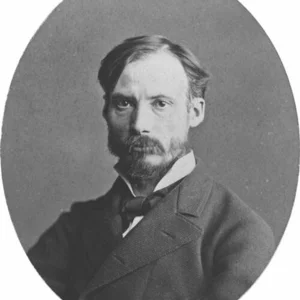

French painter (1841–1919) and a leading figure of Impressionism. Celebrated for his luminous scenes of Parisian life and his portrayals of women and childhood, he developed a warm and sensual style.
Pierre-Auguste Renoir(1841 — 1919)
Auguste Renoir
France
9 min read
Frequently asked questions
Famous Quotes
« The pain passes, but the beauty remains.»
« I paint with my balls.»
Key Facts
- Born on February 25, 1841, in Limoges; died on December 3, 1919, in Cagnes-sur-Mer
- Took part in the first Impressionist exhibition in 1874, alongside Monet, Degas, and Pissarro
- Painted Le Bal du moulin de la Galette in 1876, a masterpiece of Parisian life
- Suffered from severe rheumatoid arthritis from 1892 onward, yet continued painting until his death
- Around 1881–1882, shifted toward a more classical style following a trip to Italy
Works & Achievements
Presented at the first Impressionist exhibition, this painting depicts an elegantly dressed woman in a theatre box. It illustrates Renoir's fondness for Parisian society scenes and his luminous treatment of fabrics and faces.
A masterpiece of Impressionism, this large canvas captures the joy of a popular Sunday afternoon in Montmartre. Renoir displays his mastery of light filtered through foliage and faces animated by movement.
A portrait of a prominent Parisian bourgeois woman surrounded by her children, warmly received at the official Salon. This painting earned Renoir social recognition and opened doors to a wealthy clientele.
Painted on the terrace of the Maison Fournaise in Chatou, this canvas brings together Renoir's friends at a festive luncheon by the Seine. Aline Charigot, the painter's future wife, can be recognized holding a small dog in her arms.
The result of three years of work, this canvas marks Renoir's break with Impressionism and his return to a more classical style inspired by Raphael. The figures are modeled with firm contours, very different from the hazy brushstrokes of his previous period.
Purchased by the state at the initiative of the poet Stéphane Mallarmé, this painting symbolizes Renoir's official recognition. It combines the tenderness of his gaze on childhood with the warm luminosity of his bourgeois interiors.
Anecdotes
Before becoming a painter, Renoir began working at the age of thirteen as an apprentice porcelain decorator at a Parisian manufactory. This meticulous training taught him to master vivid colors and delicate forms — skills he would later transfer directly onto his canvases.
In 1869, Renoir and Monet painted side by side on the banks of the Seine at La Grenouillère, a floating open-air café popular with Parisians. Their two paintings of the same subject are now considered the birth certificate of Impressionism, each capturing the same shimmering light on the water with its own distinct sensibility.
To paint *Bal du moulin de la Galette* in 1876, Renoir carried his enormous canvas every day from his studio on the rue Cortot to the mill garden in Montmartre. His friends posed while dancing and chatting around him, giving the figures that exceptional spontaneity and vitality that can still be felt today.
In his later years, Renoir suffered from rheumatoid arthritis so severe that it completely deformed his hands. To keep painting regardless, he had his brushes strapped to his wrists with bandages. He died in Cagnes-sur-Mer in December 1919, just hours after asking for his brushes to paint some anemones.
During his trip to Italy in 1881, Renoir was deeply moved by Raphael's frescoes in the Vatican Loggie. The encounter sent him into a profound artistic crisis: he questioned Impressionism and developed a new, more austere style that critics called his "sour manner
as he sought to recapture the rigor of classical draftsmanship.
Primary Sources
Monet and I are working side by side at La Grenouillère. We are trying to capture the light dancing on the water; it is not easy, but it is thrilling.
I am still in the grip of experimentation. I am not satisfied yet; I keep erasing. I have been looking at Raphael; he did not work outdoors, but he had studied the light on ancient statues, and that was enough for him.
What seems most difficult to me is not painting extraordinary pictures, but painting simply. And simplicity in art is a sign of strength.
The public must come to us, since we cannot go to them. The juries will never let us in; let us hold our own exhibition and show what we can do.
I want to paint beautiful people in beautiful places. Misery and ugliness are not my concern. Joy, light, color — that is what I am after.
Key Places
Renoir's birthplace, known for its porcelain-making tradition. It was here that young Auguste grew up in a craftsman's family before moving to Paris to learn his trade as a painter.
The neighborhood where Renoir lived and worked during the most productive decades of his career. The Moulin de la Galette, the open-air dance halls, and the gardens of the Butte inspired his most celebrated scenes of Parisian life.
A floating riverside café on the Seine where Renoir and Monet painted side by side in 1869. These twin canvases depicting the same scene are considered the founding moment of Impressionism.
A restaurant on the banks of the Seine, west of Paris, frequented by Renoir and his boating companions. It was here that he painted “Luncheon of the Boating Party” (1881), one of the masterpieces of Impressionism.
The estate acquired by Renoir in 1907, surrounded by centuries-old olive trees, where he continued to work until his final hours despite crippling arthritis, and where he died in December 1919. Today it houses the Musée Renoir.
Typical Objects

Renoir's palette was distinguished by its warm, luminous colors: vermilion, Naples yellow, ochre, and lead white. He refused to use pure black, preferring mixtures of blues and browns to render colored shadows.

Renoir used long, soft-bristle brushes that allowed him the light, vibrant strokes characteristic of his style. Toward the end of his life, he had them tied to his wrists, deformed by arthritis, so he could continue painting.

A devoted practitioner of open-air painting in the tradition of Monet, Renoir carried his lightweight easel to riverside dance halls, gardens, and the banks of the Seine to capture natural light on the spot.

The invention of oil paint tubes in the mid-19th century had revolutionized the Impressionists' practice by allowing them to paint outdoors. Renoir sourced his supplies from reputable Parisian manufacturers and took his tubes with him everywhere.

Before committing to canvas, Renoir would make numerous preparatory studies in charcoal or red chalk to capture the poses of his models, particularly the children and young women he loved to depict in natural, unguarded attitudes.

An almost inseparable attribute of the Impressionist painter working outdoors, it shielded Renoir from the Mediterranean sun in Cagnes-sur-Mer and appeared in several portraits of his female models.
School Curriculum
Vocabulary & Tags
Key Vocabulary
Daily Life
Morning
Renoir rose early to make the most of the best morning light. In his early Parisian career, he would begin by studying his subjects in the streets or gardens, sketchbook in hand. At Cagnes-sur-Mer, he would head to his studio as soon as the morning light became favorable, assisted by his servants who supported his arms, deformed by arthritis.
Afternoon
The afternoon was devoted entirely to intensive painting, often outdoors. In Paris, Renoir roamed Montmartre and the banks of the Seine with his portable easel. He invited models — friends, neighbors, washerwomen — to pose in the natural light of gardens or open-air guinguettes. In his later years, he painted beneath the olive trees of the Collettes estate, surrounded by his favorite models.
Evening
In the evenings, Renoir enjoyed meeting friends at Parisian cafés — first the Café Guerbois, then the Café de la Nouvelle-Athènes — where Monet, Degas, Pissarro, Zola, and Mallarmé would gather. These lively discussions about art, politics, and society mattered as much to him as painting itself. As age and illness took their toll, evenings became more intimate, spent with family in Cagnes.
Food
Renoir had simple, robust tastes, leaning toward Provençal cuisine in his later years: olive oil, garden vegetables, Mediterranean fish. In Paris, he frequented the popular riverside restaurants along the Seine. He loved sharing good meals with his models and friends, a conviviality reflected in the festive luncheon scenes throughout his work.
Clothing
Renoir dressed modestly, with little concern for fashion: a dark jacket, a soft hat, the unremarkable attire of an ordinary Parisian bourgeois. While painting, he wore a smock or apron streaked with color. At Cagnes-sur-Mer, he adopted lighter clothing suited to the Mediterranean climate, often light-colored trousers and a loose jacket.
Housing
In Paris, Renoir lived for many years in modest studio apartments in Montmartre (rue Saint-Georges, rue Cortot), renting by the day during his earliest, most cash-strapped years. Fame eventually gave him access to more comfortable lodgings. From 1907 onward, he settled permanently at the Collettes estate in Cagnes-sur-Mer — a two-hectare property featuring a large house with green shutters, a glass-roofed studio, and a garden of centuries-old olive trees.
Historical Timeline
Period Vocabulary
Liens externes & ressources
Références
Œuvres
Le Bal du moulin de la Galette
1876
Les Grandes Baigneuses
1887
Jeunes Filles au piano
1892