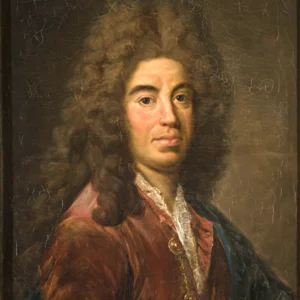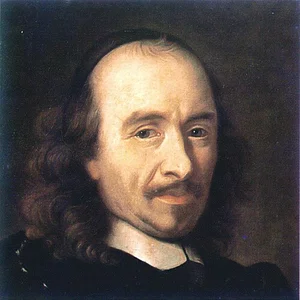

French playwright and poet (1606–1684), founder of French classical tragedy. Author of Le Cid, a landmark work of French theater that left a lasting mark on literary history. He dominated the Parisian stage in the 17th century with his tragedies and comedies.
Pierre Corneille(1606 — 1684)
Pierre Corneille
royaume de France
8 min read
Frequently asked questions
Famous Quotes
« Forgive me, generous enemy, that I dare with rapture throw myself into your arms. (Le Cid)»
« And the battle ceased for lack of combatants. (Le Cid)»
Key Facts
- 1630: Start of his dramatic career with the comedy Mélite
- 1636: Premiere of Le Cid, a landmark play that sparked the Quarrel of Le Cid, a critical debate over adherence to classical rules
- 1640–1660: Peak of his career with tragedies such as Horace (1640), Cinna (1641), and Polyeucte (1642)
- 1662: Premiere of The Liar (Le Menteur), a celebrated comedy showcasing his talent in the comic genre
- 1684: Death in Paris, recognized as one of the greatest French playwrights
Works & Achievements
Corneille's first comedy, performed in Paris to unexpected success. It launched his theatrical career and introduced a new, more natural and psychological tone into French comedy.
Corneille's absolute masterpiece, inspired by a Spanish play by Guillén de Castro. This tragicomedy explores the conflict between love and honor and remains the most performed and most studied play in classical French theatre.
A tragedy inspired by the Roman history recounted by Livy, depicting the battle of the Horatii against the Curiatii. Corneille rigorously explores the sacrifice of the individual in the name of the fatherland.
A political tragedy showing Augustus confronting a conspiracy. The play examines the nature of power and the greatness of clemency, a theme dear to Corneille and to the political context of his era.
The first Christian tragedy in French literature, recounting the martyrdom of a Roman soldier converted to Christianity. It combines love, duty, and faith in a remarkably balanced dramatic work.
A political tragedy acclaimed by audiences during the Fronde for its heroic and defiant dimension. Corneille portrays a proud and unshakeable hero facing court intrigues.
Corneille's final tragedy, considered one of his most poignant works. It marks the end of his career at a time when Racine had come to dominate the Parisian stage.
Anecdotes
The Quarrel of Le Cid in 1637 is one of the most famous literary controversies in French history. When Corneille presented his tragicomedy Le Cid, the success was immediate and overwhelming, but the Académie française, at Richelieu's instigation, issued a harsh critical opinion faulting the play for failing to observe the three unities. This controversy captivated all of Paris and paradoxically contributed to Corneille's glory.
Pierre Corneille was a profoundly shy and awkward man in speech, which stood in sharp contrast to the grandeur of his verse. His contemporaries reported that he was quite unskilled in conversation and that his voice did not do justice to the beauty of his texts. Voltaire later recounted that Corneille recited his own verses so poorly that it disappointed his admirers.
Corneille was a lawyer at the Rouen parliament for many years before devoting himself to the theatre. It was while attending a theatrical performance that the young man fell in love with the dramatic form. His legal training had a lasting influence on his writing, particularly in the way he constructed complex moral dilemmas in his tragedies.
At the end of his life, Corneille experienced relative poverty and a decline in popularity, overshadowed by the young Racine. The rivalry between the two playwrights divided Parisian audiences into two fierce camps. Boileau, a close associate of Racine, helped eclipse Corneille in the final years of his life, which was a source of great bitterness for the aging author.
The young Corneille fell in love with a young woman whose hand he was unable to obtain. This painful experience directly inspired him to write several of his early comedies, most notably Mélite in 1629, in which he portrayed the torments of thwarted love. This first success truly launched his theatrical career and introduced him to Parisian audiences.
Primary Sources
Rodrigue: 'Oh rage! Oh despair! Oh hostile old age! Have I lived this long only to face such infamy?'
The Académie holds that the subject of Le Cid is flawed in that Chimène marries her father's killer, which offends morality and plausibility.
This play has so many advantages on the side of the brilliance that dazzles, that it has suffered little on the side of the rules, from which it departs in some respects.
Camille: 'Rome, the sole object of my resentment! Rome, to whom your arm has just sacrificed my beloved!'
I never truly mastered the rules, and I always mistrusted my ability to apply them with rigor; but I always strove to please the public.
Key Places
Pierre Corneille's birthplace, where he was born in 1606 and practiced as a lawyer. He spent much of his life there and wrote several of his major works in the city.
The main theatre hall in Paris in the 17th century, where several of Corneille's plays were performed. It was the foremost venue of Parisian theatrical life of the era.
The rival venue to the Hôtel de Bourgogne where Le Cid premiered in January 1637. This extraordinary success established the reputation of both the theatre company and Corneille.
Institution founded by Richelieu in 1635, of which Corneille became a member in 1647. It played a central role in the Quarrel of Le Cid by publishing its critical Sentiments on the play.
Under the impetus of Richelieu and later Molière, this venue became a leading centre of Parisian theatrical life. Corneille presented some of his plays there at the Cardinal's commission.
Typical Objects

The everyday writing instrument of a 17th-century author. Corneille composed his plays with a quill, tirelessly reworking his alexandrines to make them more striking.

Corneille's manuscripts circulated among acting troupes before going to print. Mastery of the dramatic text, with its stage directions and long speeches, was the central tool of his craft.

Corneille studied law and practiced as a lawyer in Rouen. His knowledge of Roman law fed his tragedies, particularly the conflicts of honour and duty in Le Cid and Horace.

Candlelight was ubiquitous in bourgeois interiors of the 17th century. Corneille often worked by candlelight in the evenings, far from the bustle of Parisian life.

Under Louis XIV, theatre was frequently intertwined with music and ballet. Corneille collaborated with composers and adapted some of his works for court entertainments.

A symbol of the world of performance to which Corneille belonged, even as the French stage of the 17th century was gradually abandoning masks in favour of the actors' natural style of play.
School Curriculum
Vocabulary & Tags
Key Vocabulary
Tags
Mouvement
Daily Life
Morning
Corneille rose early, in the manner of the Norman bourgeoisie of his time. He devoted the first hours of the morning to reading and correspondence, before heading to his law office in Rouen or, later in Paris, working on his manuscripts at home.
Afternoon
The afternoon was often dedicated to writing itself, in the relative quiet of his study. Corneille reworked his verses with great care, seeking the perfect balance between the power of the alexandrines and the plausibility of the dialogue. He would also attend rehearsals of his plays with the actors.
Evening
In the evenings, Corneille frequented literary salons, notably those of the Hôtel de Rambouillet, where the intellectual elite of Paris gathered. He sometimes attended performances of his own plays or those of his contemporaries, carefully observing the audience's reactions.
Food
The bourgeois table of the 17th century was plentiful: bread, roasted meats, thick stews, garden vegetables, and wine diluted with water. Corneille, of Norman origin, likely appreciated the products of his region, such as apples, cider, and cheeses. Meals were taken with family at set hours.
Clothing
Like any bourgeois of his standing, Corneille wore a dark woolen coat, a lace or white linen collar, silk stockings, and a wig for official occasions. At the Académie française or in society, he wore his ceremonial attire; at home, he preferred simpler and more comfortable dress.
Housing
Corneille lived for many years in Rouen in a family bourgeois house, before settling permanently in Paris in his later years. His home was that of a learned man of letters: a well-stocked library, a writing desk, a drawing room for receiving guests, all lit by candlelight and heated by a fireplace in winter.
Historical Timeline
Period Vocabulary
Visual Style
Esthétique baroque française du XVIIe siècle : clair-obscur à la chandelle, tentures de velours rouge et or, costumes de cour en dentelle, gravures classiques et parchemins enluminés.
Sound Ambience
Ambiance sonore du Paris du XVIIe siècle : brouhaha d'un parterre de théâtre, clavecin dans un salon bourgeois, plume grattant le parchemin à la lueur des chandelles et cloches de paroisse.
Liens externes & ressources
Références
Œuvres
Cinna ou la Clémence d'Auguste
1641