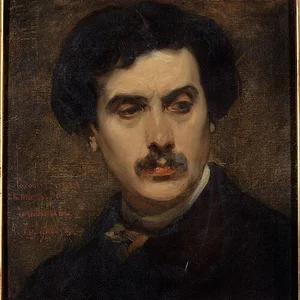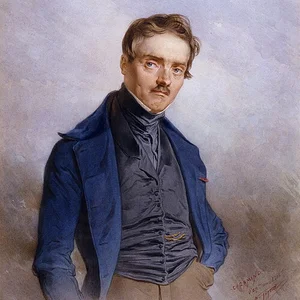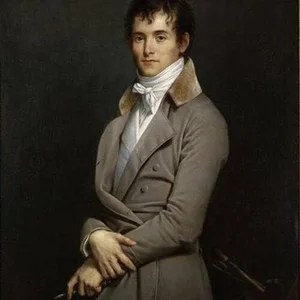

French Neoclassical painter (1774–1833), pupil of Regnault and winner of the Prix de Rome in 1797. An influential professor at the École des Beaux-Arts, he taught students such as Géricault and Delacroix, shaping the transition between Neoclassicism and Romanticism.
Pierre-Narcisse Guérin(1774 — 1833)
Pierre-Narcisse Guérin
France
9 min read
Frequently asked questions
Key Facts
- 1774: born in Paris
- 1797: wins the Prix de Rome with The Death of Cato
- Director of the Académie de France in Rome (Villa Medici) from 1822 to 1828
- Taught Géricault and Delacroix, among other students
- 1833: dies in Rome
Works & Achievements
The masterpiece that made Guérin's reputation, this canvas depicts a Roman man returning home to find his wife dead after years of exile. Contemporary audiences read it as an allegory for the émigrés of the Revolution. It is now held in the Musée du Louvre.
Inspired by Racine's tragedy, this painting shows Phaedra confessing her forbidden passion to Hippolytus, who recoils from her in horror, within a carefully constructed composition. Held in the Louvre, the work confirmed Guérin as the undisputed master of Neoclassical history painting.
An imperial commission depicting a magnanimous Napoleon granting clemency to Egyptian insurgents, this canvas attests to Guérin's place within the system of major official commissions under the Empire. It is held at the Palace of Versailles.
Drawn from Racine's tragedy, this painting shows Hector's widow confronting King Pyrrhus in an encounter charged with restrained emotion, characteristic of Guérin's Neoclassical aesthetic. The work is held in the Musée du Louvre.
This mythological painting depicting the god of sleep and the goddess of the rainbow demonstrates Guérin's mastery in rendering idealized figures and the soft, diffused light central to the Neoclassical aesthetic. It is held in the Hermitage Museum in Saint Petersburg.
Inspired by Virgil's *Aeneid*, this large canvas shows the Trojan hero enthralling the Queen of Carthage with his account of his city's fall, set within a twilit, melancholic atmosphere. Held in the Louvre, it is one of Guérin's most ambitious compositions.
Anecdotes
In 1799, Guérin exhibited at the Salon 'The Return of Marcus Sextus', a painting depicting a Roman man returning to find his wife dead after years of exile under Sulla. Audiences immediately read it as a poignant allegory for the émigrés returning to France after the Revolutionary Terror. Overnight, Guérin became famous, and the work was hailed as one of the most moving paintings of his generation.
Guérin represents one of the most fascinating paradoxes in French art history: a committed Neoclassicist and fervent admirer of David, he nonetheless trained in his studio two of the greatest revolutionaries of Romanticism — Théodore Géricault and Eugène Delacroix. These two pupils would go on to overturn everything their master had taught them, and Guérin, who could not understand their new aesthetic, was genuinely unsettled by it.
When Géricault was preparing his monumental 'Raft of the Medusa' (1819), he showed preliminary sketches to his former teacher Guérin. According to accounts passed down by several contemporaries, Guérin — shocked by the violence of the subject and the expressive treatment of the scene — reportedly urged him strongly to abandon the project. Géricault pressed on — and the painting became the founding act of French Romanticism.
In 1822, Guérin was appointed director of the Académie de France in Rome, housed in the magnificent Villa Medici on the Pincian Hill. Though in poor and fragile health, he nonetheless carried out his duties with dedication for over ten years, overseeing the training of young French artists sent to Rome on fellowship. He died there in July 1833, far from Paris, in the city that had shaped him and that he had never stopped loving.
Primary Sources
Marcus Sextus, banished from Rome by Sulla, returns to his homeland; he arrives at his house and finds his wife dead. Overwhelmed with grief, he has just caught sight of his daughter, who rushes into his arms.
Phaedra, tormented by her criminal passion for Hippolytus, her stepson, has just declared her love to him. Hippolytus, seized with horror and indignation, rejects this guilty declaration; Oenone tries to restrain her mistress.
Guérin taught us that drawing is the integrity of art, that without this fundamental rigor, no color, no expression can truly be convincing. I owe him the discipline that allowed me to break free from it.
His Majesty having been pleased to accept the resignation of Monsieur Thévenin from his duties as director of the Académie de France in Rome, appoints in his place M. Guérin, member of the Institut, history painter, to perform the said duties.
Key Places
It was in Paris that Guérin was born, trained in Regnault's studio, achieved triumph with his paintings at the Salons, and taught at the École des Beaux-Arts, where he shaped generations of painters including Géricault and Delacroix.
Guérin made his first stay in Rome thanks to the Prix de Rome, immersing himself in ancient art and the Italian Renaissance. He returned there as director of the Académie de France at the Villa Medici from 1822 until his death in 1833, overseeing the training of French resident artists.
The official Salon held at the Louvre was the primary venue for public recognition of artists under the Ancien Régime, the Revolution, the Empire, and the Restoration. Guérin exhibited his large Neoclassical canvases there and won his fame, notably in 1799 and 1802.
During his time as a resident artist and later as director, Guérin diligently studied the ancient sculptures and frescoes preserved in Rome's collections — an essential source of inspiration for his Neoclassical aesthetic grounded in "ideal beauty."
Typical Objects

A daily tool for Guérin, his wooden palette held colors prepared according to neoclassical recipes inherited from David, favoring sober tones and precise modeling. Brushes of different sizes allowed him to alternate between large areas of color and the minute details of antique draperies.

Neoclassical studios like Guérin's were filled with plaster casts reproducing Greek and Roman sculptures — the Apollo Belvedere, the Laocoön, the Venus de' Medici. These reproductions served as models for the drawing exercises assigned to students, forming the cornerstone of all academic pedagogy.

Awarded by the Académie des Beaux-Arts, the medal recognized victory in the prestigious annual competition and opened the door to a stay of several years at the Villa Medici. For Guérin, winning it in **1797** was the decisive turning point of his career.

Guérin and his neoclassical contemporaries collected pieces of fabric to simulate Greco-Roman draperies in their paintings. Arranged on live models, they were meant to evoke the nobility of ancient sculpture and lend the painted figures their idealized dignity.

Before approaching the canvas, Guérin produced numerous preparatory drawings that established with precision the composition, gestures, and expressions of the figures. This rigorous academic practice was at the heart of his teaching at the École des Beaux-Arts and set the serious history painter apart from the mere craftsman.

Distributed at the biennial Salons held at the Louvre, the catalogue listed all exhibited works with their titles, authors, and iconographic descriptions. For artists like Guérin, securing a prominent place in it was a matter of reputation, commissions, and public recognition.
School Curriculum
Vocabulary & Tags
Key Vocabulary
Daily Life
Morning
Guérin rose early to make the most of the natural light essential for painting large compositions. His mornings were devoted to work in his Parisian studio, where he developed his history paintings with meticulous rigor, carefully preparing each figure before transferring it to the large canvas.
Afternoon
In the afternoons, Guérin received his students from the École des Beaux-Arts to review their drawings after the Antique and their compositional sketches. He also made regular visits to the Louvre to study the collections or meet with fellow members of the Académie, and kept a close eye on the work of his pensioners in Rome during his time as director.
Evening
Evenings were often given over to gatherings in Parisian salons, where artists, writers, and patrons came together to discuss aesthetics and politics. Guérin also frequented the theatre and the Opéra, direct sources of inspiration for his dramatic compositions drawn from Racine and Virgil.
Food
Like the Parisian painters of his era, Guérin ate according to the bourgeois habits of the early nineteenth century: hearty meals of roasted meats, vegetables, and bread, washed down with ordinary table wine. In Rome, he discovered Italian cuisine and local wines, coming to appreciate the lightness of Mediterranean dishes, which differed considerably from French eating habits.
Clothing
For his daily work in the studio, Guérin wore a painter's smock over simple, practical clothes to protect them from splashes of paint and turpentine. For academic ceremonies, private views, and official receptions, he wore the elegant dress of a member of the Institut — a dark frock coat, white cravat, and, on occasion, his decorations.
Housing
In Paris, Guérin had access to a large, light-filled studio — essential for working on canvases that could exceed several metres in height — in a building in the artists' quarter. In Rome, as director of the Villa Medici, he occupied the director's apartments of that magnificent Renaissance villa overlooking the city from the Pincian Hill, enjoying an unrivalled view across the rooftops of the Eternal City.
Historical Timeline
Period Vocabulary
Liens externes & ressources
Références
Œuvres
Le retour de Marcus Sextus
1799
Bonaparte pardonnant aux révoltés du Caire
1808