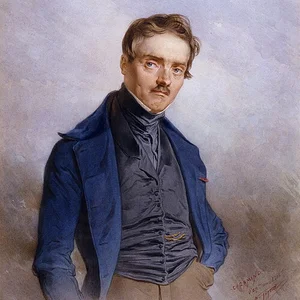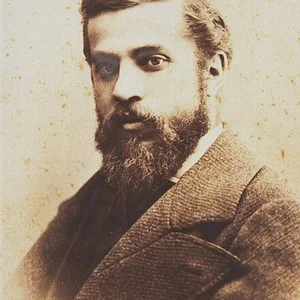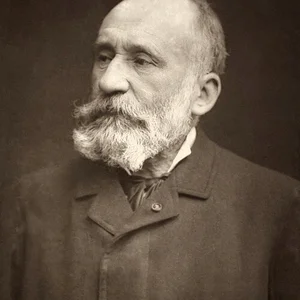

French painter (1824–1898), a major figure of Symbolism and mural painting. He is celebrated for his large allegorical compositions rendered in pale tones with a timeless atmosphere, which profoundly influenced painters at the end of the 19th century.
Pierre Puvis de Chavannes(1824 — 1898)
Pierre Puvis de Chavannes
France
8 min read
Frequently asked questions
Key Facts
- 1824: born in Lyon
- 1861: first success at the Salon with *La Guerre* and *La Paix*
- 1874–1878: creates the large mural paintings at the Palais de Longchamp in Marseille
- 1893: decorates the grand staircase of the Boston Public Library (a prestigious American commission)
- 1898: dies in Paris, having notably decorated the Panthéon and the Sorbonne
Works & Achievements
A monumental diptych for the Musée de Picardie in Amiens, Puvis's first major public commission. These two vast allegorical panels established his reputation as a master of French decorative painting.
A cycle of murals in the Panthéon in Paris dedicated to the patron saint of the capital. Considered his masterpiece, it illustrates with majestic restraint the spiritual and protective mission of Geneviève.
An easel painting exhibited at the Salon of 1881, which became an icon of Symbolism. The melancholy silhouette of the fisherman set against a bare and luminous landscape exerted a decisive influence on Gauguin, Seurat, and the painters of the following generation.
A large allegorical composition for the Grand Amphitheatre of the Sorbonne, depicting the Muses and the Arts in an idyllic grove. A pictorial manifesto of academic Symbolism, this work was acclaimed by all the critics of its time.
A large composition for the Musée des Beaux-Arts in Rouen, depicting allegorical figures in an idealized Norman landscape. An emblematic example of the fusion between modernity and classical references in Puvis's art.
A series of allegorical panels on the theme of Knowledge, commissioned by the Boston Public Library. This American commission attests to Puvis's international prestige and the influence of his style beyond Europe.
Anecdotes
Puvis de Chavannes faced repeated rejections at the official Salon early in his career. His first submissions in the 1850s were turned down or hung in unfavorable spots, forcing him at times to exhibit directly from his studio. Only through dogged persistence did he establish himself as the undisputed master of French mural painting.
Although closely associated with the great frescoes adorning public buildings, Puvis never actually painted in the traditional fresco technique. He worked in oil on large canvases in his studio, which were then marouflaged — glued onto the plaster — directly onto the walls of monuments. This method allowed him to achieve a perfect result before installation, often in spaces that were difficult to access.
Puvis maintained a discreet but deeply devoted romantic relationship with Princess Marie Cantacuzène, a Romanian painter, for nearly forty years. It was only in 1897, a year before his death, that he finally married her officially. The late union caused a stir in Parisian artistic circles, even though their relationship had been an open secret for decades.
The young Paul Gauguin revered Puvis de Chavannes to the point of declaring himself his spiritual heir. Before leaving for Tahiti, he paid a visit to the old master. Though their styles were very different, Gauguin recognized in Puvis's pale tones and timeless atmosphere a deep kinship with his own ambition to depict a primordial, serene world.
In 1895, a grand banquet was held in Puvis's honor by the artistic and literary elite of Paris, bringing together figures such as Auguste Rodin, Stéphane Mallarmé, and André Gide. This exceptional tribute, paid to a still-living artist, bore witness to the near-mythical status Puvis had achieved in the eyes of the Symbolist and Post-Impressionist generations.
Primary Sources
Above all, I seek the sensation of a calm truth, free from agitation and noise. That the viewer should feel enveloped in an atmosphere of serenity — that is what I aim for in my large decorative works.
M. Puvis de Chavannes remains the only painter who has succeeded in giving large-scale mural decoration a dignity and a nobility that are genuinely modern. His figures move through an indistinct and serene world, outside of time and history.
Here is a painter who has created a world of his own — a kind of inner Greece, luminous and cold at once. One may not care for his manner, but one cannot deny that he exists, that he has a vision of his own, and that he imposes it.
His immense body of work covers the walls of our public monuments with a serene eloquence. He reinvented for our century the great decorative art that was thought to have died with the Renaissance.
Mural art must speak to everyone, instruct and elevate souls. Colour, line, and composition must unite to create a harmony that outlasts fashions and generations.
Key Places
Birthplace of Puvis de Chavannes, born on December 14, 1824. He grew up in a cultivated bourgeois family before leaving for Paris to pursue his artistic training.
Between 1874 and 1898, Puvis created his most celebrated work here: a monumental cycle of six panels devoted to the life of Saint Geneviève, patron saint of Paris, commissioned by the republican state.
Site of Puvis's first major public commission (1861–1865): two vast allegorical panels, *Bellum* and *Concordia*, which launched his career as a decorative painter.
Between 1887 and 1889, Puvis painted a large allegorical composition here entitled *The Sacred Grove Beloved by the Arts and the Muses*, commissioned to adorn the newly rebuilt university auditorium under the Third Republic.
Between 1895 and 1896, Puvis delivered a series of allegorical decorative panels for the Boston Public Library, demonstrating the international reach of his art beyond Europe.
In the 1890s, Puvis created decorative paintings for the Hôtel de Ville, rebuilt after it was burned during the Commune, contributing to the great symbolic project of the triumphant Republic.
Typical Objects

Large full-scale drawing made in charcoal or chalk on paper, used as a precise model for mural compositions. Puvis would produce dozens of these before tackling the final canvas.

Large canvas painted in oil in the studio, then glued with sizing paste directly onto the wall of a public building. This technique gave Puvis complete control over the finished result before installation in spaces that were sometimes difficult to access.

Wooden palette on which Puvis mixed his colors, characterized by a dominant use of whites, bluish greys, and earthy ochres to achieve his signature matte, hazy tones.

Wooden structure allowing the artist to work on monumental formats that could exceed ten meters in width. Puvis's studios were renowned for their exceptional size, suited to the scale of his public commissions.

A recurring symbolic attribute in Puvis's allegories, representing glory, victory, or poetic inspiration. It appears in compositions such as *The Sacred Grove, Beloved of the Arts and the Muses* to distinguish figures of Knowledge.

Flowing fabrics that Puvis used as costumes for his models, seeking to evoke an idealized, timeless Antiquity in his allegorical compositions. These draperies gave his figures their hieratic, serene quality.
School Curriculum
Vocabulary & Tags
Key Vocabulary
Daily Life
Morning
Puvis rose early and made his way to his vast Parisian studio at the first light of day, taking advantage of the natural light to assess his tones and values. He would typically begin by reviewing his preparatory cartoons and setting out his palette before tackling the canvas.
Afternoon
Afternoons were devoted to intensive work on his large canvases, standing on wooden scaffolding. He occasionally received models to pose in antique draperies, and tirelessly refined his compositions until he achieved the balance and serenity he sought.
Evening
His evenings were spent in the artistic and literary salons of Paris, where he mixed with Mallarmé, Rodin, and the young Symbolist painters who admired him. He often dined with Princess Cantacuzène, his companion of forty years, in their Parisian apartment.
Food
Like many wealthy Parisian bourgeois of his time, Puvis ate modestly: meals taken at fixed hours, roast meats, seasonal vegetables, cheeses, and Burgundy wines. He was fond of quick lunches taken in the studio so as not to interrupt his work.
Clothing
Puvis dressed in a neat, bourgeois manner: dark frock coat, waistcoat, and a lavallière cravat for official outings. In the studio, he wore a large grey canvas painter's smock to protect his clothes during long working sessions on his monumental formats.
Housing
He lived in a comfortable Parisian apartment and had a large studio suited to his monumental formats, in the Pigalle district. His living spaces reflected the taste of the cultivated bourgeoisie of the Third Republic: period furniture, art books, and carefully chosen objects.
Historical Timeline
Period Vocabulary
Liens externes & ressources
Références
Œuvres
Le Bois sacré cher aux Arts et aux Muses
1884-1889
Inter Artes et Naturam (Entre les Arts et la Nature)
1890
Panneaux décoratifs de la Boston Public Library
1895-1896