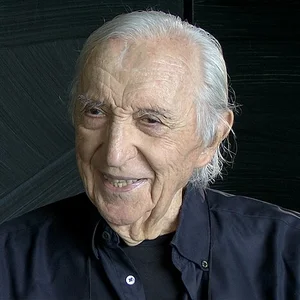

Pierre Soulages (1919–2022) was a French painter and printmaker, a major figure of lyrical abstraction. He is known worldwide for his exploration of the color black and light, which he called *outrenoir* ("beyond black").
Pierre Soulages(1919 — 2022)
Pierre Soulages
France
10 min read
Frequently asked questions
Famous Quotes
« It is not the black that interests me, but the light that black reflects.»
« Painting is light transformed.»
Key Facts
- Born on December 24, 1919, in Rodez (Aveyron)
- From the 1970s onward, developed the concept of *outrenoir* — light reflected by black
- Created the stained-glass windows of the Abbey Church of Sainte-Foy in Conques (1994), internationally acclaimed
- Retrospective at the Centre Pompidou in 2009 celebrating his 90th birthday
- Died on October 25, 2022, in Paris, at the age of 102
Works & Achievements
First abstract works made with walnut stain on paper, a natural medium that Soulages repurposed from its traditional use. These gestural compositions foreshadow his entire approach and reveal the deep unity of a body of work that began in the aftermath of the war.
Large oil on canvas representative of Soulages's first period, with its powerful horizontal and vertical black strokes on a light ground. Works from this series entered the collections of MoMA in New York and the Centre Pompidou, securing his international recognition.
Monumental composition illustrating the growing scale of Soulages's formats and his shift toward darker, denser surfaces. The size of the work exceeds human scale, forcing the viewer into a bodily relationship with the painting rather than a purely visual one.
A body of canvases entirely covered in black paint worked into varied textures and reliefs, exploring reflected light. Produced over more than forty years, these works represent Soulages's most original contribution to art history and earned him worldwide recognition.
A set of 104 translucent stained-glass windows created for the Romanesque church of Conques, without colour or figurative imagery, diffusing a soft and even light. This public commission is regarded as one of the great successes of the encounter between contemporary art and medieval heritage.
A set of large vertical black panels with contrasting textures belonging to the *outrenoir* series. This polyptych illustrates how Soulages establishes a dialogue between panels and draws light through an entire exhibition space.
Anecdotes
At the age of nine, Pierre Soulages covers a sheet of white paper with black shoe polish. When his teacher asks what he is doing, he answers that he is making “snow.” This anecdote, often told by the artist himself, reveals that from childhood he thought of black not as the absence of light, but as a revealer of whiteness and clarity — an intuition that would guide his entire body of work.
In 1938, at the age of nineteen, Soulages visits the abbey church of Sainte-Foy de Conques for the first time — a medieval village in the Aveyron. He is struck by the way light filters into the Romanesque building and by the austerity of its sculpted capitals. Forty-nine years later, in 1987, it is precisely he who is chosen to create the new stained glass windows for that same church — an extraordinary full circle, from a teenage revelation to a commission for an old master.
In 1979, Soulages is working on an entirely black canvas that he considers a failure. Instead of destroying it, he steps back and looks: the surface does not show black, but a reflected light that shifts with the angle of view. This is the birth of *outrenoir* — a concept meaning what lies beyond black. He devotes the next forty years to exploring this luminous phenomenon exclusively.
When the Commission des Monuments Historiques invites him to submit proposals for the stained glass windows at Conques, Soulages categorically refuses any colored glass. Working with a specialist glassmaker, he develops a unique translucent glass, lightly tinted with an imperceptible golden hue, that diffuses a soft, unified light without telling any figurative story. This bold decision, initially very controversial, is now unanimously praised as a masterpiece of contemporary sacred art.
In November 2021, a painting by Soulages is sold at Christie's in Paris for 26.2 million euros — a world record for a living French artist. The artist is then 101 years old. In front of journalists, he remains laconic and reserved, simply noting that the value of a work of art cannot be measured by its sale price. He passes away less than a year later, at the age of 102, leaving behind a body of work numbering several hundred canvases held in the world's greatest museums.
Primary Sources
What interests me is not black, but what black does. When I work a black surface, what I see is not black: it is the light that black reveals, a light that comes from the painting itself.
For me, black is the most luminous color. It is not about painting black, but painting with black to make light emerge. It is a light interior to the painting, not a light brought to it from outside.
I did not want color. I did not want images. I wanted a light that was itself the event, a neutral light that tells nothing, but transforms space and time within the church.
Outrenoir is not just another color. It is a different mental field, a way of seeing that opens up when the gaze accepts abandoning itself to the black surface and receiving what it reflects.
Key Places
Birthplace of Pierre Soulages, born here in 1919 and raised surrounded by Romanesque art from the Aveyron region. Since 2014, Rodez has been home to the Musée Soulages, designed by the architects RCR Arquitectes, which holds the largest collection of the artist's works in the world.
Soulages settled in Paris in 1946 and built his entire international career there, taking part in avant-garde Salons and exhibiting in galleries that established him as one of the central figures of European lyrical abstraction.
A place of revelation for Soulages as early as 1938, and later of creation between 1987 and 1994: he designed 104 translucent stained-glass windows there that transform the interior light of the Romanesque church into an entirely new visual and spiritual experience.
Soulages studied at the École des Beaux-Arts in Montpellier in 1941, where he encountered works by Cézanne and Picasso that deepened his commitment to abstraction before he left for Paris.
From the 1950s onward, New York was a crucial hub for Soulages's international recognition: his works entered the collections of MoMA and he exhibited there regularly, engaging in dialogue with the American Abstract Expressionists.
Typical Objects

Soulages used scrapers, spatulas, and palette knives rather than brushes to work black paint in thick layers on canvas, creating striations, reliefs, and ridges that interact differently with reflected light. These tools are the gestural and material signature of his work.

Before oil paint, the young Soulages used walnut stain — a natural brown-black dye extracted from walnut husks — for his early works on paper in the 1940s. This rustic medium, rooted in the folk traditions of the Aveyron region, foreshadowed his lifelong obsession with dark pigments.

Soulages worked on very large raw linen canvases whose rough texture interacted with layers of black paint to amplify light-reflection effects. The monumental scale of his formats imposes an immersive physical presence on the viewer standing before the work.

For the Abbatiale Sainte-Foy, Soulages had a unique translucent glass developed — neither transparent nor opaque — that filters natural light without breaking it into colors. These 104 windows constitute an architectural and luminous work without precedent in contemporary sacred art.

Alongside painting, Soulages practiced engraving and aquatint on metal, printed with an etching press. This medium allowed him to transpose his research on black into the realm of printmaking, with texture and contrast effects unique to intaglio.

The central material of all of Soulages' work is black paint applied in thick or thin layers, smooth or textured depending on the desired effect. He moved between oil and acrylic depending on the drying properties needed to create reflective or matte surfaces.
School Curriculum
Vocabulary & Tags
Key Vocabulary
Daily Life
Morning
Pierre Soulages began his day early, heir to the rural discipline of the Aveyron. After a simple breakfast, he made his way to his Parisian studio, where he had carefully arranged the lighting to control the natural light — an essential condition for observing the reflective effects of his black surfaces at different times of day.
Afternoon
The afternoon was devoted to studio work: standing before the canvas, he applied black paint with a squeegee or palette knife, then stepped back several meters to observe the variations in reflected light, before returning to rework the surface. This process of observation and intervention could continue for hours in complete silence, with no music and no conversation.
Evening
In the evening, Soulages and his wife Colette — his companion since their youth in Rodez and his lifelong intellectual confidante — would sometimes receive friends, fellow painters, poets, or art critics at their understated Montparnasse apartment. An avid reader of philosophy and literature, Soulages preferred these intimate dinners to the glamorous openings he avoided as much as possible.
Food
His eating habits remained firmly rooted in the Aveyronnaise tradition: aligot, tripoux, sheep's milk cheese, simple and generous home cooking. He was wary of Parisian gastronomic trends and ate regularly and in moderation. His exceptional longevity — he died at the age of 102 — is often attributed to this simple, consistent way of life.
Clothing
In his studio, Soulages wore ordinary work clothes, often stained with black, indifferent to his appearance. In public, he favored a sober, classic style — dark tones, no sartorial flourishes whatsoever. His understated look gave no hint of the status he had achieved as a world-famous, multimillionaire painter.
Housing
Soulages and Colette spent most of their lives in a Montparnasse apartment in Paris, the historic artists' quarter. The interior, by all accounts, was sober, sparsely furnished, and unassuming — a few works by friends, some books, a worktable. This deliberate simplicity stood in sharp contrast to the astronomical value of the canvases being produced in his nearby studio.
Historical Timeline
Period Vocabulary
Liens externes & ressources
Références
Œuvres
Brou de noix sur papier (premières séries)
1946
Peinture 195 × 130 cm, 23 décembre 1953
1953
Vitraux de l'abbatiale Sainte-Foy de Conques
1994
Polyptyque XI, 1999
1999