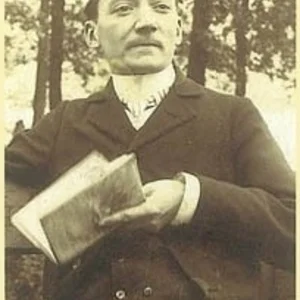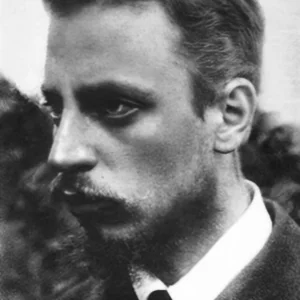

Austrian poet writing in German, one of the greatest lyric poets of the 20th century. Author of the Duino Elegies and the Sonnets to Orpheus, he explores existential anguish, solitude, and the search for meaning.
Rainer Maria Rilke(1875 — 1926)
Rainer Maria Rilke
Autriche, Allemagne, Autriche-Hongrie
7 min read
Frequently asked questions
Famous Quotes
« Be patient toward all that is unsolved in your heart and try to love the questions themselves.»
« A work of art is good if it has arisen out of necessity.»
Key Facts
- Born in 1875 in Prague (then part of the Austro-Hungarian Empire)
- Published The Notebooks of Malte Laurids Brigge in 1910, a major novel of modernism
- Completed the Duino Elegies and the Sonnets to Orpheus in 1922, published in 1923
- Author of Letters to a Young Poet (written 1903-1908, published 1929)
- Died of leukemia in 1926 in Montreux (Switzerland)
Works & Achievements
Collection of religious and mystical poems, written partly after his travels in Russia. It revealed the young poet to the general public.
An admiring essay devoted to the sculptor, a testament to Rodin's decisive influence on his conception of art.
Collection of the “thing-poems” in which Rilke describes objects, animals and works of art with an almost sculptural precision; it contains “The Panther.”
Rilke's only novel, the private diary of a young Danish poet in Paris, exploring fear, loneliness and death in the great modern city.
Cycle of ten long elegies, a summit of twentieth-century poetry, meditating on the angel, death, love and the human condition.
Fifty-five sonnets written in just a few weeks, a song of praise to life, to transformation and to the figure of the poet Orpheus.
Posthumous collection of letters addressed to a young aspiring poet, which became a celebrated guide on vocation, solitude and creation.
Anecdotes
When he was born in Prague in 1875, his parents named him René. It was the Russian writer Lou Andreas-Salomé, whom he loved passionately from 1897 onward, who suggested he adopt the more masculine and Germanic name Rainer. The poet would keep this name for the rest of his life.
Around 1905, Rilke became the secretary of the famous sculptor Auguste Rodin in Paris. Watching Rodin tirelessly carve his material, he learned to look at objects and animals with a new kind of attention. From this lesson came his “thing-poems,” such as the famous poem “The Panther.”
In 1912, while staying at Duino Castle, perched on a cliff above the Adriatic, Rilke went for a walk one very windy day. According to the legend he himself told, he heard a voice in the storm dictating to him the first line of what would become the *Duino Elegies*: “Who, if I cried out, would hear me among the angels' hierarchies?”
In February 1922, alone in the little tower of Muzot in Switzerland, Rilke experienced an extraordinary creative fever. In a few weeks he completed his *Duino Elegies*, begun ten years earlier, and wrote the fifty-five *Sonnets to Orpheus* in a single burst. He described this episode as a “hurricane” of the spirit.
Rilke died in 1926 of leukemia in a Swiss sanatorium. For his epitaph, he had himself composed a poem about the rose, the flower he loved above all others. A persistent legend claims that he died from the prick of a rose thorn; in reality it was the illness that took him, but the story has remained attached to his memory.
Primary Sources
Search for the reason that commands you to write; see whether it has spread its roots into the very depths of your heart.
Who, if I cried out, would hear me among the orders of angels? For beauty is nothing but the beginning of terror.
Everything in a few days, it was a nameless hurricane, a storm in the spirit; everything in me that was fibre and tissue cracked apart.
Rose, oh pure contradiction, desire to be the sleep of no one beneath so many lids.
Key Places
Rilke's birthplace, then the capital of Bohemia within the Austro-Hungarian Empire. He grew up there in a German-speaking family.
The city where Rilke settled in 1902 and worked alongside the sculptor Auguste Rodin. The setting of the novel *The Notebooks of Malte Laurids Brigge*.
A castle perched on a cliff above the Adriatic, near Trieste. Rilke began his *Duino Elegies* there in 1912, as a guest of Princess Marie von Thurn und Taxis.
A small medieval tower in the Swiss canton of Valais, near Sierre, where Rilke lived from 1921. There he completed the *Duino Elegies* and wrote the *Sonnets to Orpheus* in 1922.
A care facility above Montreux, Switzerland, where Rilke died of leukemia on 29 December 1926.
A village in Valais where Rilke is buried, near the church perched on a rock. His grave bears the epitaph about the rose that he had composed himself.
Liens externes & ressources
Références
Œuvres
Le Livre d'heures (Das Stunden-Buch)
1905
Auguste Rodin
1903
Nouveaux Poèmes (Neue Gedichte)
1907-1908
Les Carnets de Malte Laurids Brigge
1910
Élégies de Duino (Duineser Elegien)
1923
Sonnets à Orphée (Die Sonette an Orpheus)
1923
Lettres à un jeune poète
1929