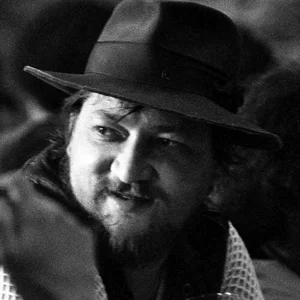

German filmmaker, playwright, and actor, a major figure of New German Cinema. Over a dazzling career spanning some fifteen years, he directed more than forty films that dissect postwar West German society.
Rainer Werner Fassbinder(1945 — 1982)
Rainer Werner Fassbinder
Allemagne de l'Ouest
6 min read
Frequently asked questions
Key Facts
- Born on 31 May 1945 in Bad Wörishofen, shortly after the end of the Second World War
- Co-founded the antiteater in Munich in 1968, an experimental theatre troupe
- Directed *The Marriage of Maria Braun* (1979), a major international success
- Filmed the television epic *Berlin Alexanderplatz* (1980), adapted from Alfred Döblin
- Died on 10 June 1982 in Munich, at only 37, after making more than 40 films
Works & Achievements
His first feature film, austere and stylized, foreshadowing his personal cinema.
A film about an immigrant worker rejected in a Munich neighborhood, in which Fassbinder already tackles everyday racism.
A cruel chamber drama about love and domination, adapted from his own stage play.
A love story between an elderly German woman and a young Moroccan immigrant worker; one of his most famous films about racism.
A portrait of a woman in post-war Germany, the first part of his trilogy about West Germany and a major international success.
A monumental television series of more than fifteen hours, adapted from Alfred Döblin's novel and regarded as a masterpiece.
A black-and-white drama about a fallen former star, awarded the Golden Bear in Berlin.
His final film, highly stylized, adapted from a novel by Jean Genet and released after his death.
Anecdotes
In just about fifteen years, Fassbinder directed more than forty films, sometimes shooting four or five feature films in the same year. He slept little and worked with a troupe of loyal actors who followed him from film to film, such as the actress Hanna Schygulla. This frantic pace has remained legendary in the history of cinema.
At 22, in the bubbling Munich of 1968, he took charge of a small theater company that he renamed the “antiteater.” This troupe lived and worked almost as a commune, and many of its members later followed him into the cinema. It was there that Fassbinder learned to direct actors and to put on a show very quickly, with few resources.
In 1980, he adapted “Berlin Alexanderplatz” for television, a huge novel by Alfred Döblin, in the form of a series more than fifteen hours long (thirteen episodes and an epilogue). When it aired, many viewers protested, finding the images too dark. The work is today considered one of his greatest achievements.
Fassbinder admired the melodramas of the German-American director Douglas Sirk, whose films played on emotions and flamboyant colors. Deeply moved, he devoted an enthusiastic essay to him in 1971 and drew on him for his own style. His film “Ali: Fear Eats the Soul” thus takes up the story of Sirk's film “All That Heaven Allows.”
In February 1982, his film “Veronika Voss” won the Golden Bear at the Berlin Film Festival, the highest award in German cinema. Just a few months later, on June 10, 1982, Fassbinder died in Munich at only 37 years old, from a mixture of cocaine and sleeping pills, while he was already preparing new projects.
Primary Sources
Douglas Sirk made the most tender films I know: they are the films of someone who loves human beings and does not despise them as we do.
I want to build a house with my films. Some are the cellars, others the walls, others still the windows. But I hope that in the end it will be a house.
Cinema should give people the courage to live, show them that things can be changed, and that fear prevents us from loving.
Key Places
Small Bavarian spa town where Rainer Werner Fassbinder was born on 31 May 1945, a few weeks after the end of the war.
City where Fassbinder partly grew up, founded his “antiteater” and set up his film crew. It is also where he died in 1982.
Capital then divided by the Wall, the setting and subject of several of his films; it is where part of his work was filmed and awarded prizes, including “Berlin Alexanderplatz”.
City in the Rhineland where Fassbinder spent part of his childhood and adolescence before turning to theatre and cinema.
Liens externes & ressources
Références
Œuvres
Les Larmes amères de Petra von Kant
1972
Le Mariage de Maria Braun
1979
Berlin Alexanderplatz
1980
Le Secret de Veronika Voss (Die Sehnsucht der Veronika Voss)
1982