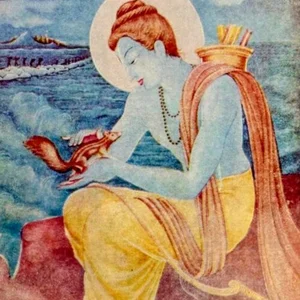

Rāma is the seventh avatar (incarnation) of the god Vishnu in Hindu mythology. The central hero of the Rāmāyaṇa, one of the two great epics of ancient India, he embodies the values of dharma (duty) and virtue. His story, blending epic adventure with moral teachings, remains foundational to Hindu culture and religion.
Frequently asked questions
Key Facts
- Born in Ayodhya as a prince, son of King Dasharatha
- 14-year exile in the forest following court intrigues, accompanied by his wife Sītā and his brother Lakshmana
- Abduction of Sītā by Ravana, the demon king of Lanka, which sets off Rāma's epic quest
- Construction of a bridge to Lanka with the help of an army of monkeys led by Hanuman
- Final victory over Ravana and triumphant return to Ayodhya to establish Rama Rajya (Rāma's ideal reign)
Works & Achievements
A great Sanskrit epic of over 100,000 verses recounting the adventures of Rāma. This landmark of Indian literature conveys the fundamental values of dharma and remains the central sacred text of Hinduism.
Rāma accepts a 14-year exile in the forest to honor his father's royal vow. This act symbolizes personal sacrifice and devotion to family duty — cardinal values of Hindu dharma.
The legendary construction of a bridge linking India to Lanka to rescue the captive Sītā. This epic feat represents the triumph of good over evil and remains symbolically significant in India's sacred geography.
The decisive battle led by Rāma and his army against the demon Rāvaṇa to free his wife Sītā. This epic confrontation symbolizes the victory of virtue over evil and injustice.
Rāma establishes an ideal and just reign known as Rāmarājya (the kingdom of Rāma), defined by prosperity, justice, and virtue. This model of ideal governance inspired Hindu rulers for centuries.
Rāma represents the seventh incarnation of the god Vishnu on earth, embodying the divine in human form. This central concept of Hinduism makes Rāma far more than a hero — he is a divine manifestation of the cosmos.
Anecdotes
According to the Rāmāyana, Rāma was born in Ayodhyā, capital of the kingdom of Kosala. His father, King Dasharatha, had destined him for the throne, but an ancient promise forced Rāma to accept a fourteen-year exile in the forest. This pivotal event in the epic illustrates the observance of dharma (duty) even in the face of personal sacrifice.
Rāma was accompanied into the forest by his wife Sītā and his brother Lakshman. During this exile, Sītā was abducted by Rāvaṇa, the demon king of Lankā, which triggered a great epic battle. This central story of the Rāmāyana teaches Indian children the values of bravery and marital fidelity.
The Rāmāyana tells how Rāma built a miraculous bridge to the island of Lankā with the help of an army of monkeys led by Hanumān. This alliance between humans and animal creatures remains a symbol of cooperation and transcending differences in Indian literature.
After his triumphant return to Ayodhyā and his coronation, Rāma governed according to principles of justice and the well-being of his people. His reign became legendary and was called "Rāma Rajya" (the kingdom of Rāma), a symbol of ideal governance in Indian political philosophy.
The text of the Rāmāyana, composed between the 4th century BCE and the 2nd century CE, contains approximately 24,000 verses. Though rooted in ancient legend, this epic remains one of the most influential literary works in human history and continues to be taught in Indian schools.
Primary Sources
Rāma, the son of Daśaratha, was renowned for his virtues. He was well-versed in the Vedas and their auxiliary sciences. He was courageous, generous, just, and benevolent toward all beings. He embodied dharma and wisdom.
Rāma, the greatest of kings, whose glory extends across the three worlds, is renowned for having fulfilled all his duties with perfection and for having upheld the cosmic order (dharma).
Vishnu took the form of Rāma to destroy Rāvaṇa and restore dharma. His deeds and exemplary life stand as the model of virtue for all mortals.
Rāma, the perfect incarnation of Vishnu, showed the path of virtue through his exile, his battle against evil, and his devotion to his duties as a son, a husband, and a king.
Key Places
Capital of the kingdom of Kosala and birthplace of Rāma according to the Ramayana. This sacred city is considered the royal residence where Rāma grew up and began his reign after returning from exile.
A vast forest region where Rāma spent much of his fourteen years of exile alongside his wife Sītā and his brother Lakṣmaṇa. Many of the Ramayana's key adventures take place within this forest.
The island kingdom of the demon Rāvaṇa, who abducted Sītā. The epic battle between Rāma and Rāvaṇa to rescue Sītā forms the climax of the Ramayana and symbolizes the triumph of good over evil.
A sacred mountain where Rāma, Sītā, and Lakṣmaṇa retreated during part of their exile. The site has since become an important pilgrimage destination associated with the events of the Ramayana.
A city on the banks of the Godavari River, mentioned in the Ramayana as a significant location during Rāma's exile. It is regarded as a Hindu pilgrimage center tied to the epic.
A traditional memorial site in Varanasi (Benares), associated with events from the Ramayana. It is a place of worship and pilgrimage where Hindu devotees come to honor the avatar of Vishnu.
Typical Objects

A legendary divine bow wielded by Rama to accomplish his heroic feats, most notably to defeat the demon Ravana. This bow symbolizes divine power and the hero's dharma.

A bladed weapon characteristic of kshatriya warriors in ancient India. Rama, a warrior prince, wields this weapon in battle, embodying the martial power of the warrior nobility.

A container for arrows used by archers in the Vedic age. Associated with Rama, it symbolizes his divine arsenal and his ability to overcome evil.

A distinctive ornament marking Rama's royal status as prince of Ayodhya. It represents his dignity, authority, and role as the ideal king in Hindu mythology.

Clothing worn at the ancient Indian royal court, donned by Rama during his exile. They symbolize his princely status and stand in contrast to the years of austerity he endured in exile.

A horse-drawn military vehicle used by warriors and kings of ancient India. Rama rides it during his campaigns, most notably against Ravana.

A ritually significant instrument in ancient Hinduism, symbolizing divine power and purity. Associated with the avatars of Vishnu, it represents cosmic authority.

A symbol of matrimonial bonds and conjugal fidelity. The ring given to Sita by Rama represents love and devotion in marriage, a central theme of the Ramayana.
School Curriculum
Vocabulary & Tags
Key Vocabulary
Daily Life
Morning
Rāma begins his day with religious rituals and ceremonial ablutions in water, in keeping with the Brahminic practices of ancient India. He engages in meditation and prayer at sunrise, honoring the gods in accordance with his role as an exemplary prince. After these devotions, he takes part in royal councils and the governance affairs of the kingdom of Ayodhyā.
Afternoon
Rāma devotes his afternoons to martial training and mastery of weapons — bow, sword, and spear — essential skills for a prince of his rank. He may also take part in hunting, a noble pursuit reserved for the royal class and warriors (Kshatriya). These activities strengthen both his physical prowess and his political authority.
Evening
In the evening, Rāma attends royal banquets where formal meals are served, providing an opportunity for diplomatic exchanges and family gatherings. He receives visitors and ministers, and takes part in discussions on the administration of the kingdom. Evenings conclude with religious rituals before retiring to his royal chambers.
Food
As a high-ranking prince, Rāma's diet includes rice, lentils (dal), seasonal vegetables, fruits, dairy products (milk, ghee, yogurt), and honey. In keeping with Hindu aristocratic customs, his consumption of meat is limited and generally reserved for ceremonial occasions. Water and herbal energy drinks round out his meals.
Clothing
Rāma wears the dhoti — a cloth draped around the waist — a symbol of princely elegance, along with a fitted tunic or upper garment and royal ornaments such as necklaces, bracelets, and crowns. His garments are made of muslin or fine silk, dyed in rich colors and adorned with jewels that reflect his status as prince of Ayodhyā.
Housing
Rāma resides in the royal palace of Ayodhyā, a grand architectural fortress with spacious apartments, council halls, and ceremonial spaces. The palace is built of stone and wood, decorated with columns and sculptures, and surrounded by royal gardens and fortifications. This palatial setting reflects the cosmic order (rita) that Rāma embodies.
Historical Timeline
Period Vocabulary
Visual Style
Un style fusionnant l'art épique indien ancien avec les techniques de peintures miniaturistes persanes, enrichi d'or et de teintes précieuses, créant une atmosphère spirituelle et mythologique empreinte de divinité et de sagesse ancestrale.
Sound Ambience
Une ambiance sonore mystique et sacrée évoquant les temples hindous anciens, les épopées légendaires et la quête spirituelle de Râma. Les sons mêlent instruments traditionnels indiens, chants sacrés et bruits de la nature, créant une atmosphère à la fois héroïque et profondément méditative.
Liens externes & ressources
Références
Œuvres
Le Râmâyana
Composition entre IIe siècle av. J.-C. et IIe siècle apr. J.-C.
L'exil de Rāma
Événement épique (période traditionnelle : VIIe siècle av. J.-C.)
Le Pont de Rāma (Rāma Setu)
Événement épique
La Bataille de Lanká
Événement épique
Le Royaume d'Ayodhyá
Événement épique (après l'exil)
L'Avatar de Vishnou
Concept mythologique intemporel