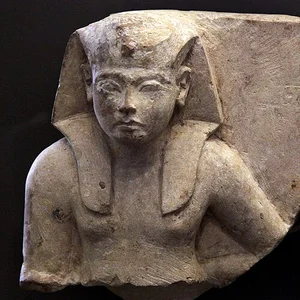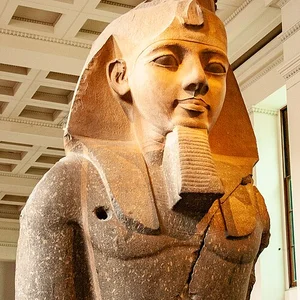

Ramesses II is one of the greatest pharaohs of ancient Egypt, who reigned for 66 years in the 13th century BC. He is famous for his colossal monuments, including the temples of Abu Simbel, and for the Battle of Kadesh against the Hittites.
Ramesses II(1302 av. J.-C. — 1212 av. J.-C.)
Ramesses II
Égypte antique
8 min read
Frequently asked questions
Key Facts
- A 66-year reign (c. 1279–1213 BC), one of the longest in pharaonic history
- Battle of Kadesh (1274 BC) against the Hittites, the first major military confrontation documented in history
- Construction of the Abu Simbel temples and numerous monuments across Egypt (temples, colossal statues)
- Signing of a peace treaty with the Hittite king Hattusili III (c. 1259 BC)
- Numerous military campaigns in Nubia and the Near East to expand the Egyptian empire
Works & Achievements
Two rock-cut temples carved into the Nubian sandstone cliff: the great temple dedicated to the deified Ramesses II and the gods Amun, Ra, and Ptah, and the small temple dedicated to Queen Nefertari. Both are UNESCO World Heritage Sites.
A colossal funerary temple on the west bank of the Nile at Thebes, decorated with scenes from the Battle of Kadesh. It also housed storehouses and granaries that supplied the entire Theban region.
Begun by Seti I and completed by Ramesses II, this 5,000 m² hall with its 134 papyrus columns is the largest columned hall ever built in the ancient world.
The earliest known international peace treaty in history, inscribed in Akkadian on silver tablets and carved on the walls of Karnak and the Ramesseum. A copy is displayed at the United Nations headquarters in New York.
Ramesses II greatly expanded the Luxor Temple, adding a monumental pylon, a colonnade, and six colossal statues of himself. He also erected two obelisks in front of the pylon — one of which now stands in the Place de la Concorde in Paris.
A long epic poem recounting the Battle of Kadesh from Ramesses II's perspective, carved on the walls of numerous temples (Abu Simbel, Karnak, Luxor, Abydos). It is considered one of the earliest epic literary texts in history.
Anecdotes
At the Battle of Kadesh (around 1274 BC), Ramesses II found himself nearly surrounded by the Hittite army after his troops had been scattered. According to Egyptian inscriptions, he charged alone against thousands of enemies, calling upon the god Amun for protection. This episode, which he had carved onto numerous temples, is one of the earliest heroic narratives in history.
Ramesses II lived to approximately 90 years old — an exceptional age in the ancient world. He outlived about a dozen of his eldest sons and fathered over a hundred children with his many wives and concubines. His mummy, discovered in 1881, shows that he suffered from severe arthritis and dental problems in his later years.
To stamp his reign across Egypt, Ramesses II erected colossal statues of himself throughout the country and even had his name carved over the monuments of his predecessors, effectively claiming their works as his own. This practice, known as 'monument usurpation,' earned him a reputation for eternity chiseled in stone.
The peace treaty signed between Ramesses II and Hittite king Hattusili III around 1259 BC is the oldest known international treaty to have survived. Written in Akkadian on silver tablets, it established a defensive alliance, a prisoner exchange, and mutual assistance in the event of invasion. A copy is on display at the UN headquarters in New York.
In 1976, the mummy of Ramesses II was sent to France for restoration and treatment of a fungal infection. It traveled with an Egyptian diplomatic passport listing 'king' as his occupation, and was welcomed at Le Bourget airport with the full military honors reserved for heads of state.
Primary Sources
"His Majesty charged at full gallop and plunged into the mass of the Hittite enemy, alone, with no other beside him. His Majesty looked behind him: he was surrounded by two thousand five hundred chariots."
"Ramesses, great king of Egypt, and Hattusili, great king of the land of the Hittites, have concluded a treaty of eternal alliance to establish peace and brotherhood between them forever."
"I have built for you a dwelling hewn from the mountain of Nubia, in rock as solid as the horizon of the sky. My statues stand there like mountains, for eternity."
"The king of Egypt, great king, mighty king, has written to me, saying: 'Between you and me, let there be friendship, peace, and brotherhood forever.'"
"Ramesses II, son of Seti I, reigned sixty-seven years, one month, and eleven days over the Two Lands of Egypt."
Key Places
Site of the two cliff-carved temples commissioned by Ramesses II, including the Great Temple with its four 20-meter colossi. This architectural masterpiece was saved from the waters of Lake Nasser in 1968 through an international UNESCO rescue operation.
Capital city built by Ramesses II in the eastern Nile Delta, near the site of ancient Avaris. This royal city, now buried beneath farmland, housed the royal palace, temples, and arsenals.
The mortuary temple of Ramesses II on the west bank of the Nile, opposite Luxor. Its imposing ruins — including a shattered colossus that inspired Shelley's poem 'Ozymandias' — stand as testament to the grandeur of his reign.
Site of the famous Battle of 1274 BC against the Hittites, on the banks of the Orontes River. This Hittite fortress city was the prize of a confrontation that led to the first negotiated peace treaty in recorded history.
The vast temple complex at Thebes where Ramesses II built the Great Hypostyle Hall, featuring 134 colossal columns. It is the largest religious complex of the ancient world, dedicated primarily to the god Amun.
Typical Objects

A curved-blade saber of Asian origin, adopted by the Egyptian army. Ramesses II is often depicted holding the khepesh, a symbol of his martial power on the reliefs of Kadesh.

A headdress combining the white crown of Upper Egypt and the red crown of Lower Egypt. Ramesses II wore it during official ceremonies to symbolize his authority over the entire country.

An elongated oval containing the pharaoh's name in hieroglyphics, ensuring his divine protection. Ramesses II had his cartouches inscribed on an exceptional number of monuments, including those of his predecessors.

A light two-wheeled vehicle pulled by two horses, essential to battles of the New Kingdom. Ramesses II commanded from his chariot at the Battle of Kadesh, and these scenes were carved on numerous temples.

Royal insignia held crossed over the chest of the deceased pharaoh. Ramesses II is depicted with these attributes on his colossal statues, most notably those at the temple of Abu Simbel.

The exceptional medium on which the text of the Egyptian-Hittite peace treaty of 1259 BCE was engraved. This diplomatically unique object in ancient history symbolizes the statesmanship of Ramesses II.
School Curriculum
Vocabulary & Tags
Key Vocabulary
Tags
Daily Life
Morning
Ramesses II rose before dawn to attend the temple opening rituals, in which priests symbolically awakened the divine statue. He then received reports from his viziers of the Two Lands (Upper and Lower Egypt), overseeing the administration of the empire from his capital at Pi-Ramesses.
Afternoon
Afternoons were devoted to royal audiences, military decisions, and inspecting the colossal construction projects underway. Ramesses II sometimes took part personally in major religious ceremonies such as the Opet Festival at Thebes, processing in procession along the Nile.
Evening
In the evening, Ramesses II withdrew to his apartments in the royal harem, surrounded by his chief wives and concubines. Scribes read him diplomatic dispatches and epic tales; he dictated his correspondence with the Hittite, Assyrian, and Mitannian kings.
Food
The pharaoh ate fine-quality bread, roasted meats (beef, duck, goose), Nile fish, vegetables (onions, leeks, lentils), fruits (figs, dates, grapes), and drank strong beer and wine. Royal banquets brought together courtiers and dignitaries during the great religious festivals.
Clothing
Ramesses II wore a pristine white linen kilt called the shendyt, paired with a gilded belt and decorated apron. Depending on the occasion, he donned various royal crowns and headdresses (the double crown pschent, the blue khepresh war crown, the striped nemes), and wore pectorals inlaid with semi-precious stones and gold.
Housing
Ramesses II resided primarily in his palace at Pi-Ramesses, a vast complex that included gardens, pools, royal workshops, and stables for his warhorses. In Thebes, he stayed at the Malqata palace and in the apartments adjoining the Ramesseum during the great religious festivals.
Historical Timeline
Period Vocabulary
Visual Style
Le style visuel de l'époque ramesside associe la pierre ocre des temples colossaux aux pigments vifs de lapis-lazuli et de malachite, dans une esthétique de monumentalité solaire et de hiératisme doré.
Sound Ambience
L'ambiance sonore de l'Égypte de Ramsès II mêle le bruit sourd des chantiers colossaux, les chants rituels des prêtres d'Amon et le souffle chaud du désert sur les grandes cours de pierre.
Liens externes & ressources
Références
Œuvres
Temples d'Abou Simbel
Vers 1264-1244 av. J.-C.
Ramesseum (temple funéraire de Thèbes)
Vers 1270-1250 av. J.-C.
Grande salle hypostyle de Karnak
Vers 1290-1278 av. J.-C.
Traité de Qadesh (avec Hattushili III)
Vers 1259 av. J.-C.
Temple de Louxor (agrandissement et décoration)
Vers 1279-1213 av. J.-C.
Poème de Pentaour (inscriptions de Qadesh)
Vers 1274-1258 av. J.-C.