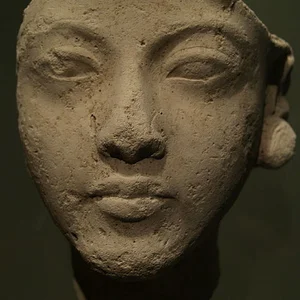

Nefertiti was the Great Royal Wife of Pharaoh Akhenaten, in the 14th century BC. She played an important role in the monotheistic religious reform of her era, promoting the cult of Aten, the sun god. Her idealized face, known through the famous bust, makes her one of the most depicted queens of Egypt.
Nefertiti(1369 av. J.-C. — 1329 av. J.-C.)
Nefertiti
Égypte antique
7 min read
Frequently asked questions
Key Facts
- Around 1369 BC: birth of Nefertiti
- Around 1353 BC: marriage to Pharaoh Akhenaten
- Around 1348 BC: participation in the monotheistic religious reform (cult of Aten)
- Around 1340 BC: construction and decoration of the palace of Amarna alongside Akhenaten
- Around 1329 BC: death of Nefertiti
Works & Achievements
Painted limestone sculpture created by the royal sculptor Thutmose, considered the masterpiece of Amarna art. It is today the global symbol of the beauty of ancient Egypt.
Large stelae carved into the cliffs delimiting the sacred territory of the new capital Akhetaten. They mention Nefertiti as co-founder of the city and attest to her central religious role.
A set of fragmentary reliefs discovered at Karnak depicting Nefertiti in warrior poses. These unprecedented images show the queen striking down enemies, a privilege previously reserved for pharaohs.
Royal residence attributed to Nefertiti at Akhetaten, decorated with frescoes depicting nature and gardens. This palace bears witness to the artistic refinement of the Amarna court.
Frescoes and reliefs in the royal tomb showing Nefertiti alongside Akhenaten worshipping Aten, participating in funerary rituals. These images are a major source for understanding her religious role.
Anecdotes
The bust of Nefertiti, discovered in 1912 by German archaeologist Ludwig Borchardt at Tell el-Amarna, is one of the most famous works of art from Antiquity. Borchardt allegedly downplayed its value in his reports in order to keep it in Germany, where it remains to this day at the Neues Museum in Berlin, much to Egypt's dismay as the country continues to demand its return.
The name "Nefertiti" means "The beautiful one has come" in ancient Egyptian, which may suggest she was originally from a foreign land, though this theory remains debated. Some historians believe she came from Mitanni, a kingdom in the Near East, while others consider her to have been Egyptian by birth.
Nefertiti mysteriously disappears from official sources around year 12 of Akhenaten's reign, circa 1336 BCE. Some scholars believe she died, while others argue she ruled under the name of pharaoh Neferneferuaten, making her one of the rare women to have exercised supreme power in Egypt.
On several reliefs from the city of Amarna, Nefertiti is depicted in warrior poses reserved for pharaohs, striking enemies with her mace. This exceptional iconography testifies to a political and symbolic power far beyond the usual role of a royal consort.
In 2015, British Egyptologist Nicholas Reeves proposed the hypothesis that Nefertiti's mummy might be located in a secret chamber hidden behind the walls of Tutankhamun's tomb in the Valley of the Kings. Radar scans appeared to confirm the existence of cavities, but subsequent excavations failed to reach a definitive conclusion.
Primary Sources
You appear beautiful on the horizon of the sky, living Aten, you who have lived since the beginning… When you set on the western horizon, the earth is in darkness like death.
The great royal wife Nefertiti, living forever and ever… she stands beside the king as Aten himself.
You are my brother. I have heard that you possess many wives and daughters. Send me one of your daughters as a wife.
The king and queen appear at the Window of Appearance, distributing gold collars to their faithful servants.
Key Places
Capital founded by Akhenaten and Nefertiti around 1346 BC in honor of Aten. It is here that the workshop of the sculptor Thutmose was discovered, containing the famous bust.
Ancient religious capital of Egypt and probable birthplace of Nefertiti. It is here that she is believed to have grown up before becoming Great Royal Wife.
Royal necropolis where many pharaohs of the New Kingdom are buried. Some Egyptologists believe that Nefertiti rests there in a secret chamber adjacent to the tomb of Tutankhamun.
Museum that has housed the famous bust of Nefertiti since 1913, discovered during the German excavations of 1912. Egypt regularly demands its return.
Great temple complex dedicated to Amun, whose sanctuaries Akhenaten and Nefertiti had closed in favor of Aten. Reliefs bearing Nefertiti's name were discovered there in the temple of Gempaaten.
Typical Objects

The famous bust of Nefertiti, crafted by the sculptor Thutmose, is the most well-known portrait of the queen. Covered in brightly colored painted plaster, it embodies the ideal of beauty of the Amarna period.

Nefertiti is often depicted wearing a flat cylindrical crown of blue color, unique to her image. This headdress, a symbol of her exceptional power, sets her apart from other queens of the period.

This broad collar of gold and semi-precious stones, composed of multiple rows of colored beads, is an essential attribute of Egyptian royal adornment. Nefertiti wears it in most of her depictions as a sign of her divine dignity.

The queen participated in ceremonies honoring Aten by shaking sistrums, sacred percussion instruments. These objects symbolized her role as mediator between the gods and mankind.

The cartouche is an elongated oval enclosing the royal name written in hieroglyphs. Nefertiti's cartouche appears alongside that of Akhenaten on numerous monuments, underscoring her status as co-ruler.

Fragments of canopic jars bearing Nefertiti's name have been discovered, attesting to the preparation of her mummification. These jars contained the internal organs of the deceased, preserved for the afterlife.
School Curriculum
Vocabulary & Tags
Key Vocabulary
Tags
Mouvement
Daily Life
Morning
Nefertiti rose at dawn to take part in the rituals of Aten worship at sunrise, a sacred moment in the Atenist religion. Her handmaidens helped her don her white linen garments and apply her elaborate makeup — black kohl around the eyes and green malachite eyeshadow on the eyelids. She would then put on her famous blue crown for the official ceremonies that occupied the first part of the morning.
Afternoon
The afternoon was devoted to court affairs: royal audiences in the columned halls of the palace, receiving foreign ambassadors alongside Akhenaten, and overseeing the construction sites of the new capital being built. Nefertiti also participated in the administration of the Aten temples and supervised the education of her six daughters in the royal apartments.
Evening
In the evening, the royal family gathered for banquets enlivened by musicians playing harp, lute, and flute, along with dancers. Nefertiti oversaw the evening offerings to Aten before the sun disappeared below the horizon. At night, she retired to her apartments in the North Palace, richly decorated with frescoes depicting gardens and birds.
Food
Nefertiti's diet was that of the upper Egyptian aristocracy: fine white bread, roasted meats (beef, goose, duck), Nile fish, fresh vegetables (lettuce, onions, cucumbers), and abundant fruits (figs, dates, grapes). She drank fine beer and wine — imported notably from Syria-Palestine — served in cups of gold and faience.
Clothing
Nefertiti wore robes of extremely fine white linen, nearly transparent, carefully pleated and draped, characteristic of the fashion of the Amarna period. Her garments were complemented by wide usekh collar necklaces in gold, lapis lazuli, and carnelian, along with bracelets and pendants. Her distinctive headdress — a blue cylindrical crown adorned with a ribbon — became her iconic emblem, recognizable the world over.
Housing
Nefertiti resided in the Great Royal Palace of Akhetaten, a vast residence with open-air courtyards overlooking the Nile, decorated with colorful frescoes depicting nature and gardens. She also had a personal palace in the northern part of the city, likely connected to her religious role as a servant of Aten. The floors were painted with marsh scenes, the columns adorned with stylized papyrus, and the walls covered with family scenes of a rare intimacy for Egyptian art.
Historical Timeline
Period Vocabulary
Visual Style
Le style visuel de Néfertiti s'inscrit dans l'art amarnien, caractérisé par des formes naturalistes et allongées, une palette de dorés chauds et de bleus profonds, et une lumière solaire omniprésente évoquant le culte d'Aton.
Sound Ambience
L'ambiance sonore de la cour d'Amarna mêle chants liturgiques dédiés à Aton, tintement de sistres sacrés et sons de la vie palatiale égyptienne, entre bruits du Nil proche et musiques de cour raffinées.
Liens externes & ressources
Références
Œuvres
Buste de Néfertiti
Vers 1345 av. J.-C.
Stèles de frontière d'Amarna
Vers 1346-1344 av. J.-C.
Reliefs du temple de Gempaaton à Karnak
Vers 1353-1350 av. J.-C.
Palais nord d'Amarna
Vers 1345 av. J.-C.
Représentations dans le tombeau royal d'Amarna
Vers 1340 av. J.-C.
Rechercher
See also
Related Characters
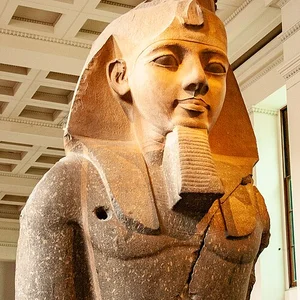
Ramesses II
1302 av. J.-C. — 1212 av. J.-C.
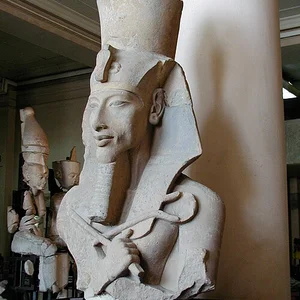
Akhenaten
1400 av. J.-C. — 1335 av. J.-C.
Alexandra Kollontai
1872 — 1952
Eleanor of Aquitaine
1124 — 1204
Amenhotep III
1399 av. J.-C. — 1350 av. J.-C.
Amina Cachalia
1930 — 2013