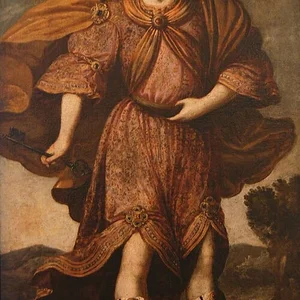

Raziel is an archangel from Jewish Kabbalistic tradition, guardian of divine secrets and celestial mysteries. According to legend, he gave Adam the Sefer Raziel HaMalakh, a book containing the secrets of the universe. His name means "secret of God" in Hebrew.
Raziel
Raziel
8 min read
Frequently asked questions
Key Facts
- His Hebrew name Raziel (רָזִיאֵל) means "secret of God"
- He is mentioned in the Babylonian Talmud and in various Jewish mystical traditions
- The Sefer Raziel HaMalakh (Book of Raziel the Angel) is a medieval Kabbalistic text composed around the 13th century
- According to legend, Raziel gave the Book to Adam after his expulsion from Paradise to help him understand creation
- He is considered one of the seven principal archangels in medieval Jewish angelology
Works & Achievements
The "Book of the Angel Raziel" is the principal text attributed to this archangel. It compiles divine names, protective formulas, astrological treatises, and secrets of Creation, and was used as a protective amulet in many medieval Jewish communities.
A foundational text of Jewish mysticism describing Creation through the 22 Hebrew letters and 10 sefirot. Although it predates the codification of the figure of Raziel, it forms the cosmological framework within which his role is understood.
A summation of medieval Kabbalistic mysticism written in Aramaic, attributed to Rabbi Shimon bar Yochai but composed by Moses de León. The Zohar establishes Raziel's place in the angelic hierarchy and his connection to the sefirah of Chokhmah.
A collection of texts describing mystical journeys through the "celestial palaces" to the divine throne (Merkavah). These texts form the direct background for the medieval angelic traditions that include Raziel.
A midrashic biblical commentary containing one of the most detailed accounts of the gift of Raziel's book to Adam, and a key reference for understanding the narrative mythology surrounding this archangel.
Anecdotes
According to Kabbalistic tradition, Raziel stood so close to the divine throne each day that he could hear every word spoken by God. He recorded these secrets in a book with sapphire pages, which he gave to Adam after his expulsion from Paradise to help him find his place again in the order of the world.
Other angels, jealous that Adam possessed such knowledge, reportedly stole Raziel's book and threw it into the sea. God commanded the angel Rahab, prince of the sea, to retrieve it and return it to Adam. This story illustrates the tension in Kabbalistic thought between transmitting divine knowledge and the temptation to keep it secret.
Legend holds that the book then passed to Noah, who used it to build the ark and understand natural cycles. It was later passed on to Enoch, then Abraham, and finally to King Solomon, who used it to acquire his legendary wisdom. This chain of transmission reflects the importance of esoteric knowledge continuity in Jewish tradition.
The Sefer Raziel HaMalakh as it has come down to us is a genuine medieval text compiled in the 13th century, most likely in Rhineland Kabbalistic circles. Although attributed to the archangel Raziel, modern scholars recognize it as a compilation of earlier Jewish magical treatises, divine names, and protective formulas — a testament to the richness of medieval mystical practice.
In Kabbalah, Raziel is associated with the sephirah Chokmah (Wisdom), the second level of the Tree of Life. He is one of the seven principal archangels, each governing a sphere of existence. His role as 'keeper of secrets' makes him a central figure in medieval debates about what can and cannot be revealed to human beings.
Primary Sources
This book was given to Adam by the angel Raziel so that he might know the secrets and mysteries of the higher spheres and the mysteries of the lower world, and so that he might understand the ways of creation.
When Adam was expelled from the Garden of Eden, the angel Raziel handed him a book from the celestial heights. Adam took hold of the book, studied it, and through it came to understand the secrets of the stars and the cycles of the heavens.
There exists a secret book whose letters are formed of fire, transmitted from Paradise, whose very contents the angels themselves long to know.
And Enoch was taken up by the angels and instructed in the secrets of heaven, the movements of the stars, the length of the years, and the commandments of God.
Key Places
The mythical location where, according to Kabbalistic tradition, the angel Raziel delivered the book to Adam. Eden represents the original point of contact between the divine and the human, and the starting point for the transmission of esoteric knowledge.
A center of the Hasidei Ashkenaz movement in the 12th century, this thriving Jewish community in the Rhineland is one of the places where elements later incorporated into the Sefer Raziel HaMalakh were likely composed.
Home to a major Kabbalistic school in the 13th century, influential in shaping the doctrines of the sefirot and angelology. Girona was one of the centers where the figure of Raziel was developed theologically.
The capital of Kabbalah in the 16th century, where masters such as Isaac Luria (the Ari) developed an elaborate angelology placing Raziel within a complex mystical cosmology.
The site where the Babylonian Talmud was compiled and a hub of intense Jewish mystical activity (the Hekhalot literature) — a distant but foundational context in which the angelic tradition surrounding Raziel took root.
Typical Objects

A book of sapphire or parchment containing divine secrets, the names of angels, and the mysteries of creation. It is Raziel's central attribute — both his gift to humanity and the symbol of his role as keeper of celestial knowledge.

In some versions of the legend, Raziel's book is described as engraved on a tablet of pure sapphire, reflecting divine light. Sapphire, a celestial stone in ancient traditions, symbolizes the wisdom and purity of the message being conveyed.

Like many archangels, Raziel is sometimes depicted carrying a flaming sword, a symbol of divine protection and the boundary between secrets that are revealed and those that must remain hidden.

In medieval Kabbalistic tradition, each archangel possesses a sigil — a unique graphic symbol used to invoke them or to seek their protection. Raziel's sigil appears in several medieval Jewish grimoires.

Kabbalistic scholars who studied the teachings attributed to Raziel worked on parchment scrolls covered in Hebrew letters, divine names, and mystical diagrams, symbolically reproducing his legendary book.

A central ritual object of Judaism, the menorah symbolizes the seven lower sefirot of the Tree of Life and the seven associated archangels. It evokes the cosmological framework within which Raziel plays his part.
School Curriculum
Vocabulary & Tags
Key Vocabulary
Tags
Daily Life
Morning
At dawn, Raziel stands at the gates of Paradise, where divine light begins to filter into creation. According to mystical texts, he opens the book of secrets at the moment when angels begin the first liturgical song of the day (Shacharit). His perpetual presence beside the divine throne allows him to hear every decree pronounced in the celestial spheres.
Afternoon
At the heart of the day, Raziel watches over the boundary between the visible world and the hidden world. In Kabbalistic tradition, this is the time of active contemplation: he observes human souls and takes note of which ones are drawing closer to wisdom. Medieval scholars who invoked him would spend this time deciphering the divine names contained in his book.
Evening
In the evening, at the hour of Mincha prayer, Raziel gathers the secrets of the day that has passed and inscribes them in the celestial registers. Jewish tradition associates dusk with the moment of reflection and self-examination — it is the hour when the veil between heaven and earth is thinnest, most conducive to the revelation of the mysteries that Raziel keeps.
Food
As an angelic being, Raziel does not eat in any material sense. In Kabbalistic cosmology, angels are sustained by divine light (Or Ein Sof) and by the breath of human prayers rising toward the heavens. Texts describe this spiritual 'nourishment' as the direct contemplation of the Divine Presence.
Clothing
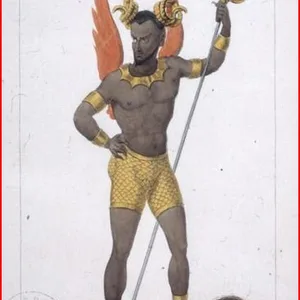
Kabbalistic texts describe Raziel clothed in pure light, his wings spanning the space between the celestial spheres. His symbolic garments are formed of flaming Hebrew letters, each letter bearing a divine attribute. White and sapphire blue are the colors traditionally associated with him.
Housing
Raziel resides in the third heaven, known as Shehaqim according to medieval Jewish cosmology. He occupies a position close to the divine throne (Merkavah), at the boundary between the realms accessible to higher angels and the absolutely hidden mysteries. His space is described as a celestial library hall whose walls are covered with divine names engraved in light.
Historical Timeline
Period Vocabulary
Visual Style
Esthétique des enluminures médiévales ashkénazes et byzantines : fond bleu nuit et or, lettres hébraïques entrelacées, ailes irisées et livre de saphir lumineux, géométrie sacrée et diagrammes de l'Arbre de Vie.
Sound Ambience
Ambiance de scriptorium kabbalistique médiéval : silence sacré, flammes de lampes à huile, murmures de prières hébraïques et bruissements de parchemin sous la plume d'un copiste en quête des secrets divins.
Liens externes & ressources
Références
Œuvres
Sefer Raziel HaMalakh (ספר רזיאל המלאך)
XIIIe siècle (compilation)
Sefer Yetzirah (Livre de la Formation)
IIIe – VIe siècle
Zohar (Livre de la Splendeur)
Fin XIIIe siècle
Littérature des Hekhalot
IIIe – VIIe siècle
Midrash Avkir
VIIe – Xe siècle