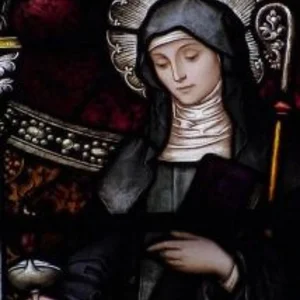

Saint Brigid of Kildare (c. 451-525) was an Irish abbess and the founder of the great monastery of Kildare. Together with Saint Patrick and Saint Columba, she is one of the three patron saints of Ireland. A largely legendary figure, she is often associated with the Celtic goddess Brigid.
Frequently asked questions
Key Facts
- Born around 451 at Faughart, near Dundalk, in Ireland
- Founds the monastery of Kildare around 480 (Cill Dara, “the church of the oak”), a double monastery housing both men and women
- Becomes one of the three patron saints of Ireland alongside Saint Patrick and Saint Columba
- Her feast day, 1 February, coincides with Imbolc, the ancient Celtic festival marking the start of spring
- Dies around 525; her cult spreads throughout medieval Europe and her figure is linked to the pagan goddess Brigid
Works & Achievements
Brigid establishes one of Ireland's most important monasteries, which becomes a great spiritual, intellectual, and artistic center of the Early Middle Ages.
With Bishop Conleth, she leads a community bringing together monks and nuns, a rare case in which an abbess wields considerable authority.
The monastery becomes a center of copying and teaching; Gerald of Wales would later describe an illuminated gospel book there of almost miraculous beauty.
The establishment of a sacred flame tended by the nuns, which would remain a symbol of Kildare until the late Middle Ages.
The invention of the cross that bears her name, which became an Irish national symbol and an object of popular devotion still alive today.
Her reputation for generosity toward the poor and travelers makes her a model of Christian hospitality, celebrated in poems and hymns.
Anecdotes
The most famous legend tells that Brigid asked the King of Leinster for a plot of land to build her monastery. The king, mockingly, promised her as much land as her cloak could cover. Brigid then spread out her cloak, which miraculously began to grow in all directions until it covered the vast plain of the Curragh. The astonished king granted her the land and converted.
At Kildare burned a sacred fire that the nuns tended day and night, never letting it go out. According to tradition, twenty nuns took turns guarding it, and on the twentieth night it was Brigid herself who watched over the flame. A circular hedge surrounded this fire, which no man was allowed to cross — a detail still described by the chronicler Gerald of Wales in the twelfth century.
Brigid is credited with inventing the famous cross woven from rushes that bears her name. Legend has it that she made it at the bedside of a dying pagan chieftain: as she wove the strands together, she explained the Christian faith to him, so that the man asked for baptism before he died. Even today, these crosses are woven in Ireland on the 1st of February.
An ancient poem attributed to Brigid expresses her legendary hospitality in a surprising way: in it she wishes to offer not gold, but a vast lake of beer to the King of Heaven and all the heavenly family. This image reflects the importance of welcome and sharing in early medieval Irish culture.
Several accounts tell that Brigid, coming home soaked by the rain, hung her wet cloak on a sunbeam streaming through the window, as if it were a clothesline, and that the garment stayed there to dry. Such everyday miracles abound in the Lives devoted to her.
Primary Sources
Cogitosus describes the great church of Kildare and the tombs of Bishop Conleth and the virgin Brigid, placed on either side of the altar and adorned with gold, silver and precious stones, topped with suspended crowns.
A hagiographic account in Old Irish relating the birth of Brigid to a noble father, Dubthach, and an enslaved mother, as well as her many miracles connected with milk, butter and generosity toward the poor.
Brigid, ever-good woman, golden radiant flame: may she lead us to the eternal kingdom, the resplendent sun.
I would like a great lake of beer for the King of Kings; I would like the family of Heaven to be drinking it throughout all eternity.
At Kildare, the fire of Saint Brigid is said to be inextinguishable: not that it cannot be put out, but because the nuns tend it with such care and devotion that it has burned without interruption since the time of the saint.
Key Places
Village traditionally regarded as the birthplace of Brigid, in northeastern Ireland, where a shrine dedicated to her still survives.
Site of the great double monastery founded by Brigid, a major religious center of Leinster where she lived, governed, and was buried.
A vast plain near Kildare which, according to legend, Brigid's cloak miraculously covered in order to obtain the land for her monastery.
Church raised on the site of the former monastery; here lie the remains of the 'fire temple' where the perpetual flame once burned.
Typical Objects
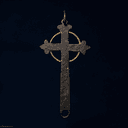
A small cross woven from rushes with four equal arms, which tradition attributes to Brigid. It is still made on 1 February to protect Irish homes.
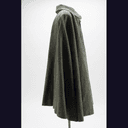
A large woollen cloak, the central attribute of several miracles: the one that stretches out to cover the plain of the Curragh and the one hung on a sunbeam.
📷 CC BY 4.0 · Wikimedia Commons ↗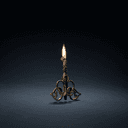
A sacred flame kept burning without interruption by the nuns of Kildare, a symbol of Brigid and a probable echo of ancient Celtic fire cults.
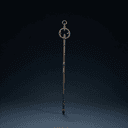
A curved staff symbolising Brigid's authority as an abbess leading a great monastery and a community of nuns.
Brigid is associated with milk, butter and cows; many miracles tell how she multiplies butter or feeds the poor with an inexhaustible supply of milk.
A sacred tree said to have given Kildare its name ('Cill Dara', the church of the oak), linking Brigid's Christianity to the nature venerated by the Celts.
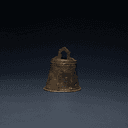
A small handbell of the Irish monks, used to call the community to prayer in keeping with the rhythm of the canonical hours.
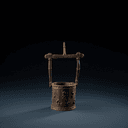
A spring associated with Brigid, a place of pilgrimage where people came seeking healing; several wells 'of Saint Brigid' still exist in Ireland.
School Curriculum
Vocabulary & Tags
Key Vocabulary
Daily Life
Morning
Like every Irish monastic community, the day begins before dawn with the prayer of matins and lauds in the wooden church. Abbess Brigid joins her nuns to chant the psalms, then oversees the first milking of the monastery's cows.
Afternoon
The afternoon is divided between manual labor and the leadership of the community: spinning wool, tending the livestock, copying manuscripts in the scriptorium. Brigid also receives the poor, the sick, and the visitors who come seeking counsel or alms.
Evening
The evening brings the prayer of vespers and then compline. Hospitality being sacred, lodging and a meal are offered to travelers before the silence of the night, broken only by the vigils of the nuns keeping the sacred fire.
Food
Monastic fare is simple: barley or oat bread, milk, butter and cheese, sometimes fish or eggs. Light beer accompanies the meals, and frequent fasts mark the rhythm of the liturgical year.
Clothing
Brigid wears a tunic of undyed wool drawn in at the waist, covered by the great Irish mantle (*brat*), and a nun's veil covering her head, a sign of her religious consecration.
Housing
The monastery of Kildare is built of round huts of wattle and daub with thatched roofs, clustered around a church of wood and oak, the whole surrounded by an earthen bank or a palisade marking out the sacred enclosure.
Historical Timeline
Period Vocabulary
Liens externes & ressources
Références
Œuvres
Fondation du monastère de Kildare
vers 470-480
Organisation d'un monastère double
vers 480
École et scriptorium de Kildare
Ve-VIe siècle
Le feu perpétuel de Kildare
Ve-VIe siècle
La croix de jonc tressée
tradition
Œuvre de charité et d'hospitalité
Ve-VIe siècle