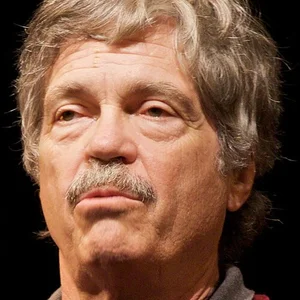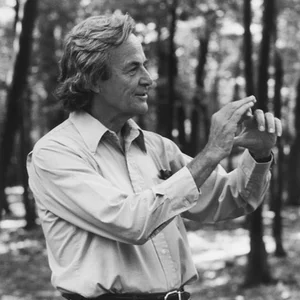

American physicist (1918–1988), Nobel Prize in Physics 1965 for his work on quantum electrodynamics. Pioneer of Feynman diagrams and a legendary figure in science communication.
Richard Feynman(1918 — 1988)
Richard Feynman
États-Unis
8 min read
Frequently asked questions
Famous Quotes
« If you think you understand quantum mechanics, you don't understand quantum mechanics.»
« Science is the belief in the ignorance of experts.»
« Nature's imagination is far greater than man's.»
Key Facts
- 1918: born in New York
- 1943–1945: participation in the Manhattan Project at Los Alamos
- 1965: Nobel Prize in Physics (shared with Schwinger and Tomonaga) for quantum electrodynamics
- 1986: reveals the cause of the Challenger disaster before the investigating commission
- 1988: death in Los Angeles from cancer
Works & Achievements
Feynman developed a revolutionary graphical method for calculating interactions between photons and electrons. These diagrams considerably simplified calculations that had previously been intractable, and are still used daily by physicists around the world.
A three-volume collection of his lectures delivered at Caltech, covering the full breadth of physics from high-school level to advanced university. Translated into many languages, they remain a worldwide reference for their clarity and pedagogical depth.
Feynman proposed that protons and neutrons are made up of smaller particles he called “partons,” paving the way for the discovery of quarks and the theory of the strong nuclear force.
A collection of autobiographical anecdotes that became a worldwide bestseller, in which Feynman humorously recounts his life as a physicist — from the Manhattan Project to his adventures as a bongo player. The book has inspired generations of young people to take an interest in science.
In his lecture “Simulating Physics with Computers,” Feynman laid the theoretical foundations of quantum computing, anticipating by several decades the breakthroughs now unfolding in this revolutionary field.
As a member of the presidential Rogers Commission, Feynman wrote a personal dissenting report pointing to the organizational and cultural failures at NASA — going beyond the immediate technical cause of the faulty O-rings.
Anecdotes
At Los Alamos, during the Manhattan Project, Feynman amused himself by picking the locks of safes containing classified documents. He sometimes left little notes inside to prove he had been there, which horrified the security officers. This habit earned him a legendary reputation among his fellow physicists.
During the investigation into the Challenger shuttle disaster in 1986, Feynman performed a simple but decisive demonstration: he dipped a piece of O-ring into a glass of ice water in front of television cameras, showing that it became brittle in the cold. This gesture revealed the probable cause of the accident and deeply embarrassed NASA, which was trying to downplay its failures.
Feynman was a passionate bongo drummer and regularly played in bars and clubs in Pasadena, sometimes in unexpected venues where he would work out equations on paper napkins. He refused to separate his intellectual life from his everyday pleasures, believing that curiosity should be total and boundless.
As a child during the Great Depression, Feynman earned a few cents fixing radios in his Queens neighborhood. He had a reputation for diagnosing problems just by thinking before touching the device, which amazed customers. This habit of thinking before acting would define his entire career as a scientist.
Feynman taught himself to decipher Mayan script and discovered an error in an academic publication on Mayan mathematics. He presented his findings at a conference before a room of specialists, illustrating his conviction that intellectual curiosity should have no disciplinary boundaries.
Primary Sources
What I cannot create, I do not understand. Physics is like sex: sure, it may give some practical results, but that's not why we do it. These lectures, originally intended for Caltech students, constitute one of the most profound introductions to modern physics.
I learned very early the difference between knowing the name of something and knowing something. My father had taught me to observe, to ask questions, and never to be satisfied with a ready-made answer.
We have managed to write a theory of quantum electrodynamics whose predictions agree with experiment to a remarkable precision. This is the greatest precision achieved in theoretical physics, perhaps in all of science.
For a successful technology, reality must take precedence over public relations, for Nature cannot be fooled.
The first principle is that you must not fool yourself — and you are the easiest person to fool. You must be scrupulously honest with yourself about your own scientific results.
Key Places
A modest neighborhood in New York where Feynman was born and raised. His father Melville introduced him to observing nature from a very young age, laying the foundations of his scientific curiosity.
Feynman completed his doctorate here between 1939 and 1942 under the supervision of John Wheeler, developing his earliest theories on quantum mechanics and electrodynamics.
The secret site of the Manhattan Project where Feynman worked from 1943 to 1945 on the design of the atomic bomb. He lived through his most intense years there, marked by the death of his wife Arline and the first nuclear explosions.
Feynman taught physics here from 1950 until his death in 1988, developed his major theories, and delivered his legendary lectures that would travel around the world.
The city where Feynman received the Nobel Prize in Physics in December 1965, in recognition of his work on quantum electrodynamics. He attended accompanied by his mother and made the most of the ceremony by celebrating all night long.
Liens externes & ressources
Références
Œuvres
Formulation de l'électrodynamique quantique (QED) et diagrammes de Feynman
1948
The Feynman Lectures on Physics (Les cours de physique de Feynman)
1963-1965
Modèle des partons
1969
Vous voulez rire, M. Feynman ! (Surely You're Joking, Mr. Feynman!)
1985
Conférence fondatrice sur les ordinateurs quantiques
1981
Rapport annexe sur l'accident de Challenger
1986