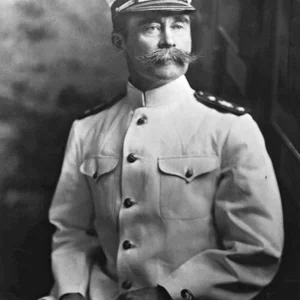

An American Arctic explorer, Robert Peary is famous for claiming the first expedition to reach the geographic North Pole in April 1909. A United States Navy officer, he devoted two decades to exploring polar regions.
Robert Peary(1856 — 1920)
Robert Peary
États-Unis
8 min read
Frequently asked questions
Famous Quotes
« The Pole at last. The prize of three centuries. My dream and goal for twenty years. Mine at last.»
« I have the Pole.»
Key Facts
- Born on May 6, 1856 in Cresson, Pennsylvania, died on February 20, 1920 in Washington D.C.
- Claims to have reached the North Pole on April 6, 1909, accompanied by Matthew Henson and four Inuit guides.
- His claim is disputed by Frederick Cook, who asserts he reached it a year earlier in 1908.
- Conducted several expeditions to Greenland between 1886 and 1897, mapping the island and studying Inuit populations.
- Officially recognized by the U.S. Congress in 1911 for his discovery of the North Pole.
Works & Achievements
A two-volume account of expeditions to Greenland between 1886 and 1897. Peary describes his Arctic travel methods and geographical discoveries, laying the groundwork for his international reputation as a polar explorer.
An account of the 1905–1906 expedition aboard the SS Roosevelt, during which Peary set a new world latitude record at 87°06'N. The book details the extreme conditions and logistical innovations developed during the journey.
The official, detailed account of the successful expedition, published to defend his claim amid the Cook controversy. This book remains the primary source on the final march to the Pole and the methods used.
A technical manual synthesizing two decades of experience in polar regions. Peary shares his methods for equipment, provisioning, and team management, aimed at training and inspiring future explorers.
Anecdotes
During his 1898–1902 expedition through the Canadian Arctic archipelago, Peary suffered severe frostbite that cost him eight toes. Far from giving up, he continued his explorations with specially made boots crafted by the Inuit. This tenacity in the face of physical hardship became one of the most frequently cited traits in his biography.
Peary never traveled alone: he relied entirely on the techniques and expertise of the Inuit people of Greenland and the Canadian Arctic. He adopted their fur clothing, their raw-meat diet, and their igloo-building methods, convinced that no Western explorer could survive without this ancestral knowledge.
His faithful companion was Matthew Henson, an African American man who was fluent in the Inuit language and expert at driving dog sleds. During the final march to the Pole in 1909, it was Henson who first planted the American flag, a few minutes before Peary arrived. He would not be officially recognized for this achievement until decades later, after his death.
Peary's claim was immediately challenged by Frederick Cook, a physician who asserted that he had reached the North Pole a year earlier, in April 1908. The dispute between the two men captivated American and international public opinion for years. To this day, historians debate the validity of Peary's position measurements, with some arguing that he may have missed the exact Pole by several dozen kilometers.
Peary developed an innovative logistical system he called the support-team method: several groups would set out together, then turn back one by one to establish food depots, allowing the lead group to push as far as possible. This strategy, inspired by military supply techniques, revolutionized the organization of major polar expeditions.
Primary Sources
The Pole at last! The prize of three centuries. My dream and goal for twenty-three years. Mine at last! I cannot bring myself to realize it.
April 6, 1909. The igloo was built and we turned in for a sleep of a few hours before starting on the final march to the Pole.
I have the honor to report that I reached the North Pole on April 6, 1909, at ten o'clock in the morning.
Every resource of our ingenuity and experience was called upon to meet the extraordinary difficulties of Arctic travel in its most formidable aspect.
The Eskimo dog is the one absolutely indispensable animal for Arctic work; without him the exploration of the Arctic regions would be impossible.
Key Places
Birthplace of Robert Peary on May 6, 1856. After his father's death, he grew up in Maine with his mother, developing a taste for nature and adventure.
The northernmost land departure point of the 1909 expedition, located approximately 770 km from the North Pole. Peary made it his forward base for the final marches across the pack ice.
Peary's ultimate destination, claimed to have been reached on April 6, 1909 after twenty-three years of effort. The exact validity of this claim remains debated by historians and geographers.
The Inuit region of northwestern Greenland where Peary recruited his guides and sled dogs for his various expeditions. His relationship with the local Inuit communities was lasting and complex.
The island where Peary owned a summer residence, now listed as a historic site. It was here that he learned by telegram of Cook's competing claim and began preparing his public defense.
The burial place of Robert Peary, who died on February 20, 1920. His tomb, adorned with a granite globe marking the North Pole, has become a place of remembrance for explorers.
Liens externes & ressources
Références
Œuvres
Northward over the 'Great Ice'
1898
Nearest the Pole
1907
The North Pole — Its Discovery in 1909
1910
Secrets of Polar Travel
1917