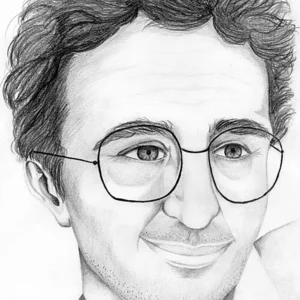

Roberto Bolaño (1953-2003) was a Chilean writer and poet, a major figure in late twentieth-century Latin American literature. Exiled after the 1973 coup d'état, he settled in Mexico and then Spain, where he wrote a dense body of novels that earned acclaim posthumously.
Roberto Bolaño(1953 — 2003)
Roberto Bolaño
Chili
5 min read
Frequently asked questions
Famous Quotes
« Literature is a lot like a samurai battle, but a samurai does not fight another samurai: he fights a monster.»
Key Facts
- Born on April 28, 1953, in Santiago, Chile
- Founded the infrarealist poetry movement in Mexico around 1975 with Mario Santiago Papasquiaro
- Published 'The Savage Detectives' in 1998, which won the Herralde Prize and then the Rómulo Gallegos Prize (1999)
- Died on July 15, 2003, in Barcelona of liver failure
- His monumental novel '2666' was published posthumously in 2004
Works & Achievements
A fake dictionary of imaginary far-right writers, revealing his dark humor and inventiveness.
A short novel about a poet who became a torturer under the Chilean dictatorship, a meditation on evil and art.
A sweeping choral novel inspired by infrarealism, awarded the Herralde and Rómulo Gallegos prizes.
The story of a woman hiding in the restrooms of the University of Mexico during the 1968 repression.
The monologue of a priest and literary critic who turns a blind eye to the crimes of the dictatorship.
A posthumous, world-spanning novel in five parts, centered on the femicides of Santa Teresa, regarded as his masterpiece.
Anecdotes
In 1975, in Mexico City, Bolaño founded the “infrarealism” movement with his friend Mario Santiago Papasquiaro, a band of provocative young poets. They became famous for disrupting the public readings of official writers, even going so far as to interrupt the great poet Octavio Paz in order to shake up the literary establishment.
Having returned to Chile to support Allende's government, Bolaño was arrested shortly after the coup of September 1973. According to his own account, he was released after eight days because two of the prison guards had recognized him: they were former classmates.
Before fame, Bolaño took on a string of odd jobs in Spain: dishwasher, grape picker, night watchman at a campground near Barcelona. He wrote at night, after work, living a very modest material life.
When his son Lautaro was born in 1990, Bolaño turned seriously to the novel, more lucrative than poetry, in order to support his family. This decision triggered a final decade of extraordinary literary productivity.
Suffering from a serious liver disease, Bolaño worked relentlessly on his monumental novel “2666” during his final years. He suggested publishing it as five separate novels to provide more income for his children, but the work appeared in a single volume in 2004, a year after his death.
Primary Sources
Everything I have written is a love letter or a farewell letter to my own generation, those of us who were born in the 1950s and who at some point chose to take up activism.
“Did you invite Lima and Belano to join visceral realism? I said yes, of course, I invited them.” The adventure of the young poets opens the novel.
An unfinished world-novel in five parts, published posthumously, in which the murders of women in Santa Teresa echo the real femicides of Ciudad Juárez.
Literature is a dangerous profession, he said, comparing true writing to a risky dive rather than to a comfortable career.
Key Places
Chilean capital where Roberto Bolaño was born in 1953, before his family moved several times around the country.
City where the family emigrated in 1968 and where Bolaño, a young poet, founded the Infrarealist movement in 1975.
Region in southern Chile where Bolaño, having returned home, was arrested shortly after the 1973 coup d'état.
Small Spanish coastal town where Bolaño settled and wrote most of his fiction.
Major Catalan city where Bolaño died in 2003, in hospital, while awaiting a liver transplant.
Typical Objects

The writer's working tool before the computer age, on which Bolaño typed his manuscripts, often at night.

Notebooks and bundles of pages where he piled up notes, poems and drafts of his sprawling novels.

Constant companions of his long writing nights; a heavy smoker, Bolaño tied tobacco to his literary work.

A voracious reader, Bolaño surrounded himself with novels, poetry collections and crime fiction that fed his abundant work.

The light source for his writing vigils, when he worked after his days spent at odd jobs.

A hot drink that accompanied his nights of work, in a sober life focused on writing.
School Curriculum
Vocabulary & Tags
Key Vocabulary
Tags
Daily Life
Morning
A night owl, Bolaño often woke up late in the morning. During his years of fame in Blanes, he tended to his family before returning to his desk and his manuscripts in progress.
Afternoon
His afternoons were split between voracious reading of novels and poetry, correspondence with other writers, and the preparation of his own texts. When he was younger, in Spain, he instead juggled a string of odd jobs to earn a living.
Evening
Night was his true time for creation: he wrote for hours on end, cigarette in hand, in silence, shaping his sprawling novels late into the darkness.
Food
His material life remained frugal for a long time, made up of simple meals. Over the years, his liver disease forced him to watch what he ate and to give up alcohol.
Clothing
Bolaño cultivated a modest, careless look: glasses, long hair, plain jackets, far from the image of the worldly writer and true to the rebellious spirit of his youth.
Housing
He lived in modest dwellings, notably an apartment in the small seaside town of Blanes, in Catalonia, where he set up his writing desk facing the Mediterranean.
Historical Timeline
Period Vocabulary
Liens externes & ressources
Références
Œuvres
La Littérature nazie en Amérique (La literatura nazi en América)
1996
Étoile distante (Estrella distante)
1996
Les Détectives sauvages (Los detectives salvajes)
1998
Amulette (Amuleto)
1999
Nocturne du Chili (Nocturno de Chile)
2000