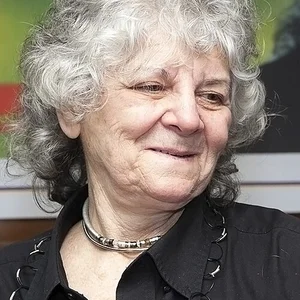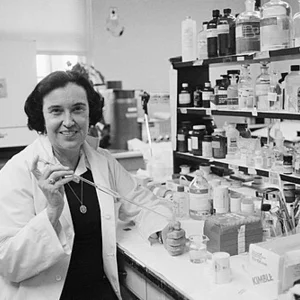

Rosalyn Yalow was an American medical physicist and a pioneer of nuclear medicine. With Solomon Berson, she developed the radioimmunoassay (RIA), a technique that revolutionized biological diagnostics. She received the Nobel Prize in Medicine in 1977.
Rosalyn Yalow(1921 — 2011)
Rosalyn Yalow
États-Unis
6 min read
Frequently asked questions
Famous Quotes
« We must believe in ourselves or no one else will believe in us.»
Key Facts
- Born on July 19, 1921, in the Bronx, New York
- Developed the radioimmunoassay (RIA) with Solomon Berson in the 1950s
- First application of RIA to measure insulin in human blood (1959-1960)
- Received the Nobel Prize in Physiology or Medicine in 1977, the second woman to win it
- Died on May 30, 2011, in New York
Works & Achievements
She founded one of the first nuclear medicine departments, which would become a world-renowned research laboratory.
With Berson, she demonstrated that the body produces antibodies against injected insulin, an idea at first rejected by the major scientific journals.
Her major achievement: a technique capable of measuring hormones and other substances in minuscule quantities in the blood, which revolutionized medical diagnosis.
Foundational paper presenting the method for measuring insulin in human blood.
A choice not to file a patent so that the technique could spread freely around the world and benefit every patient.
The first woman to receive this prestigious distinction, often seen as an antechamber to the Nobel Prize.
An award honoring the development of the radioimmunoassay of peptide hormones; she was the second woman to receive this Nobel Prize.
The highest American scientific distinction, awarded for her body of work as a whole.
Anecdotes
As a teenager, Rosalyn devours the biography of Marie Curie written by her daughter Ève Curie. This book, which tells the story of a woman rejected and then triumphant in science, becomes her role model and convinces her that she too can become a physicist, even though it was a profession almost forbidden to women.
When she earns an assistantship scholarship at the University of Illinois in 1941, she is the only woman among the hundreds of teachers and researchers in the college of engineering, and the first since 1917. The war, which had sent so many young men to the front, opened a door usually closed to her.
At first, for lack of space, Rosalyn Yalow and Solomon Berson set up their radioisotope laboratory at the Bronx Veterans Administration hospital in a converted former janitor's closet. It is in this tiny room that a technique destined to change medicine worldwide would be born.
With Berson, she refuses to patent the radioimmunoassay (RIA). Rather than make money, they choose to freely share their invention so that laboratories all over the world can use it and save lives.
Solomon Berson, her research partner, dies in 1972. Since the Nobel Prize is never awarded posthumously, Rosalyn receives it alone in 1977. She never forgets her colleague: she names their laboratory after him and mentions him in all her speeches.
Primary Sources
The world cannot afford to lose the talents of half its people if we are to solve the many problems that beset us.
Radioimmunoassay makes it possible to measure substances present in the blood at minuscule concentrations, until then completely undetectable.
An immunological method makes it possible to measure the amount of insulin circulating in the plasma of human subjects.
Diabetic patients treated with insulin develop antibodies in their blood capable of binding to the injected hormone.
The immunoassay of insulin naturally produced by the body opens a new path for the study of hormones.
Key Places
Working-class neighborhood of New York where Rosalyn was born in 1921 and where she spent most of her life and career.
Free public university for women where she studied physics and chemistry, the first in her family to pursue higher education.
University where she earned her PhD in physics in 1945, the only woman on the engineering faculty.
Hospital where she set up a radioisotope unit and developed the radioimmunoassay together with Solomon Berson.
Typical Objects

A device that detects and measures the radiation emitted by radioactive isotopes. It is the central instrument of the radioimmunoassay, which makes it possible to count tiny quantities of labeled substances.

A radioactive isotope used as a “tracer” to label molecules such as insulin. Its radioactivity makes it possible to track and measure these molecules in the blood.

Small glass containers in which blood samples, antibodies, and labeled molecules are mixed. Hundreds of them are lined up during a series of assays.

An instrument used to draw up and transfer precise volumes of liquid. The accuracy of these movements is essential to obtaining reliable assays.

Laboratory clothing and equipment (gloves, aprons, lead shielding) protecting the researcher handling radioactive materials. A symbol of rigorous scientific work.

A book in which experiments, measurements, and results are recorded day after day. It keeps an exact record of discoveries and makes it possible to verify them.
School Curriculum
Vocabulary & Tags
Key Vocabulary
Tags
Daily Life
Morning
Rosalyn Yalow rises early and quickly heads to her laboratory at the Bronx Veterans Affairs hospital. Known for her extraordinary capacity for work, she devotes long days to her experiments, often six or seven days a week.
Afternoon
The afternoon is paced by hands-on work: labeling molecules with radioactive iodine, preparing tubes, taking measurements with the scintillation counter. She relentlessly discusses the results with Solomon Berson, bringing physics and medicine together.
Evening
In the evening, she returns to her family, but science is never far away: she reads articles and prepares the next day's experiments. She is known for inviting and cooking for the young researchers in her laboratory.
Food
Raised in a Jewish family, she keeps a kosher home and cooks the meals herself. The food of twentieth-century America, abundant and industrial, contrasts with the traditions she maintains at home.
Clothing
At work, she wears the white laboratory coat, sometimes along with protection against radiation. Outside, she dresses with the simplicity of an active middle-class American woman of her time.
Housing
She lives in an apartment in the Bronx, close to her workplace, in post-war New York. Her domestic life, raising two children while pursuing an intense career, illustrates the challenges faced by women scientists of her era.
Historical Timeline
Period Vocabulary
Liens externes & ressources
Références
Œuvres
Création du service de radio-isotopes de l'hôpital des vétérans du Bronx
1947
Découverte des anticorps anti-insuline chez les diabétiques
1956
Dosage radio-immunologique (RIA)
1959
« Assay of plasma insulin in human subjects by immunological methods » (Nature)
1959
Refus de breveter le RIA
1959
Prix Albert Lasker de recherche médicale
1976
Prix Nobel de médecine
1977