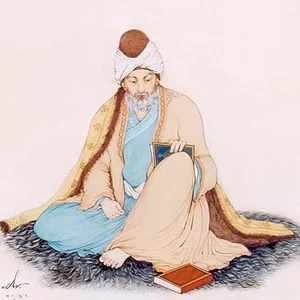

Persian Sufi poet, Masnavi, founder of the Whirling Dervishes
Rûmî(1207 — 1273)
Rûmî
Empire seldjoukide
7 min read
Frequently asked questions
Key Facts
Works & Achievements
A mystical epic poem in six books comprising more than 25,000 verses, considered one of the greatest works in Persian literature. This masterpiece of Sufism weaves allegorical stories and spiritual teachings to guide disciples toward divine illumination.
A collection of lyric poetry containing more than 40,000 verses arranged as ghazals, dedicated to his spiritual master Shams. These poems express divine love and mystical ecstasy, offering a profound exploration of spiritual experience.
The establishment of a structured Sufi brotherhood based on Rumi's teachings, characterized by the ritual of whirling dance (Sema) as a meditative practice. This order persists to this day and has profoundly influenced Muslim spirituality.
A collection of spiritual discourses and conversations transcribed by his disciples, offering practical teachings on the mystical path and inner transformation. This work complements the Masnavi with direct instruction.
A compilation of poetry and spiritual instructions intended to guide disciples after the master's physical death, reflecting the Sufi understanding that spiritual teaching continues beyond earthly life.
Correspondence with his disciples and other spiritual figures, containing advice, responses to mystical questions, and guidance for personal spiritual development.
Anecdotes
Rûmî met the dervish Shams of Tabriz in 1244 in Konya, an encounter that transformed his spiritual life. This intense and mystical friendship with Shams deeply influenced his poetry and his understanding of divine love. After Shams's mysterious disappearance, Rûmî channeled his grief into his most celebrated works, most notably the Divan-e Shams.
Rûmî composed the Masnavi (or Mesnevi), an epic poem of more than 25,000 verses considered one of the greatest works of Persian and mystical literature. This spiritual masterpiece, written over many years, contains stories, parables, and Sufi teachings that convey divine wisdom through poetry.
In Konya (in present-day Turkey), Rûmî founded the mystical order of the Mevlevi, known in the West as the Whirling Dervishes. These dervishes perform a ritual spinning dance (the sema) that symbolizes the soul's journey toward the divine — a practice still alive today.
Rûmî taught and preached at the Grand Mosque of Konya, attracting many disciples and students and becoming a major spiritual figure of his time. His influence extended well beyond his death in 1273, with his teachings passed down by his disciples throughout the Ottoman Empire.
Primary Sources
I am like the reed flute that weeps for separation from the reed bed. Whoever hears my music understands the fire that consumes me. The Masnavi is the key that opens all hearts.
Shams, you are the sun that illuminates my soul. Without you, I would be lost in the darkness of ignorance. Every word I utter is a reflection of your eternal light.
Divine wisdom manifests through all beings. The soul that truly seeks will find its way toward union with the Divine, for that is its original destination.
My father was an ocean of spiritual knowledge. Those who drew near him felt a transformation of their inner being. He grounded his teachings in divine love and spiritual dance.
Key Places
Rumi's birthplace in Khorasan (present-day Afghanistan). He was born there in 1207 before fleeing the Mongol invasions with his family.
A city in Anatolia (present-day Turkey) where Rumi settled permanently and composed his major works, including the Masnavi. The central hub of his spiritual and poetic activity.
The tomb of the Sufi poet, now an important pilgrimage site. The building, converted into a museum, houses his relics and stands as a symbol of his spiritual legacy.
The Syrian city where Rumi encountered the mystic Shams of Tabriz, a pivotal figure who profoundly transformed his spiritual thought and poetry.
An Anatolian city where Rumi temporarily withdrew with his spiritual master Shams and continued his mystical teaching.
Typical Objects

A spiritual epic poem in six books composed by Rumi, considered one of the greatest works of Persian literature. This foundational Sufi text is studied and recited by dervish disciples.

Traditional garment of the whirling dervishes, consisting of a flowing robe and a distinctive turban. Rumi founded the Mevlevi order, whose members wear this characteristic garb during their rituals.

A traditional Sufi wind instrument made of reed, deeply cherished by Rumi, who wrote that the ney represents the soul separated from its origin. This instrument accompanies the ceremonies of the whirling dervishes.

An everyday object in medieval Persian life, used by Rumi for his daily spiritual practices. The rug represents the sacred space of meditation and connection with the divine.

An Islamic funerary monument where Rumi rests in Konya, Turkey. Now a major pilgrimage site, this shrine symbolizes the poet's spiritual legacy and his importance in the Sufi tradition.

A devotional object made of prayer beads used by Rumi for the recitation of spiritual formulas. Prayer beads are an essential accessory in Sufi mystical practice.

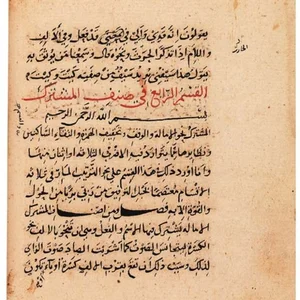
Medieval Persian manuscripts adorned with elaborate calligraphy, reflecting the literary culture from which Rumi emerged. These works bear witness to the refined educational environment of 13th-century Anatolia.

A spiritual ritual dance created by Rumi as a form of dynamic prayer in which the dervish spins on their own axis. This gesture symbolizes union with the divine and remains the central practice of the Mevlevi order.
School Curriculum
Daily Life
Morning
Rumi begins his day before dawn with ritual ablutions and the Fajr prayer, performed at the mosque or at home. He then devotes several hours to meditation, reading religious and philosophical texts, and composing mystical poetry. These moments of contemplation are essential to his daily spiritual practice.
Afternoon
The afternoon is generally dedicated to teaching. Rumi receives his disciples and students in Konya, imparting the principles of Sufism and discussing spiritual matters. He also takes part in theological discussions with other scholars and religious figures, thereby consolidating his intellectual and spiritual influence.
Evening
Evenings are often devoted to Samâ sessions — the spiritual rituals of dance and song. Rumi participates actively or leads them, guiding his disciples through these meditative and ecstatic practices that characterize the Sufi order he founded. These gatherings bring together music, poetry, and ritual movement.
Food
Rumi follows Islamic dietary precepts: his diet consists mainly of bread, vegetables, dried fruits, rice, and occasionally poultry or mutton at important meals. Wine is forbidden, replaced by water, milk, and herbal infusions. His eating habits remain simple and moderate, in keeping with the ascetic practices of Sufism.
Clothing
Rumi wears the typical attire of a Persian scholar and Sufi: a long robe (qâbâ) of coarse dark wool, a white or grey turban, and a belt. His appearance reflects his status as a spiritual master and his commitment to material renunciation, far removed from excessive adornment.
Housing
Rumi lives in Konya in Anatolia, in a comfortable but modest home befitting his standing as a respected religious master. His residence includes a reception room for welcoming disciples, a private library rich in manuscripts, and spaces for prayer and meditation. It displays no ostentatious luxury.
Historical Timeline
Period Vocabulary
Visual Style
Un style visuel inspiré des enluminures persanes médiévales, associant motifs géométriques complexes, calligraphie sacrée et figures de derviches en mouvement spiralé. L'atmosphère spirituelle est renforcée par une lumière chaude et dorée sur des fonds profonds, évoquant la mystique soufi et la transcendance divine.
Sound Ambience
Une ambiance spirituelle et méditative du Moyen Âge persan, mêlant les sons hypnotiques des derviches tourneurs aux mélodies mystiques du ney et du daf, créant une atmosphère d'extase soufie et de contemplation divine.
Liens externes & ressources
Références
Œuvres
Le Mathnawî (Mesnevi)
1258-1273
Le Divan de Shams de Tabriz
1240-1273
Fondation de l'ordre des Mevlevi (Derviches Tourneurs)
1273
Fihi ma fihi (En lui ce qui est en lui)
1263-1273
Le Livre des Morts (Mürshid-nâme)
après 1260
Les Lettres (Mektûbât)
1240-1273