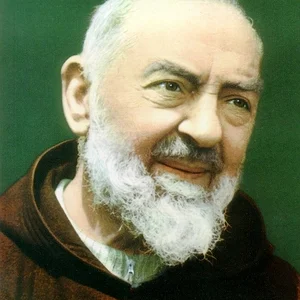

Padre Pio was an Italian Capuchin priest and friar, a major figure of 20th-century Catholicism. A mystic renowned for the stigmata he is said to have borne for half a century, he was canonized by John Paul II in 2002 and remains one of the most venerated saints in Italy.
Saint Padre Pio(1887 — 1968)
Padre Pio
Italie, royaume d'Italie
6 min read
Frequently asked questions
Famous Quotes
« Pray, hope, and don't worry.»
« Prayer is the best weapon we possess; it is a key that opens the heart of God.»
Key Facts
- Born on May 25, 1887, in Pietrelcina, in southern Italy
- Joins the Order of Friars Minor Capuchin and is ordained a priest in 1910
- Receives the stigmata on September 20, 1918, at the friary of San Giovanni Rotondo
- Dies on September 23, 1968, in San Giovanni Rotondo
- Is canonized by Pope John Paul II on June 16, 2002
Works & Achievements
A large hospital founded in San Giovanni Rotondo, which became a leading medical institution in Southern Italy. It is Padre Pio's major worldly achievement.
A network of prayer circles established by Padre Pio in response to the encouragement of Pius XII. These groups still exist today all over the world.
A collection of letters addressed to his spiritual directors and to the faithful, in which he describes his mystical experiences. An essential source for understanding his inner life.
For half a century, he devoted most of his days to hearing the confessions of the faithful. This ministry deeply shaped popular Catholic spirituality.
Padre Pio tirelessly promoted the praying of the Rosary and devotion to the suffering Christ. His example touched millions of believers.
Anecdotes
On 20 September 1918, in the choir of the friary of San Giovanni Rotondo, Padre Pio said he received the stigmata: wounds on his hands, feet, and side resembling those of Christ. He is said to have borne them for fifty years, until they vanished shortly before his death, making this one of the most famous and most debated cases of the 20th century.
Padre Pio spent hours, sometimes as many as sixteen a day, hearing the confessions of the faithful who flocked to him by the thousands. It is said that he would sometimes curtly turn away penitents he judged insincere, yet he could also dissolve into tears while listening to others.
The Vatican long regarded Padre Pio with suspicion. In the 1920s, the Holy Office even forbade him to say Mass in public and to hear confessions, suspecting fraud or delusion. These restrictions were lifted in 1933 by decision of Pius XI.
Thanks to donations from the faithful, in 1956 Padre Pio founded a large hospital, the “Casa Sollievo della Sofferenza” (Home for the Relief of Suffering), in San Giovanni Rotondo. He wanted modern medicine and prayer to heal the sick there together.
Accounts of bilocation are attributed to him: witnesses claimed to have seen him praying in several places at the same time. The Church, cautious, has not authenticated these phenomena, but they fed his reputation as a mystic during his lifetime.
Primary Sources
What shall I tell you about my crucifixion? My God, what confusion and humiliation I feel at having to disclose what you have wrought in this wretched creature!
In honour of the Holy and Undivided Trinity, we declare and define Blessed Pio of Pietrelcina to be a saint, and we enroll him among the saints.
The lesions on the hands are covered by a reddish membrane, with no bleeding, no oedema, and no inflammation of the surrounding tissue.
Key Places
Village in the province of Benevento where Francesco Forgione was born in 1887. His peasant childhood shaped his popular piety there.
Friary and town in the Gargano where Padre Pio lived from 1916 until his death. Today it is a major pilgrimage shrine.
City in Campania where Padre Pio was ordained a priest in 1910. It marks the beginning of his priestly ministry.
Hospital founded by Padre Pio and inaugurated in 1956 in San Giovanni Rotondo. He wanted it to unite medical care with Christian charity.
Site of his beatification in 1999 and his canonization in 2002 by John Paul II, before hundreds of thousands of pilgrims.
Typical Objects

Padre Pio wore dark brown mittens to cover the wounds on his hands, which he hid out of modesty. They became one of the objects most closely associated with his image.

The brown woolen robe bound with a cord of three knots, symbolizing the vows of poverty, chastity, and obedience. Padre Pio wore it throughout his religious life.

Before a large crucifix in the choir, Padre Pio is said to have received his stigmata in 1918. The cross lies at the center of his devotion to the Passion of Christ.

Padre Pio called the rosary his “weapon” and recited it ceaselessly. He encouraged all the faithful to pray the rosary every day.

Padre Pio spent long hours there each day, hearing lines of penitents who came from all over Europe. The confessional was the heart of his ministry.

Instruments of the Mass that Padre Pio celebrated with a slowness and intensity that struck the faithful. His Mass could last more than two hours.
School Curriculum
Vocabulary & Tags
Key Vocabulary
Daily Life
Morning
Padre Pio rose before dawn to prepare and celebrate his Mass, which could last two hours, so deeply did he immerse himself in it. As soon as the service ended, he made his way to the confessional, where long lines of penitents were already waiting for him.
Afternoon
His afternoons were divided between confession, prayer, and reading the abundant mail that reached him from all over the world. He also received the sick and visitors who came seeking a word or a blessing.
Evening
In the evening, he prayed the rosary, meditated on the Passion, and ended his day with long hours of prayer. He slept very little, often only a few hours.
Food
Padre Pio ate extremely little, sometimes the equivalent of one small meal a day, which astonished his contemporaries and the doctors. His food remained simple and frugal, in keeping with the Capuchin rule.
Clothing
He wore the brown homespun habit of the Capuchins, girded with the cord of three knots, and fingerless gloves to conceal the wounds on his hands. His clothes were poor and worn.
Housing
He lived in a plain monastic cell at the friary of San Giovanni Rotondo, furnished with a narrow bed, a table, and a few devotional objects. The bareness of his room reflected his vow of poverty.
Historical Timeline
Period Vocabulary
Liens externes & ressources
Références
Œuvres
Casa Sollievo della Sofferenza
1956
Groupes de prière
à partir de 1947
Correspondance spirituelle (Epistolario)
1910-1922 (principalement)
Ministère de la confession
1916-1968
Diffusion de la dévotion au Sacré-Cœur et au Rosaire
XXe siècle