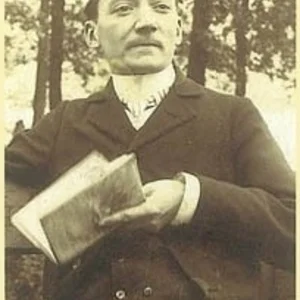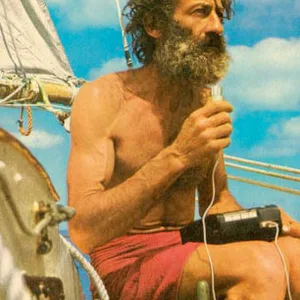

French sailor and writer (1925-1994), an iconic figure of solo sailing. Competing in the first non-stop round-the-world race in 1968, he gave up the chance of victory to keep sailing on toward the Pacific, becoming a symbol of the inner quest and of humanity's relationship with the sea.
Bernard Moitessier(1925 — 1994)
Bernard Moitessier
France
6 min read
Frequently asked questions
Famous Quotes
« I am continuing non-stop toward the Pacific Islands because I am happy at sea, and perhaps also to save my soul.»
Key Facts
- Born on 10 April 1925 in Hanoi, in French Indochina
- Took part in 1968 in the Sunday Times Golden Globe Race, the first non-stop, single-handed round-the-world race
- In 1969, while in a position to win, he abandoned the race to keep sailing toward Tahiti aboard his ketch Joshua
- Author of major narratives such as “Cape Horn: The Logical Route” (1967) and “The Long Way” (1971)
- Died on 16 June 1994 in Paris
Works & Achievements
His first book, in which he recounts his early days as a sailor and his shipwrecks; it reveals his talent as a storyteller of the sea.
An account of the long crossing from Tahiti to Alicante by way of Cape Horn, completed with his wife Françoise.
Nearly 37,455 nautical miles sailed nonstop and single-handed; a feat he turned into a spiritual quest.
His most famous work, an account of his voyage and of his decision to keep sailing on toward the Pacific; a classic of maritime literature.
A posthumous autobiography published the year before his death, a summing-up of a whole life spent between the sea and the search for meaning.
Anecdotes
In 1968, Bernard Moitessier set off in the first solo non-stop round-the-world race, the Sunday Times Golden Globe. Well positioned to win after rounding the three great capes, he made a decision that astonished the world: instead of sailing back up to England to claim victory and the prize, he kept on toward the Pacific, completing nearly one and a half loops around the globe.
Refusing to use a radio, Moitessier communicated with land in an unusual way: he tucked his messages and rolls of film into weighted tins, then catapulted them with a slingshot onto the decks of ships he passed. It was in this manner, off Cape Town in March 1969, that he announced to the world that he was abandoning the race.
His famous sailboat, a steel ketch, was named Joshua — in tribute to Joshua Slocum, the first man to complete a solo circumnavigation of the world at the end of the 19th century. The boat is now preserved and open to visitors at the Maritime Museum of La Rochelle.
Born in Hanoi and raised in Indochina, Moitessier learned the sea as a child in the Gulf of Siam aboard junks and local fishing boats. Before his great voyages, he lost two sailboats in succession, the Marie-Thérèse and then the Marie-Thérèse II, both wrecked on reefs.
During his long weeks of solitude at sea, Moitessier practiced yoga on the deck of Joshua and pursued a deep spiritual reflection. He explained that he had carried on “because I am happy at sea, and perhaps to save my soul,” a phrase that has become legendary.
Primary Sources
My intention is to continue the voyage, still nonstop, toward the islands of the Pacific, because I am happy at sea and perhaps to save my soul.
I am continuing nonstop toward the Pacific because I am happy at sea, and perhaps also to save my soul. Time no longer has the same value when you live with the sea and the sky.
Cape Horn, for a sailor, is what Everest is for a mountaineer: a myth that you carry within yourself long before you reach it.
I understood very early, in the Gulf of Siam, that the sea cannot be conquered: you only learn to live with it, to listen to it.
Key Places
Moitessier's birthplace, where he was born in 1925; he spent his childhood in Asia, in close contact with the sea.
The seas of his childhood, where he learned to sail on local fishing boats before his great ocean crossings.
Starting port of the Sunday Times Golden Globe Race, which he left in August 1968 aboard Joshua.
The dreaded southern tip of South America, a legend among sailors; he rounded it during his southern voyages, including the Long Way.
The end point of his Long Way, where he arrived in June 1969 after giving up the race; he would live there for several years.
Joshua is preserved here today and open to visitors, having become a place of remembrance for solo sailing.
Typical Objects

His 12-metre steel ketch, sturdy and spare, named in tribute to the navigator Joshua Slocum. It was aboard this vessel that he completed his Long Way.

Refusing to carry a radio, he used it to catapult his messages and film reels, sealed in weighted boxes, onto the decks of passing ships.

An autonomous wind-vane steering device that held the sailboat on course, allowing the solo navigator to sleep, handle the boat, and rest.

An astronomical navigation instrument with which he measured the altitude of the sun and stars to fix his position on the open sea.

Notebooks in which he recorded his course, the weather, and his inner reflections; they fed into his books, including The Long Way.

He filmed his solo crossing and sent the reels ashore with his slingshot, from far out at sea.
School Curriculum
Vocabulary & Tags
Key Vocabulary
Daily Life
Morning
At daybreak, he inspected **Joshua**'s rigging, sails, and deck after the night. He took his position with the sextant and recorded his course and the weather in his logbook.
Afternoon
Afternoons were split between sail repairs, small jobs around the boat, and reading. He practiced yoga on deck and watched the sea and the birds for long stretches.
Evening
In the evening, he prepared a simple meal on the stove and kept watch beneath the stars. Solitude fed an intense inner reflection on his life and his relationship with the world.
Food
On board, his everyday fare consisted of rice, canned food, biscuits, and carefully rationed water. He sprouted seeds for a little fresh food and sometimes supplemented his meals with fish he caught.
Clothing
At sea, he wore oilskins, wool sweaters, and boots against the cold and the spray of the southern oceans. In fine weather, he was happy to stay bare-chested and barefoot on deck.
Housing
His home was **Joshua**'s cramped cabin: a bunk, a chart table, instruments, and provisions. Everything in it was designed to withstand storms and last for months without a port of call.
Historical Timeline
Period Vocabulary
Liens externes & ressources
Références
Œuvres
Vagabond des mers du Sud
1960
Cap Horn à la voile
1967
Tour du monde de la Golden Globe Race
1968-1969
La Longue Route
1971
Tamata et l'Alliance
1993