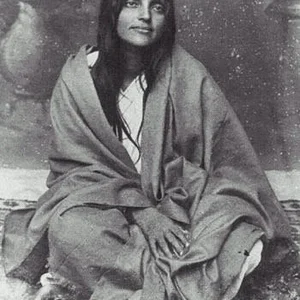

A Hindu mystic and saint from Bengal, revered as a major figure of 20th-century Indian spirituality. Considered by her disciples to be an embodiment of the divine, she drew many followers across India without ever having received any formal religious training.
Frequently asked questions
Key Facts
- Born in 1896 in Kheora, in the district of Tripura (Bengal, in present-day Bangladesh)
- Nicknamed “Ma” (Mother) by her disciples, revered as a maternal figure of the divine
- Founded and inspired many ashrams across India during the 20th century
- Counted among her admirers such figures as Indira Gandhi and Prime Minister Jawaharlal Nehru
- Died in 1982 in Dehradun, India
Works & Achievements
Her main “work” was her presence: thousands of people came to receive her darshan (vision) and her brief spiritual sayings, passed on by word of mouth.
Collections of her sayings transcribed by her disciples, forming the written core of her teaching on detachment and the quest for the divine.
Another compilation of spiritual aphorisms attributed to the saint, widely circulated among her devotees.
An organization bringing together the many ashrams created around her across India, perpetuating the gatherings and devotional practice.
A “Week of Self-Restraint” of prayer, fasting and collective meditation that she instituted, still celebrated today in her ashrams.
The chapter that Paramahansa Yogananda devoted to her in *Autobiography of a Yogi* helped make her figure known outside India.
Anecdotes
Born Nirmala Sundari in a village in eastern Bengal (present-day Bangladesh), she was married very young, at around 13, according to custom. But her husband, Ramani Mohan Cakravarti (known as Bholanath), later recounted that he lived a purely spiritual marriage: she would enter states of ecstasy whenever he approached her, and he eventually came to recognize her as his own guru.
Anandamayi Ma had received almost no formal schooling and claimed no human teacher. When asked who her guru was, she would reply that it was herself, or that the entire universe was her teacher. This status as a spiritual autodidact struck many Indian and Western observers.
She was first called 'the mother of joy' (Anandamayi Ma) because of the states of bliss that seized her during devotional singing (kirtan): her body could freeze, tremble, or light up with a smile for hours at a time. Those close to her sometimes had to feed her and watch over her during these periods.
Indian Prime Minister Jawaharlal Nehru and his daughter Indira Gandhi came to see her, as did many other notable figures. Paramahansa Yogananda devoted an admiring chapter to her in his famous book *Autobiography of a Yogi* (1946), where he calls her “the joy-permeated mother.”
She never led an organization in the strict sense, but her disciples founded numerous ashrams around her throughout India, from the Himalayas (Dehradun, Kankhal) to Bengal. She spent much of her life traveling from one to another, refusing to settle permanently in any one place.
Primary Sources
“Father, there is little to tell.” She spread her graceful hands in a deprecatory gesture. “My consciousness has never associated itself with this temporary body. Before I came on this earth, Father, ‘I was the same.’ As a little girl, ‘I was the same.’”
“Seek to know the One who is eternal, unchanging. All that appears and disappears is not real; what remains forever, that is your true nature.”
“As long as the slightest trace of desire remains, perfect peace cannot be attained; surrender yourself completely and let unfold what is meant to happen.”
“When she sang the name of the divine, her whole body seemed to melt into ecstasy, and those who watched her felt their hearts grow calm.”
Key Places
Birthplace of Nirmala Sundari, in a Vaishnava Brahmin family of rural Bengal.
Capital of East Bengal where, in the 1920s, her circle of devotees took shape and a temple was established at Ramna.
A locality in Bengal where the couple settled around 1918 and where her states of ecstasy and intense spiritual practices began.
A town at the foot of the Himalayas where she often stayed and where she died in 1982; site of one of her principal ashrams.
A sacred place on the Ganges where her samadhi (tomb) and one of the major ashrams of the movement born around her are located.
A holy city of Hinduism on the Ganges, which she visited regularly and where an ashram was established in her name.
Typical Objects
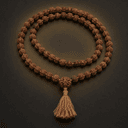
A string of beads, often made of rudraksha seeds or tulsi wood, used to count repetitions of the divine name (japa). A central object of Hindu devotion.
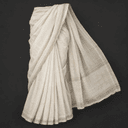
A garment of white cotton, the color of renunciation and purity, which Anandamayi Ma usually wore. White signifies detachment from material possessions.
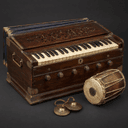
A small bellows-powered organ accompanying collective devotional songs (kirtan), in the midst of which the saint would enter into ecstasy. Accompanied by drums (mridanga) and cymbals.
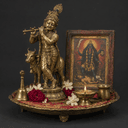
Statues and images of the deities (Krishna, Kali) set up in the temples and ashrams where flowers, incense, and food were offered (puja).
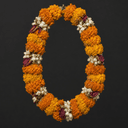
Garlands of marigolds, jasmine, or roses offered as a mark of respect to saints and deities. Devotees would cover Anandamayi Ma with them during darshan.
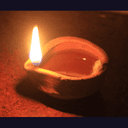
A small lamp waved before the deity or the saint during the arati ceremony. The flame symbolizes the light of consciousness.
📷 CC BY-SA 3.0 · Wikimedia Commons ↗School Curriculum
Vocabulary & Tags
Key Vocabulary
Daily Life
Morning
Days in the ashrams began before dawn with devotional songs (kirtan), the recitation of mantras, and the arati ceremony. Anandamayi Ma, often awake very early, granted her first darshan to the devotees who came to see her.
Afternoon
The afternoon was devoted to spiritual conversations, visitors' questions, and the organization of religious festivals. She moved frequently from one ashram to another, never staying long in the same place.
Evening
Evening brought new kirtan and the arati of dusk. During these songs, she could enter deep states of ecstasy (bhava), absorbed for hours in the contemplation of the divine.
Food
She ate extremely little and, during certain periods, it is reported that she had to be fed by hand by those close to her when she was plunged in ecstasy. Her diet was strictly vegetarian, in keeping with Hindu tradition.
Clothing
She usually wore a simple white cotton sari, the color of renunciation, sometimes covered with the garlands of flowers offered by the faithful. Her long hair and her smile remained striking features of her image.
Housing
She lived in the ashrams built for her by her disciples, from Dhaka in Bengal to the foothills of the Himalayas. Refusing to own property or to settle down, she led an itinerant existence, welcomed everywhere by her devotees.
Historical Timeline
Period Vocabulary
Liens externes & ressources
Références
Œuvres
Enseignement oral et darshan
années 1920-1982
Matri Vani (« Paroles de la Mère »)
à partir des années 1950
Sad Vani (« Paroles de Vérité »)
années 1950-1960
Réseau d'ashrams Shree Shree Anandamayee Sangha
fondé à partir de 1929-1950
Rassemblements annuels Samyam Saptah
à partir des années 1950
Diffusion en Occident via Yogananda
1946