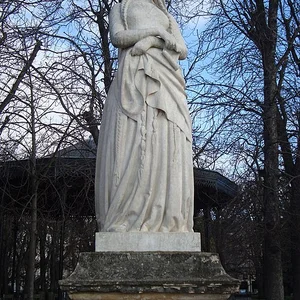

A Gallo-Roman religious woman of the 5th century, Genevieve became the patron saint of Paris. According to tradition, she rallied the people of Paris in the face of the threat posed by Attila and his Huns in 451, urging them to pray rather than flee.
Saint Genevieve
Saint Genevieve
6 min read
Frequently asked questions
Key Facts
- Born around 420 in Nanterre, in Roman Gaul
- In 451, she is said to have encouraged the people of Paris not to flee from Attila's Huns
- Played a role during the siege of Paris by the Franks of Childeric I
- Died around 502-512, she is buried in Paris; her tomb becomes a place of pilgrimage
- Proclaimed patron saint of Paris, celebrated on January 3rd
Works & Achievements
According to tradition, she convinces the Parisians to stay and pray; the city is spared by Attila, lastingly establishing her reputation.
Organization of a river convoy of grain from Troyes during a famine caused by the Frankish siege, a founding act of her legendary charity.
Driving force behind the construction of a basilica on the tomb of the first bishop of Paris, the origin of the Abbey of Saint-Denis.
Support for the building of the church where Clovis, Clotilde, and she herself would rest, on the hill that would take her name.
Her memory becomes that of the protector of Paris, invoked during epidemics, floods, and invasions throughout the Middle Ages.
Tradition of carrying her relics in procession through Paris to ward off plagues and calamities, which became a major ritual of the city.
Anecdotes
According to the tradition recorded in her Latin Life, Geneviève is said to have met Bishop Germanus of Auxerre around 429, when she was still a child. He reportedly noticed her in the crowd at Nanterre and singled her out as one consecrated to God, marking the beginning of her religious vocation.
In 451, when Attila and his Huns threatened Paris (Lutetia), many inhabitants wanted to flee. Tradition holds that Geneviève urged them to stay, to fast, and to pray, promising that the city would be spared. The Huns did indeed turn away from Paris, which established her renown.
During a siege of Paris by the Franks under Childeric, the city was suffering from famine. Legend recounts that Geneviève is said to have organized a convoy of boats on the Seine to Arcis and Troyes to bring back wheat and feed the starving Parisians.
Geneviève held a deep devotion to Saint Denis, the first bishop of Paris, who was martyred. She is said to have promoted the construction of a first basilica over his tomb, on the site of present-day Saint-Denis.
At her death around 512, Geneviève was buried alongside the Frankish king Clovis and Queen Clotilde in the Church of the Holy Apostles, which she had helped to have built on the hill that today bears her name (the Montagne Sainte-Geneviève, where the Panthéon stands).
Primary Sources
When the rumour spread that Attila, king of the Huns, was laying waste to everything, the inhabitants of Paris, seized with terror, wanted to move their belongings to safety in other towns. Genevieve urged them not to flee, declaring that the cities to which they were thinking of fleeing would be devastated, while Paris, protected by Christ, would be spared.
In the basilica of the holy apostles Peter and Paul, which Clovis and Clotilde had themselves built, rests the blessed Genevieve.
As the city was overwhelmed by famine, Genevieve boarded boats and sailed up the river as far as Arcis and Troyes, from where she brought back grain to feed the starving people.
Key Places
Village in Roman Gaul near Lutetia where Geneviève is said to have been born around 423. It was there that she reportedly met Bishop Germanus of Auxerre.
The city where Geneviève spent most of her life and of which she became the protector. There she is said to have organized the spiritual resistance against the Huns and the food supply during the famine.
A hill on the Left Bank of Paris where the Church of the Holy Apostles was built, the site of her burial. The Panthéon now occupies part of the location.
The site of the martyrdom and tomb of Saint Denis, the first bishop of Paris. Geneviève promoted the construction of a basilica there, the starting point of the future royal abbey.
A town in Champagne, on the river route along the Seine, where tradition places the purchase of the wheat meant to feed the Parisians during the shortage.
The episcopal city of Germanus of Auxerre, a spiritual figure who is said to have recognized and guided Geneviève's vocation when she was a child.
Typical Objects

An emblematic attribute of Genevieve in iconography: a candle that the devil tries to blow out and that an angel relights. It symbolizes the light of faith kept alive despite hardship.

A veil received when she was consecrated as a virgin devoted to God, around the age of fifteen. It marks her entry into religious life.

A medal bearing the image of the cross that, according to tradition, Bishop Germanus gave her at Nanterre as a pledge of her vocation. For her it took the place of jewelry and finery.

A vessel used to sail up the Seine to Troyes and bring grain back to the starving people of Paris. It became an emblem of her charity; the ship still appears on the coat of arms of Paris.

A precious chest meant to hold her relics after her death. Carried in procession through Paris during great calamities (epidemics, floods), the shrine was a major object of medieval devotion.

Bread handed out to the poor and the hungry, a symbol of the asceticism and charity of Genevieve, who herself ate very frugally.
School Curriculum
Vocabulary & Tags
Key Vocabulary
Daily Life
Morning
Rising before dawn, Geneviève devoted her first hours to prayer and the reading of the Psalms. Like the consecrated virgins of her time, she followed a rhythm close to that of monks, punctuated by the daily offices.
Afternoon
Her days were filled with works of charity: visiting the poor and the sick, distributing food, and organizing relief for the people of Paris. She involved herself in the affairs of the city whenever she could ease its suffering there.
Evening
In the evening, she extended her vigils and prayers, often well into the night. Tradition emphasizes her prolonged fasts and her nocturnal prayers, hallmarks of the asceticism of the holy women of Late Antiquity.
Food
Geneviève led a life of extreme frugality: according to her Life, she ate only barley bread and beans, and often took food only twice a week. She abstained from meat and wine as a form of asceticism.
Clothing
She wore the plain garb of consecrated virgins: a long tunic of dark wool and a veil covering her head, without jewelry or ornaments, signs of her renunciation of the world.
Housing
Living in Lutetia, she lodged in a modest dwelling, without the luxury of the wealthy Gallo-Romans. The setting was that of a city of Late Antiquity, blending Roman heritage with the growing presence of the Franks.
Historical Timeline
Period Vocabulary
Liens externes & ressources
Références
Œuvres
Préservation de Paris face aux Huns (451)
451
Ravitaillement de Paris affamée
vers 480
Promotion du culte de saint Denis
vers 502
Église des Saints-Apôtres (future Sainte-Geneviève)
vers 510
Patronage spirituel de Paris
à partir du VIe siècle
Procession de la châsse
Moyen Âge