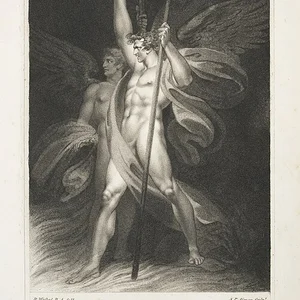

Supreme archangel of the Abrahamic traditions, commander of the heavenly armies and protector of Israel in the Hebrew Bible. Victor over Satan in the Book of Revelation, he is venerated in Judaism, Christianity, and Islam.
Archangel Michael
Archangel Michael
8 min read
Frequently asked questions
Key Facts
- First mentioned in the Book of Daniel (c. 165 BCE) as the protector of Israel
- In the Book of Revelation (ch. 12), he leads the angels against the dragon-Satan and casts him out of heaven
- In Islam, he is known as Mikail, entrusted with nourishing bodies and souls
- His Catholic liturgical feast is celebrated on September 29 (together with Raphael and Gabriel)
- Mont-Saint-Michel in Normandy is dedicated to him, founded in the 8th century following an apparition in 708
Works & Achievements
A foundational text presenting Michael as the 'great prince' and protector of Israel. The first named mention of an archangel in Scripture, and the cornerstone of all Michaeline theology.
The account of the heavenly war in which Michael defeats the dragon-Satan. This text fixed for centuries the image of the archangel as a warrior and triumphant figure in the Christian imagination.
An Essene text describing an eschatological war between the sons of light, led by Michael, and the sons of darkness. It reveals the central importance of Michael within currents of ancient Judaism.
Oil on canvas commissioned by Pope Leo X, now held at the Louvre. A masterpiece of the Italian Renaissance depicting Michael as a celestial warrior, and the defining reference work of Michaeline iconography.
A major architectural ensemble of Norman Romanesque and Gothic art, built in honor of the archangel. A symbol of French medieval Christendom and a masterpiece of monastic architecture.
A great Flemish altarpiece in which Michael appears in the Last Judgment scenes holding the scales of souls. A masterwork of 15th-century Flemish painting, housed in Ghent.
Anecdotes
In the Book of Daniel (c. 165 BCE), Michael is introduced as the 'great prince' and protector of Israel, tasked with defending the Jewish people against hostile heavenly powers. This is one of the earliest instances in sacred scripture where an angel is given both a name and a specific mission.
According to the Book of Revelation (late 1st century CE), Michael leads the heavenly armies against the dragon — a symbol of Satan — and casts him out of heaven. This cosmic battle has inspired countless works of art, from Raphael to Rubens, cementing Michael's status as the supreme warrior angel.
In the 5th century, the archangel is said to have appeared on Monte Gargano in southern Italy, leading to the founding of the Sanctuary of Monte Sant'Angelo — one of the first great Christian pilgrimage sites dedicated to Michael. The site is today a UNESCO World Heritage landmark.
In 708, according to tradition, the Archangel Michael appeared to Bishop Aubert of Avranches, commanding him to build a sanctuary on a rocky island off the coast of Normandy. That place would become Mont-Saint-Michel, an icon of medieval France and a masterpiece of Gothic architecture.
In Islam, Michael (Mika'il in Arabic) is one of the four great angels mentioned in the Quran. He is entrusted with rain and sustenance, ensuring that God's creatures are nourished. His mention in Surah Al-Baqara (2:98) reflects his importance across all three Abrahamic faiths.
Primary Sources
"At that time shall arise Michael, the great prince who has charge of your people."
"But when the archangel Michael, contending with the devil, was disputing about the body of Moses, he did not presume to pronounce a blasphemous judgment, but said, 'The Lord rebuke you.'"
"Now war arose in heaven. Michael and his angels fighting against the dragon. And the dragon and his angels fought back, but he was defeated, and there was no longer any place for them in heaven."
"Whoever is an enemy to God and His angels and His messengers and Gabriel and Michael — then indeed, God is an enemy to the disbelievers."
"The archangel appeared and said: I am Michael the Archangel, who stands continually before God. This place I have chosen to be honored and invoked."
Key Places
Sanctuary founded in 708 according to tradition following an apparition of the archangel. A major medieval pilgrimage site and architectural symbol of France, inscribed on the UNESCO World Heritage List.
The first western sanctuary dedicated to Michael, founded after his legendary apparition in 492. A major pilgrimage site of the early Middle Ages, inscribed on the UNESCO World Heritage List.
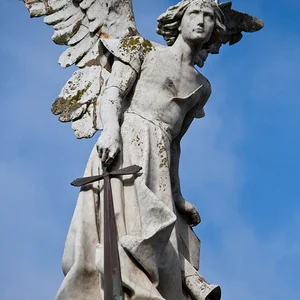
Hadrian's mausoleum converted into a papal fortress, topped by a statue of Michael sheathing his sword. The building commemorates the vision of Gregory the Great that marked the end of the plague of 590.
A rocky islet off the Irish coast home to a 6th-century Celtic monastery dedicated to Michael. An extreme pilgrimage destination, bearing witness to the spread of the Michaelic cult across Northern Europe.
Archaeological site where the Dead Sea Scrolls were discovered in 1947, containing Essene texts such as the War Scroll, which describes Michael as the commander of the heavenly armies.
Typical Objects

Michael's primary martial attribute, symbolizing divine justice. In medieval and Renaissance depictions, he wields this sword to vanquish Satan or weigh the souls of the dead.

Michael is depicted holding scales to weigh souls at the Last Judgment, determining their heavenly or infernal fate. This attribute links him to traditions of judging the dead found also in ancient Egypt.

As commander of the heavenly armies, Michael is often depicted clad in Roman or medieval soldier's armor, emphasizing his warrior role as protector against evil.

The dragon crushed beneath Michael's foot is the symbol of Satan's defeat, drawn directly from the Book of Revelation. This element is ubiquitous in his iconography across the centuries.

In the Christian tradition, Michael is sometimes associated with the trumpet of the Last Judgment that will awaken the dead. This attribute presents him as the herald of the end of times.

In certain liturgical representations, Michael carries a lily or royal scepter, signifying his purity and his rank as prince of the heavenly armies in the angelic hierarchy.
School Curriculum
Vocabulary & Tags
Key Vocabulary
Tags
Daily Life
Morning
As a celestial, non-human figure, Michael has no daily life in the earthly sense. In mystical texts, he is described as standing perpetually before the divine throne, ready to carry out God's will from the dawn of creation. Medieval monks devoted to him would begin their day with the Office of Lauds, praying to the archangel to protect them through the coming day.
Afternoon
Theological tradition portrays Michael as ceaselessly watching over the cosmos, arbitrating celestial conflicts and guarding the souls of the faithful. In the medieval liturgical cycle, his intervention is invoked during exorcisms and spiritual battles, which clergy would often perform mid-day during the offices of Terce and Sext.
Evening
In the evening, at monasteries such as Mont-Saint-Michel or Monte Sant'Angelo, monks would chant Vespers and Compline in honor of the archangel, entrusting him with the keeping of souls through the night. Michael is especially associated with the moment of death, watching over the passage of the soul between this world and the next.
Food
As an angelic being, Michael does not eat. However, apocryphal texts describe angels as sustaining themselves through divine contemplation and the light of the Creator. In accounts of his earthly apparitions, he never consumes food, underscoring his radically non-human nature.
Clothing
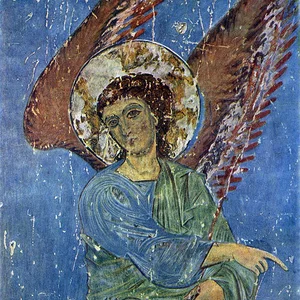
Michael is depicted in the armor of a celestial warrior — Roman or medieval breastplate, greaves, and helmet — symbolizing his military function. His great white wings mark his angelic nature, while a royal purple cloak emphasizes his rank as prince of the heavenly host in the hierarchy of angels.
Housing
Michael dwells in heaven, closest to the divine throne according to biblical and apocryphal texts. On earth, his 'residences' are the sanctuaries built in his honor: naturally elevated sites (Monte Gargano, Mont-Saint-Michel, Skellig Michael) that symbolize the ascent toward God, often situated at the boundary between heaven and earth.
Historical Timeline
Period Vocabulary
Visual Style
Direction artistique inspirée des enluminures médiévales et de la peinture religieuse byzantine et renaissante, avec une palette de bleus profonds, d'or et de vermillon, baignée d'une lumière sacrée dramatique.
Sound Ambience
Atmosphère de solennité sacrée mêlant chants grégoriens, cloches monastiques et écho de batailles célestes, évoquant à la fois la majesté du paradis et la puissance guerrière de l'archange.
Liens externes & ressources
Références
Œuvres
Livre de Daniel (Bible hébraïque)
vers 165 av. J.-C.
Apocalypse de Jean
vers 95 apr. J.-C.
Manuscrits de la mer Morte — Règle de la Guerre (1QM)
Ier siècle av. J.-C.
Saint Michel terrassant le dragon — Raphaël
1518
Le Mont-Saint-Michel — abbaye bénédictine
XIe-XVIe siècle
Polyptique de l'Agneau Mystique — Jan van Eyck
1432