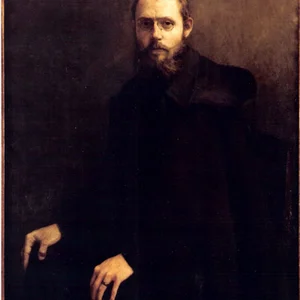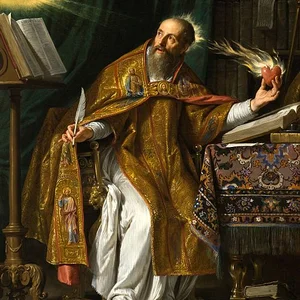

Christian theologian and philosopher of the 4th century, bishop of Hippo in North Africa. Author of the Confessions and The City of God, he is one of the most influential Latin Fathers of the Church in the history of Christianity.
Augustine of Hippo(354 — 430)
Augustine of Hippo
Rome antique
9 min read
Frequently asked questions
Famous Quotes
« Our heart is restless until it finds its rest in you.»
« You have made us for yourself, O Lord, and our heart is restless until it rests in you.»
« Love, and do what you will.»
Key Facts
- 354: Born in Thagaste (present-day Algeria)
- 386: Converts to Christianity after a long intellectual quest
- 396: Becomes bishop of Hippo
- 397–400: Writes the Confessions, the first spiritual autobiography in the Western world
- 430: Dies in Hippo during the Vandal siege
Works & Achievements
An autobiographical account in thirteen books tracing Augustine's spiritual journey from birth to conversion. Considered the first great autobiographical text in Western literature, it is still read and studied worldwide today.
A vast apologetic work in twenty-two books written in response to the sack of Rome in 410. Augustine develops a theology of history contrasting the earthly city, founded on self-love, with the heavenly city, founded on the love of God; this text laid the foundations of medieval political thought.
A theological treatise in fifteen books on the mystery of the Christian Trinity, which seeks to find its traces in the structure of the human soul. A landmark work of Latin theology, it profoundly influenced medieval scholasticism.
The most voluminous of Augustine's works, composed of sermons and commentaries on each of the 150 biblical Psalms. It reveals his method of allegorical interpretation of Scripture and his deep piety.
A handbook of biblical hermeneutics and Christian rhetoric defining how to interpret and communicate the Scriptures. This foundational text established the rules of preaching and exegesis for the entire Middle Ages.
A critical review of his entire written output, in which Augustine revisits his texts to correct errors or refine positions. A unique document from Antiquity, it testifies to his commitment to intellectual rigor until the very end of his life.
Anecdotes
Before his conversion, Augustine led a dissolute life and kept a concubine for fifteen years, with whom he had a son, Adeodatus. In his Confessions, he recounts having prayed: "Lord, grant me chastity and continence, but not yet." This line reveals with humor and honesty his inner struggle between desire and faith.
Augustine was first drawn to Manichaeism, a dualistic religion that opposed good and evil as two equal forces. He adhered to it for nine years before uncovering its intellectual contradictions through a debate with the Manichaean bishop Faustus of Milevis, whose poor arguments left him deeply disappointed.
His definitive conversion took place in 386, in a garden in Milan, when he heard a child's voice repeating "Tolle, lege" (take up and read). He opened Paul's epistles at random and was struck by the passage he read. He was baptized the following year by Ambrose of Milan during the Easter Vigil of 387.
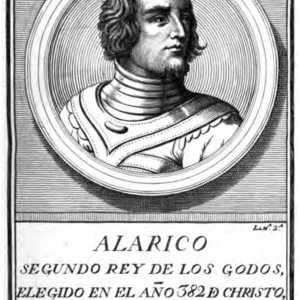
When Alaric's Visigoths sacked Rome in 410, many blamed Christians for having weakened the Empire by abandoning the ancient gods. Augustine responded by writing The City of God, a monumental work in twenty-two books refuting this charge and proposing a new vision of human history grounded in divine Providence.
Augustine died in August 430 as the Vandals were besieging Hippo. He was seventy-five years old and had led his diocese for thirty-four years. According to his biographer Possidius, he had the penitential psalms written on the walls of his room so he could read them until his final moments, weeping continuously.
Primary Sources
Our heart is restless, until it repose in Thee. Thou madest us for Thyself, and our heart is restless, until it repose in Thee.
Two cities have been formed by two loves: the earthly by the love of self, even to the contempt of God; the heavenly by the love of God, even to the contempt of self.
For now we see through a glass, darkly; but then face to face. Now I know in part; but then shall I know even as also I am known.
What you cannot do, confess it; what you can do, accomplish it. What you do not yet have, ask for it. For without me you can do nothing.
It is for this reason that we pray — so that our desire may be exercised and expanded, that it may be capable of receiving what we are being prepared to obtain.
Key Places
Augustine's hometown in Numidia, a Roman province in North Africa. He was born there in 354, received his early education, and founded a monastic community upon his return from Italy in 388.
The intellectual and religious capital of Roman Africa, where Augustine studied rhetoric from 370 to 383. He also taught there and took part in the great conference of 411 that condemned Donatism.
Capital of the Western Roman Empire in the 4th century, where Augustine secured a chair of rhetoric in 384. It was in Milan that he met Ambrose, converted in a garden in 386, and was baptized in 387.
A coastal city in Numidia where Augustine was ordained a priest in 391 and then bishop in 396. He led his diocese there for thirty-four years, wrote the bulk of his work, and died there in 430 during the Vandal siege.
The port of Rome where Augustine's mother, Monica, died in 387, shortly after his baptism. He lived there with her and shared a celebrated mystical experience he describes in the Confessions: a joint contemplation by a window, known as the 'Vision of Ostia'.
Typical Objects

Augustine wrote on parchment codices, a format that was gradually replacing papyrus scrolls. He dictated much of his work to secretaries (notarii) and owned a considerable library, which he bequeathed to his Church.

An essential tool of the ancient scholar, the calamus (a sharpened reed) was used to write on wax tablets or parchment. Augustine would revise his own texts and maintained an extensive correspondence with hundreds of people across the Empire.

As a bishop, Augustine wore the liturgical vestments proper to his office when presiding over Masses and baptisms. North African episcopal dress in the 5th century was simple — white linen — without the richness of later Byzantine garments.

Olive oil lamps lit the long nights of work and monastic prayer. Augustine often worked at night in his cell, meditating on the Scriptures or dictating his treatises by the flickering light of these small earthenware lamps.

Augustine had a particular devotion to the Psalms of David, which he commented on in his Enarrationes in Psalmos, one of his most voluminous works. According to his biographer Possidius, as death approached he had the penitential psalms inscribed on the walls of his room.

Used for provisional notes, drafts, and teaching, these wax-coated tablets could be erased and reused. Augustine used them to prepare his sermons and lectures before writing up a fair copy on parchment.
School Curriculum
Vocabulary & Tags
Key Vocabulary
Daily Life
Morning
Augustine rose at dawn to celebrate Mass and sing Lauds with his monastic community. At Hippo, he had established a common life for the diocesan clergy, inspired by the monastic communities he had known. The morning was devoted to the Eucharist, the Liturgy of the Hours, and the reading of Scripture.
Afternoon
In the afternoon, Augustine administered ecclesiastical justice (audientia episcopalis), receiving parishioners involved in disputes according to the Roman practice that granted bishops a judicial role. He also dictated letters, treatises, and sermons to his secretaries, and received visitors who came from across the Empire to debate theology.
Evening
In the evening, after Vespers, Augustine dined in community in a refectory where a rule forbade gossip but permitted reading aloud. He then devoted part of the night to personal study, writing his works, or meditating on the Psalms by the light of an oil lamp.
Food
Augustine led a sober life and advocated frugality. The basic meal in Roman North Africa consisted of spelt or barley bread, vegetables, olives, cheese, and dried fish. Meat was rare and reserved for guests. North African wine was consumed diluted with water, in small quantities.
Clothing
As bishop, Augustine wore a white linen tunic (tunica), a dalmatic, and a dark cloak (pallium) during liturgical services. In daily life, he dressed in a simple monastic robe, brown or grey, in contrast to the elaborate clothing of certain prelates whom he criticized. Clerical tonsure was practiced, though its exact form still varied at the time.
Housing
Augustine lived in the episcopal residence (domus episcopi) adjoining the basilica of Hippo, which he had transformed into a communal home for his clergy. The buildings were constructed of fired brick on Roman foundations, with inner courtyards (atrium) shaded by vines and fig trees, providing coolness and a place for contemplation.
Historical Timeline
Period Vocabulary
Visual Style
Afrique du Nord romaine tardive : lumière ocre et chaude, architecture de brique et de pierre, intérieurs de basiliques ornés de mosaïques, style alliant réalisme romain et iconographie paléochrétienne.
Sound Ambience
Ambiance sonore d'Hippone au Ve siècle : mer Méditerranée, basilique chrétienne avec chants liturgiques latins, scriptorium monastique, vie urbaine romano-africaine.
Liens externes & ressources
Références
Œuvres
Confessions (Confessiones)
397-400
La Cité de Dieu (De civitate Dei)
413-426
De la Trinité (De Trinitate)
399-419
Commentaires sur les Psaumes (Enarrationes in Psalmos)
392-422
De la doctrine chrétienne (De doctrina christiana)
396-426
Rétractations (Retractationes)
426-427