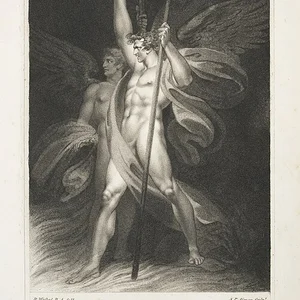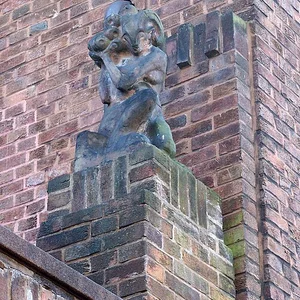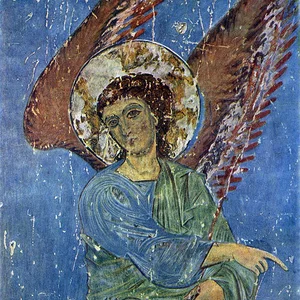

Archangel and divine messenger present in all three monotheistic religions. In Christianity, he announces to Mary the birth of Jesus. In Islam, he reveals the Quran to the prophet Muhammad.
Archangel Gabriel
Gabriel
8 min read
Frequently asked questions
Key Facts
- In the Hebrew Bible (Book of Daniel, ~165 BCE), Gabriel appears to interpret the visions of the prophet Daniel
- In the Gospel of Luke (~80 CE), Gabriel announces to Mary that she will conceive Jesus — this is the Annunciation
- In Islam, Gabriel (Jibril) reveals the Quran to Muhammad between 610 and 632 CE
- Gabriel is one of the few angels named by name in all three sacred texts of the Abrahamic religions
- He is often depicted carrying a white lily in medieval Christian iconography, a symbol of purity
Works & Achievements
A fresco in the convent of San Marco in Florence depicting Gabriel kneeling before Mary. A masterpiece of Renaissance Christian art, it has become one of the most reproduced images of the angelic figure.
A painting housed in the Uffizi Gallery in Florence, showing Gabriel delivering the divine message to Mary in an idealized garden. The delicate rendering of the wings and light makes it one of the pinnacles of Renaissance painting.
An English epic poem in which Gabriel appears as the leader of the guardian angels of Paradise. Milton gives him a warrior and protective role, greatly enriching his depiction in Western culture.
The Quran, transmitted by Gabriel to the Prophet Muhammad, is considered in Islam to be the direct word of God. Gabriel is explicitly mentioned as the bearer of divine revelation.
A collection of mosaic representations in the basilicas of Ravenna, Constantinople, and Rome depicting Gabriel in his primary roles. These works established angelic iconography throughout the Eastern Christian world.
A Jewish apocryphal text that ranks Gabriel among the archangels and assigns him specific functions: he is notably appointed over celestial fire and serpents. This text has profoundly influenced the theology of angels across all three Abrahamic religions.
Anecdotes
In the Gospel of Luke, Gabriel appears to the priest Zechariah in the Temple of Jerusalem to announce the birth of John the Baptist. Zechariah, filled with doubt, is struck mute until his son is born — Gabriel's way of confirming the truth of the divine message.
In the Quran, Gabriel (Jibril) appears to Muhammad in the Cave of Hira, near Mecca, around 610 CE. He commands the Prophet three times to 'recite' (iqra'), even though Muhammad could not read — the revelation is thus presented as a miraculous act of direct transmission of divine knowledge.
In the Book of Daniel (6th century BCE), Gabriel is tasked with explaining to the prophet the meaning of complex apocalyptic visions concerning the fall of kingdoms. It is one of the first biblical texts to explicitly name an angel, marking a turning point in Jewish theology.
According to Islamic tradition, Gabriel accompanies Muhammad during the Night Journey (Isra and Mi'raj), a spiritual ascension through the seven heavens. Gabriel acts as guide and intercessor, presenting the Prophet to biblical figures such as Abraham, Moses, and Jesus.
In medieval Christian iconography, Gabriel is almost always depicted holding a white lily at the Annunciation — a flower symbolizing Mary's purity. This pictorial convention spread throughout Europe from the 12th century onward and remains instantly recognizable to this day.
Primary Sources
The angel said to him: 'I am Gabriel. I stand in the presence of God, and I have been sent to speak to you and to bring you this good news.' (Luke 1:19) [...] 'You will conceive and give birth to a son, and you are to call him Jesus.' (Luke 1:31)
I heard a man's voice from the Ulai calling out, 'Gabriel, tell this man the meaning of the vision.' [...] He said: 'I am going to tell you what will happen later in the time of wrath.' (Daniel 8:16–19)
Say: 'Whoever is an enemy to Gabriel — it is he who brought it down upon your heart by permission of Allah, confirming what came before it and as guidance and good tidings for the believers.' (Quran 2:97)
And these are the names of the holy angels who watch: Uriel [...] Raphael [...] Raguel [...] Michael [...] Saraqael [...] Gabriel [...] and Remiel. (1 Enoch 20:1–8)
He [Gabriel] embraced me very tightly until I could bear it no more, then released me and said: 'Read!' I replied: 'I cannot read.' He then embraced me tightly a second time [...] then said again: 'Read in the name of your Lord who created.'
Key Places
The place where Gabriel appears to the priest Zechariah to announce the birth of John the Baptist, according to the Gospel of Luke. This temple, the center of Jewish worship, represents the point of contact between the divine and the human.
The site of the first Quranic revelation: it is here that Gabriel appears to Muhammad to deliver the first verses of the Quran around 610 CE. This site is one of the holiest in Islam.
The city where, according to the Gospel of Luke, Gabriel appears to Mary to announce that she will be the mother of Jesus. The modern basilica is built on the traditional site of Mary's home.
The setting of the prophet Daniel's visions, which Gabriel interprets and gives meaning to. This place symbolizes the exile of the Jewish people and the context in which angelic theology emerged in the Bible.
A site associated with several angelic appearances in the Gospels and in Jewish and Christian eschatological traditions. The figure of Gabriel is linked to the prophetic announcements connected to this place.
Typical Objects

Gabriel's most famous iconographic attribute in Christian art, the lily symbolizes purity and divine grace. It appears in almost every depiction of the Annunciation since the Middle Ages.

Gabriel is often depicted carrying a scroll or parchment, symbolizing the divine message he conveys. This symbol underscores his role as messenger and bearer of the sacred Word.

In eschatological tradition (the end of times), Gabriel is associated with the trumpet whose blast will announce the Last Judgment. This attribute appears in Byzantine art and medieval iconography.

In certain Byzantine and Islamic representations, Gabriel carries a scepter or staff symbolizing his authority as a heavenly messenger and his status as God's envoy.

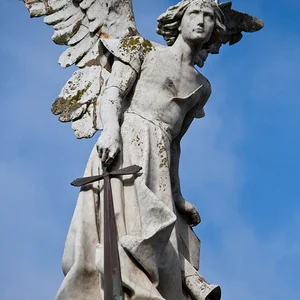
A universal attribute of angels across all three Abrahamic religions, Gabriel's wings evoke his celestial nature and his ability to cross the boundary between the divine world and the human world.

Gabriel is frequently depicted surrounded by light or bearing a luminous nimbus, symbolizing his divine nature and the splendor of the message he carries. In Islamic accounts, his first appearance to Muhammad is described as dazzling.
School Curriculum
Vocabulary & Tags
Key Vocabulary
Tags
Daily Life
Morning
Being beyond human time, Gabriel has no morning in the ordinary sense. In sacred texts, he is described as ever-watchful and ever-ready before God, prepared to be sent at any moment. His 'day' begins when he receives a divine mission.
Afternoon
Gabriel carries out his mission with precision and solemnity: he appears before the chosen human (prophet, priest, virgin), delivers the divine message with clarity, then withdraws. Each apparition is brief but decisive, altering the course of sacred history.
Evening
In Jewish and Islamic mystical traditions, angels spend eternity praising God in the heavens. Gabriel, once his mission is complete, is described as returning before the divine throne to take part in the eternal celestial liturgy.
Food
Gabriel is a spiritual being and has no diet in the human sense. Some apocryphal texts speak of angels nourishing themselves on divine contemplation and heavenly light — a metaphor for their immaterial nature.
Clothing
In Christian iconography, Gabriel is clothed in long white or golden robes, symbolizing purity and divine glory. Byzantine depictions add a royal purple mantle. In Islamic art — where figurative representation is rare — his radiant light serves as his garment.
Housing
Gabriel dwells in the heavens, alongside God and the other archangels, according to all three monotheistic traditions. The Book of Enoch describes a celestial palace of crystal and fire. This dwelling symbolizes the eternal abode of divine light, beyond the reach of ordinary mortals.
Historical Timeline
Period Vocabulary
Visual Style
Style inspiré des mosaïques byzantines et de la peinture de la Renaissance italienne : lumière dorée, drapés fluides blancs et or, halos rayonnants sur fond de ciel azur ou d'architecture sacrée.
Sound Ambience
Ambiance de sanctuaire sacré, mêlant le silence des temples de pierre, le vent du désert et la résonance de prières en hébreu ou en arabe. Une présence sonore à la fois solennelle et céleste.
Liens externes & ressources
Références
Œuvres
L'Annonciation (Fra Angelico)
vers 1440-1445
L'Annonciation (Léonard de Vinci)
vers 1472-1475
Le Paradis perdu (John Milton)
1667
Sourate Al-Baqara — Révélation coranique
vers 610-632 apr. J.-C.
Mosaïques byzantines de la Nativité et de l'Annonciation
IVe-XIIe siècle
Livre d'Hénoch — Chapitre des Veilleurs
IIe siècle av. J.-C.