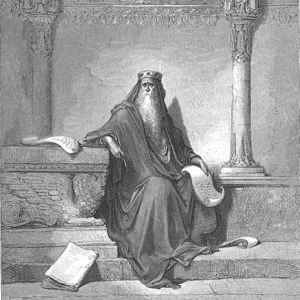

King of Israel (c. 970–931 BCE), son of David, renowned for his legendary wisdom and for building the Temple in Jerusalem. A major figure in the Hebrew Bible, he embodies justice and knowledge in the Judeo-Christian tradition.
Frequently asked questions
Famous Quotes
« Then two women who were harlots came to the king and stood before him. The one woman said, 'Oh, my lord, this woman and I live in the same house; and I gave birth to a child while she was in the house. Then on the third day after I gave birth, this woman also gave birth. And we were alone; there was no one else with us in the house, just the two of us in the house. This woman's son died in the night, because she lay on it.'»
« The heart of the wise inclines to the right, but the heart of the fool to the left.»
Key Facts
- c. 970 BCE: ascension to the throne of Israel following his father David
- c. 966–960 BCE: construction of the Temple of Jerusalem, the kingdom's main religious sanctuary
- Famous judgment involving two women both claiming a child: he proposes to cut the child in two in order to identify the true mother
- Visit of the Queen of Sheba, symbolizing the kingdom's diplomatic and commercial relations
- c. 931 BCE: death of Solomon and division of the Kingdom of Israel
Works & Achievements
A landmark architectural and religious achievement, the Temple became the spiritual center of the Kingdom of Israel. Its construction symbolizes the pinnacle of Solomon's reign and the religious unification of Israel.
A collection of maxims and practical wisdom passed down through biblical tradition. This work embodies Solomon's legendary reputation as a master of wisdom and justice.
A lyrical biblical poem celebrating love and beauty, traditionally attributed to Solomon. This work holds a unique place in ancient Hebrew literature.
Solomon divided the kingdom into 12 districts for efficient administrative management and strengthened central authority. This reform consolidated royal power and ensured the stability of the kingdom.
Solomon established major trade routes and forged alliances with neighboring kingdoms, most notably Egypt. These policies enriched Israel and secured its economic prosperity.
A biblical philosophical work exploring the meaning of life and the vanity of human endeavors. This book reflects a reflective and critical wisdom attributed to Solomon.
Anecdotes
Solomon inherited the throne of Israel after the death of his father David around 970 BCE. According to the Bible, he prayed to God asking not for wealth or power, but for wisdom to govern his people well. This request earned him his legendary reputation as a wise king, capable of delivering fair and just judgments.
King Solomon is famous for building the Temple of Jerusalem, the most important place of worship in ancient Judaism. Constructed around 960–950 BCE, the Temple reportedly took seven years to complete and required thousands of workers. It became the religious and political heart of the kingdom of Israel.
Solomon greatly expanded and enriched the kingdom of Israel by developing trade, most notably with the Queen of Sheba, a region in what is now southern Arabia. These commercial and diplomatic exchanges made his reign a period of economic prosperity and international prestige for Israel.
Solomon's famous judgment involving two women both claiming the same baby illustrates his proverbial wisdom: he proposed cutting the child in two, which revealed the true mother — who gave up her claim rather than see her child killed. This story, told in the Bible, shows how Solomon used intelligence to uncover the truth.
By the end of his reign, Solomon had reportedly amassed enormous wealth in gold and silver, and according to biblical accounts had 700 wives and 300 concubines. This opulence reflects the power of the kingdom in the 10th century BCE, though some details were likely embellished by tradition.
Primary Sources
King Solomon exceeded all the kings of the earth in riches and in wisdom. And all the kings of the earth sought the presence of Solomon, to hear his wisdom, which God had put in his heart.
Solomon said to God: You have shown great steadfast love to David my father, and have made me king in his place. O LORD God, let your promise to David my father now be fulfilled.
I prayed, and understanding was given me; I called upon God, and the spirit of wisdom came to me.
A list of conquered cities including references to Levantine kingdoms contemporary with Solomon, attesting to the existence of organized kingdoms in Israel.
Key Places
Capital of the Kingdom of Israel and seat of Solomon's royal power. It was in Jerusalem that he established his court and governed his kingdom.
A major monument built during Solomon's reign (around 960–950 BCE). This temple, known as the First Temple, became the religious and symbolic heart of ancient Judaism.
Birthplace of his father David and an important region of Solomon's kingdom. It symbolizes the origins of the Davidic dynasty, of which Solomon was the heir.
Region in the northern part of the Kingdom of Israel where Solomon established military garrisons and administrative centers to consolidate his power.
A commercial port on the Red Sea (Gulf of Aqaba) developed under Solomon to promote maritime trade and exchange with neighboring kingdoms.
Phoenician city with which Solomon maintained important commercial and diplomatic relations, particularly for the supply of building materials for the Temple.
Typical Objects

A major architectural monument built during Solomon's reign, a symbol of his power and wisdom. This temple served as the religious and political center of the ancient Kingdom of Israel.

A royal seat adorned with ivory and gold, emblematic of Solomon's power and wealth. It represents the magnificence of his court and his status as a wise and prosperous king.

A sacred chest containing the Tablets of the Law, placed at the heart of the Temple of Jerusalem during Solomon's reign. It symbolizes the covenant between God and the people of Israel.

A ring or amulet engraved with the royal seal, associated with the wisdom and magical powers attributed to the king in legend. This symbol became iconic in esoteric traditions.

Instruments used to record Solomon's laws, judgments, and wisdom. They represent his role as a wise lawgiver and renowned judge throughout the ancient Near East.

Tunics and cloaks dyed purple — a rare and precious color in antiquity — marking the distinctive sign of royal status. They reflect the wealth and prestige of Solomon's court.

Precious materials imported via the trade routes Solomon controlled, used during Temple ceremonies. They symbolize the kingdom's thriving commerce and abundant riches.

A symbolic instrument representing Solomon's fair judgment and wisdom, for which he was celebrated throughout the ancient world. It embodies his role as a wise monarch, arbitrator, and judge.
School Curriculum
Vocabulary & Tags
Key Vocabulary
Tags
Mythologie
Daily Life
Morning
Solomon begins his day before dawn with ritual ablutions, a religious practice common among Israelite kings. He then proceeds to the royal court, where advisors and scribes await him to handle the administrative affairs of the kingdom. Judicial hearings also begin in the late morning, with Solomon delivering judgments in accordance with the Torah and the customs of the realm.
Afternoon
The afternoon is devoted to royal audiences, overseeing the construction of the Temple in Jerusalem, and conducting trade negotiations with neighboring kingdoms. Solomon supervises the building works and receives the ambassadors and merchants who pass through the gates of the royal palace. Formal meals may be served in the early afternoon, bringing together the court and visiting dignitaries.
Evening
In the evening, Solomon takes part in royal banquets with his court — occasions to strengthen political alliances and assert his authority. He may consult scribes and sages on matters of governance and law. Before sunset, prayers and offerings at the Temple mark the close of the day, in keeping with the religious practices of the kingdom of Israel.
Food
Solomon enjoys the rich diet typical of the Levantine elite: fine bread, meats (lamb, goat), fish from the coast, fruits (dates, grapes), honey, and vegetables. Wine is consumed regularly at royal banquets, either imported or produced locally. Olive oil, cheese, and aromatic herbs round out a diet that reflects his status as a powerful king.
Clothing
Solomon wears garments of fine linen dyed in purple and red — symbols of royal power in the 10th century BCE. An embroidered tunic, an ornate belt, and a royal cloak make up his official appearance. He adorns himself with royal insignia, gold jewelry, and diadems, marking his dignity and both his political and religious authority.
Housing
Solomon resides in a royal palace in Jerusalem, an impressive structure built with stone and cedar from Lebanon. The palace includes several courtyards, audience halls, private apartments, and storage areas for tributes and goods. Close by stands the Temple of Jerusalem, whose construction he oversees — together, the two buildings form the administrative and religious heart of the kingdom of Israel.
Historical Timeline
Period Vocabulary
Visual Style
Un style mêlant l'art miniaturiste persan, les mosaïques byzantines et les enluminures médiévales, avec des ornements géométriques complexes, des tonalités chaudes dorées et des bleus profonds. Une ambiance solennelle et spirituelle évoquant la sagesse royale et la splendeur du Temple.
Sound Ambience
Une ambiance sonore majestueuse et spirituelle évoquant le Temple de Jérusalem sous le règne du Roi Salomon, mêlant rituels sacrés, travaux de construction et la sérénité de la cour royale de l'Antiquité.
Liens externes & ressources
Références
Œuvres
Construction du Temple de Jérusalem
vers 960-950 av. J.-C.
Livre des Proverbes
compilation tardive, attribuée à Salomon
Le Cantique des Cantiques
attribué à Salomon, datation incertaine
Réorganisation administrative du royaume
vers 970-931 av. J.-C.
Expansion commerciale et alliances diplomatiques
vers 970-931 av. J.-C.
L'Ecclésiaste (Qohélet)
attribué à Salomon, datation incertaine