 flip
flipʻIka ota
ʻIka ota
Why this dish? Raw fish in coconut cream is the quintessential daily meal of the Tongan islands. Salote, though queen, remained deeply attached to the food practices of her people. ʻIka ota was prepared on the shores of Tongatapu with the morning's catch — a dish the queen shared equally with her court and with fishermen during her village tours.
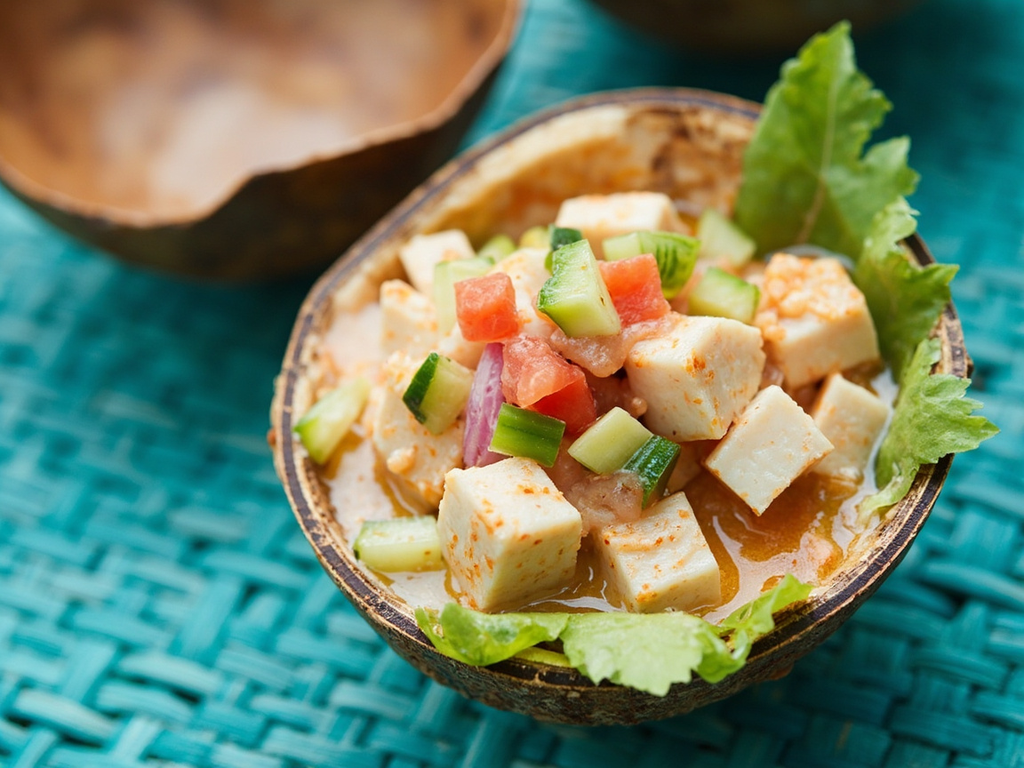
Raw fish marinated in lime juice until it whitens, then coated with fresh coconut cream with diced cucumber, tomato, and onion. Fresh, bright, and nourishing — the Pacific ceviche.
ʻIka ota is the sea coming to us, barely transformed. Our fishermen of Tongatapu bring in tuna or snapper in the morning, and by noon it is in the bowl, whitened by the lime, softened by the lolo. I know no more honest dish. It only needs the fish to be fresh and the coconut ripe — the rest, the sea and the sun have already done. When I travel to Auckland or London, it is always this simple taste that brings me back home.
- •Very fresh white fish or tuna — One nice fillet per person (Base of the dish)
- •Limes (laimi) — Enough to cover the fish (Acid cooking)
- •Fresh coconut cream (lolo) — One good pressed bowl (Creamy sauce)
- •Cucumber — One, diced (Freshness and crunch)
- •Tomato — One, small dice (Mild acidity)
- •Onion — Half, finely sliced (Pungency)
- •Salt — A pinch (Seasoning)
ʻIka ota
Raw fish marinated in lime juice until it whitens, then coated with fresh coconut cream with diced cucumber, tomato, and onion. Fresh, bright, and nourishing — the Pacific ceviche.
Why this dish? Raw fish in coconut cream is the quintessential daily meal of the Tongan islands. Salote, though queen, remained deeply attached to the food practices of her people. ʻIka ota was prepared on the shores of Tongatapu with the morning's catch — a dish the queen shared equally with her court and with fishermen during her village tours.
ʻIka ota is the sea coming to us, barely transformed. Our fishermen of Tongatapu bring in tuna or snapper in the morning, and by noon it is in the bowl, whitened by the lime, softened by the lolo. I know no more honest dish. It only needs the fish to be fresh and the coconut ripe — the rest, the sea and the sun have already done. When I travel to Auckland or London, it is always this simple taste that brings me back home.
Ingredients (period version)
- Very fresh white fish or tuna — One nice fillet per person (Base of the dish)
- Limes (laimi) — Enough to cover the fish (Acid cooking)
- Fresh coconut cream (lolo) — One good pressed bowl (Creamy sauce)
- Cucumber — One, diced (Freshness and crunch)
- Tomato — One, small dice (Mild acidity)
- Onion — Half, finely sliced (Pungency)
- Salt — A pinch (Seasoning)
Ingredients
- Tuna or sea bream fillet (sashimi quality) — 400 g (Base of the dish)
- Limes — 6 to 8 (about 150 ml juice) (Acid cooking)
- Thick coconut cream — 200 ml (Sauce)
- Cucumber — 1 medium, seeded, diced (Freshness)
- Tomato — 1 medium, small dice (Acidity)
- Red onion — ½, finely sliced (Pungency)
- Fine salt — ½ tsp (Seasoning)
- Fresh chili (optional) — ½, seeded, sliced (Heat (modern addition))
Method
- Cut the fish into 2 cm cubes. Place in a non-metallic bowl.
- Squeeze the limes and pour the juice over the fish until covered. Lightly salt.
- Marinate in the refrigerator for 20 to 30 minutes: the fish should become opaque on the surface but remain slightly translucent in the center.
- Drain the lime juice (the fish should not be swimming in liquid).
- Add cucumber, tomato, and onion. Gently mix.
- Pour cold coconut cream over everything and mix one last time.
- Serve immediately in half coconut shells or bowls, well chilled.
How it was made : ʻIka ota is attested throughout the Pacific in variations (raw fish in coconut milk). In Tonga, it was prepared without refrigeration — the fish caught in the morning was marinated and consumed within the hour. Tomato and onion, introduced by European missionaries and traders in the 19th century, were well integrated into Tongan cuisine by Salote's time.
The contemporary twist : Serve in a polished half coconut shell, with a few local herbs (cilantro or flat-leaf parsley) and grated lime zest on top.
Sources : Pollock, Nancy J. « These Roots Remain: Food Habits in Islands of the Central and Eastern Pacific since Western Contact ». University of Hawaii Press, 1992. · Churchward, C. Maxwell. « Tongan Dictionary ». Government Printing Press, Tonga, 1959.
Salote Tupou III · Charactorium