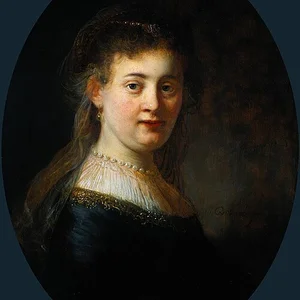

Saskia van Uylenburgh (1612-1642) was the wife and favorite model of the painter Rembrandt. Born into a Frisian patrician family, she inspired numerous portraits, drawings, and etchings by the Dutch master during the years of his success.
Saskia van Uylenburgh(1612 — 1642)
Saskia van Uylenburgh
Provinces-Unies
6 min read
Frequently asked questions
Key Facts
- Born in 1612 in Leeuwarden (Friesland) into a patrician family, the daughter of a burgomaster
- Married Rembrandt van Rijn in 1634
- Posed for numerous works by Rembrandt, including 'Saskia as Flora' (1634)
- Gave birth to Titus in 1641, the only one of her four children to survive
- Died in 1642 and was buried in the Westerkerk in Amsterdam
Works & Achievements
An intimate portrait made three days after their engagement; one of the most famous works associated with Saskia as a model.
A painting in which Rembrandt depicts his wife as the goddess of spring, crowned with flowers, a symbol of youth and fertility.
A joyful double portrait showing the couple feasting, the painter raising his glass and Saskia seated on his lap.
A series of prints that make Saskia one of the recurring models in Rembrandt's etched work.
Tender sketches of Saskia bedridden during her pregnancies and illness, bearing witness to the intimacy of the household.
Anecdotes
Saskia van Uylenburgh met Rembrandt through her cousin Hendrick van Uylenburgh, an art dealer with whom the young painter was lodging in Amsterdam. A few days after their engagement in 1633, Rembrandt made a small silverpoint drawing showing Saskia wearing a wide flowered straw hat, with an inscription noting that he had sketched her three days after their betrothal.
Saskia had four children with Rembrandt, but three died in infancy. Only their son Titus, born in 1641, survived. This succession of bereavements deeply affected the couple, and Saskia herself died at only 29, a few months after Titus was born, probably of tuberculosis.
In her will, Saskia left her fortune to Titus while granting Rembrandt the use of the assets, on the condition that he did not remarry. This clause had heavy consequences: later, Saskia's family kept watch over the inheritance money, which complicated the painter's already fragile financial situation.
Rembrandt depicted Saskia in a wide variety of roles: the goddess Flora crowned with flowers, a biblical figure, or simply a smiling wife. The famous painting sometimes called “Rembrandt and Saskia in the Scene of the Prodigal Son” shows them both merry at the tavern, the painter raising his glass, Saskia seated on his lap.
Born into a wealthy patrician family from Frisia, Saskia brought a substantial dowry and a social network that helped Rembrandt establish himself in Amsterdam's high society. Her father, Rombertus van Uylenburgh, had been burgomaster of Leeuwarden and had known William of Orange.
Primary Sources
“This is a portrait of my wife, at the age of 21, drawn on the third day after our betrothal, on 8 June 1633.”
Saskia names her son Titus as sole heir, leaving her husband Rembrandt the usufruct of the estate for as long as he does not remarry.
Rembrandt van Rijn, of Leiden, and Saskia van Uylenburgh, of Leeuwarden, declare their intention to marry.
Key Places
Capital of Friesland where Saskia was born in 1612 into an influential patrician family.
Major merchant city of the United Provinces where Saskia lived with Rembrandt and where she died in 1642.
Frisian village where Saskia and Rembrandt married in 1634, near the young woman's family.
Vast residence bought by the couple in 1639 in Amsterdam's Jewish quarter, today the Rembrandthuis museum.
Amsterdam's oldest church, where Saskia was buried after her death in 1642.
Typical Objects

Flower-trimmed headwear worn by Saskia in Rembrandt's betrothal drawing. An elegant accessory of well-to-do ladies of the Dutch Golden Age.

A fine metal instrument used to trace delicate lines on prepared paper. Rembrandt used it for his portrait of Saskia in 1633.

A refined piece of jewellery worn in several portraits of Saskia, a sign of the Uylenburgh family's wealth and patrician taste.

The formal attire of wealthy Dutch townswomen, made of costly fabrics and white embroidered collars. Saskia wears similar ones in her portraits.

A metal plate bitten by acid, used to print prints. Rembrandt engraved several portraits of Saskia using this technique.

A green stemmed glass used for wine in well-off Dutch households. Rembrandt raises one in the double portrait of the couple at the tavern.
School Curriculum
Vocabulary & Tags
Key Vocabulary
Daily Life
Morning
As the wife of a prosperous painter, Saskia woke up in a well-kept house staffed with servants. Her morning might begin by overseeing the household, caring for the children and getting dressed, before posing for Rembrandt in his studio bathed in northern light.
Afternoon
In the afternoon, she received relatives and acquaintances from Amsterdam's polite society, or managed domestic affairs. She also served as a model, posing in a variety of costumes for her husband's portraits, drawings and etchings.
Evening
In the evening, the couple shared a meal and sometimes festive moments, as shown in the double portrait at the tavern. They read, played music or discussed the collections of art and curiosities that Rembrandt accumulated.
Food
Wealthy Dutch people of the Golden Age ate bread, cheese, butter, herring and other fish, meats and vegetables from the polders. Imported wine and beer accompanied meals, while spices and exotic fruits brought by trading ships were a sign of wealth.
Clothing
Saskia wore the rich fabrics of the patrician women: dresses of dark velvet, white lace collars and cuffs, ornate hats and pearl jewellery. These costly garments displayed the high status of the **Uylenburgh** family.
Housing
The couple lived in a vast house on the **Breestraat**, bought in **1639**, spread over several floors with a studio, reception rooms and collections of works of art. It was a dwelling typical of Amsterdam's notables, rich in paintings, prints and curiosities.
Historical Timeline
Period Vocabulary
Liens externes & ressources
Références
Œuvres
Saskia coiffée d'un chapeau de paille (dessin à la pointe d'argent)
1633
Rembrandt et Saskia dans la scène du fils prodigue à la taverne
vers 1635
Portrait de Saskia (gravures et eaux-fortes)
1634-1642
Saskia au lit (dessins de la maladie)
vers 1640-1642