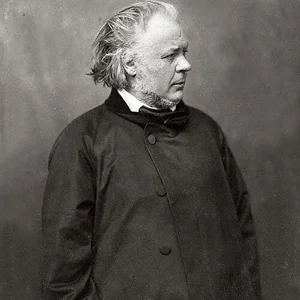

Honoré Daumier (1808-1879) was a French engraver, caricaturist, painter and sculptor. A master of lithography, he ferociously sketched the political and social life of his time, becoming one of the greatest satirists of the 19th century.
Honoré Daumier(1808 — 1879)
Honoré Daumier
France
6 min read
Frequently asked questions
Famous Quotes
« One must be of one's own time.»
Key Facts
- Born in Marseille in 1808, died in Valmondois in 1879
- In 1831 he published the caricature “Gargantua” depicting King Louis-Philippe, which earned him six months in prison in 1832
- Contributed to the satirical newspapers “La Caricature” and then “Le Charivari” from the 1830s onward
- Produced about 4,000 lithographs over the course of his career
- Creator of realist paintings that remained little known during his lifetime, such as “The Third-Class Carriage” (around 1862)
Works & Achievements
Lithograph showing Louis-Philippe as a giant devouring the people's wealth; it lands Daumier in prison.
Satirical gallery of the majority's deputies dozing on their benches, a pinnacle of political caricature.
A harrowing print denouncing a massacre, regarded as a masterpiece of socially engaged art.
A talkative swindler embodying the corruption and business spirit of the age, an immense popular success.
Series of sculpted caricature busts of politicians, the models for his caricatures.
Painting depicting poor travelers with compassion; a major work of his rediscovered art as a painter.
Canvases tirelessly revisiting Cervantes' hero, their freedom heralding modern painting.
Lithograph series mocking lawyers and magistrates, a biting satire of the judicial world.
Anecdotes
In 1832, Daumier published in the journal *La Caricature* a lithograph titled *Gargantua*, depicting King Louis-Philippe as a giant swallowing bags of gold taken from the people. The courts sentenced him to six months in Sainte-Pélagie prison: the caricature unsettled even the highest levels of the State.
To mock Louis-Philippe without naming him, Daumier and his friends gradually drew his plump face in the shape of a pear. The “pear” became the secret symbol of an entire opposition press, and a piece of political wit understood by all.
Around 1832, Daumier modelled a series of small busts in unfired clay, the *Célébrités du Juste Milieu*, grotesque caricatures of deputies and politicians. He used them as models for his lithographs, sketching the real faces from the Chamber of Deputies.
His painting *Don Quixote*, which he reworked endlessly, and his canvases long went unrecognised: people saw in him only a caricaturist. At the end of his life, nearly blind and poor, it was the painter Camille Corot who gave him a house in Valmondois so that he would not be turned out.
In 1834, after a shooting on Rue Transnonain where the troops massacred the inhabitants of a building, Daumier created *Rue Transnonain*: a dead worker on the ground, crushing the body of his child. The print, of chilling realism, was seized and destroyed by the police.
Primary Sources
Rue Transnonain, 15 April 1834.
Leaf through his work, and you will see passing before your eyes, in their fantastic and striking reality, all the living monstrosities a great city contains. Daumier has taken his art very far; he has made it a serious art; he is a great caricaturist.
Daumier is sentenced to six months' imprisonment and a fine for having incited hatred and contempt of the king's government.
Gallery of caricature portraits of the leading figures of the majority, modelled from life by Mr. Daumier.
Key Places
Daumier's birthplace, which he left as a child when his family moved to Paris to follow his father, a glazier and poet.
The city where Daumier spent most of his life, observing society and producing his thousands of lithographs for the satirical press.
The institution where Daumier served six months in detention in 1832 for his caricature Gargantua, deemed offensive to the king.
Site of the 1834 massacre that Daumier immortalized in a print denouncing the military repression.
The village where Daumier ended his life in a house given to him by his friend Corot, and where he died in 1879.
Typical Objects

Polished limestone block on which the artist draws with a greasy crayon before printing. Daumier covered thousands of them to produce his press caricatures.

Greasy-leaded crayon used to trace the drawing onto the stone. Its supple line allowed Daumier his powerful shadows and expressive faces.

Printing machine that transfers the ink from the stone to the paper under strong pressure. It made it possible to print illustrated newspapers in the thousands of copies.

Small caricatural sculptures modelled after the deputies and ministers. Daumier used them as three-dimensional models for his lithographs.

Symbolic caricature of Louis-Philippe's face turned into a pear. Having become a rallying sign of the opposition, it was scrawled on walls like a piece of political graffiti.

Illustrated satirical daily that published a full-page lithograph every day. It was the main outlet for Daumier's printed work for decades.

Tools of his little-known practice as a painter, which he developed above all in the second half of his life. With their free handling, his canvases foreshadow modern art.
School Curriculum
Vocabulary & Tags
Key Vocabulary
Daily Life
Morning
Daumier rises early in his Parisian studio to keep pace with the press, which often demands one lithograph a day. He reads the newspapers and sketches the previous day's events onto his limestone.
Afternoon
In the afternoon, he observes the street, the law courts, or the Chamber of Deputies, notebook in hand, to capture faces and attitudes. Back in the studio, he turns these sketches into satirical compositions.
Evening
In the evening, he carries his stones to the printing house of *Le Charivari* and chats with Philipon and the other draughtsmen. In his later years, he devotes his evenings to painting, far from the constraints of the newspaper.
Food
Daumier leads the modest life of a Parisian craftsman: bread, soup, ordinary wine, and simple bistro fare. In his final years of poverty, his everyday meals remain frugal despite the help of his friends.
Clothing
He wears the sober attire of the 19th-century Parisian bourgeois: dark frock coat, waistcoat, collared shirt, and hat. In the studio, a work smock protects his clothes from ink and charcoal.
Housing
He lives in often modest Parisian studios, notably on the Île Saint-Louis. At the end of his life, he occupies a small country house at Valmondois given to him by Corot.
Historical Timeline
Period Vocabulary
Liens externes & ressources
Références
Œuvres
Gargantua
1831
Le Ventre législatif
1834
Rue Transnonain, le 15 avril 1834
1834
Série Robert Macaire
1836-1838
Célébrités du Juste Milieu
1832-1835