
A sea monster of Greek mythology, Scylla was a nymph transformed into a six-headed creature by the sorceress Circe. She devours sailors from her rock in the Strait of Messina, forcing Odysseus to choose between her and the whirlpool Charybdis.
Scylla
Scylla
8 min read
Frequently asked questions
Key Facts
- Scylla is described in Homer's Odyssey (Book XII) as a monster with six heads and twelve legs
- She devours six of Odysseus's companions as he passes through the Strait of Messina
- According to some traditions, she was once a beautiful nymph transformed into a monster by Circe, who was jealous of Glaucus's love for her
- Her name is associated with the Strait of Messina, between Sicily and Italy, a place of real danger for ancient seafarers
- The expression 'between Scylla and Charybdis' still refers today to a choice between two equally dreadful perils
Works & Achievements
The foundational text describing Odysseus's passage between Scylla and Charybdis. It is the primary source of the myth: Homer paints a detailed portrait of the creature and the terrible decision Odysseus must make.
Ovid develops the story of Scylla's transformation by Circe, who is jealous of Glaucus's love for her. This romantic and tragic version left a deep mark on the Western literary tradition.
Virgil revisits the motif of the passage between Scylla and Charybdis during Aeneas's voyage fleeing Troy. The episode confirms the myth's popularity in Rome and its integration into the great Latin epic tradition.
The Argonauts led by Jason also sail near Scylla, guided by the goddess Thetis and the Nereids. This version shows that the myth existed independently of Odysseus and circulated across several heroic cycles.
Compiling Greek myths, Apollodorus synthesizes the various versions of the Scylla myth and places her within the genealogy of sea monsters in Greek mythology, linking her to Phorcys and Crataeis.
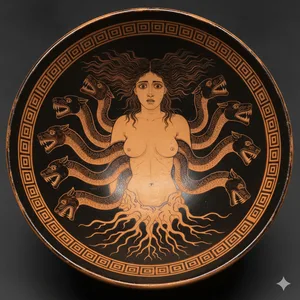
Numerous Greek amphorae and cups depict Scylla as a half-woman, half-dog creature surrounding her waist. These images are invaluable iconographic sources for understanding how the Greeks visualized the monster.
Anecdotes
Scylla was not always a monster: in the most widespread version, she was a beautiful sea nymph. The sorceress Circe, in love with the sea god Glaucus who only had eyes for Scylla, poured poison into the spring where the nymph bathed. Upon touching the poisoned water, Scylla was transformed into a terrifying creature with six howling dog heads and twelve feet.
Scylla occupied a sheer rock in the Strait of Messina, facing the whirlpool Charybdis. Three times a day, Charybdis swallowed and spat back the waters of the sea, threatening to suck in any passing ship. Greek sailors said it was better to lose a few men to Scylla's teeth than to risk an entire crew being swallowed by Charybdis — this is the classic dilemma of 'the lesser evil'.
On his voyage home from Troy, Odysseus was warned by the sorceress Circe about both dangers. He chose to sail close to Scylla rather than Charybdis, losing six of his best companions, snatched one by one by the creature's six jaws. Homer describes their dying cries as the most harrowing sound Odysseus ever heard, and the hero admits he never fully recovered from it.
The expression 'to fall from Charybdis into Scylla' — the equivalent of 'out of the frying pan, into the fire' — perfectly captures the impossible dilemma these two monsters posed for ancient sailors: whichever path they chose, deadly danger awaited them.
In Ovid's Metamorphoses, another version of the myth tells that it was Amphitrite, wife of Poseidon, jealous of Scylla's beauty, who cast the poison into the sea to disfigure her. This variant shows how Greek myths circulated and evolved from one author to another, with each poet adapting the story to their own vision of the gods and of jealousy.
Primary Sources
There, in her cave, she yelped with a shrill voice, like the cry of a young hound. Her twelve feet dangled in the void, and her six enormous necks bore as many hideous heads, each armed with three rows of teeth, set close and dark as death.
Circe poured into the spring harmful and baneful herbs, blending into it juices drawn from roots of mysterious power, and over them chanted an incantation of nine hundred verses in a dark tongue. Scylla came to the spot, and had barely waded in up to her waist when she saw barking monsters surrounding her flanks.
On the right looms Scylla, on the left insatiable Charybdis. Three times she sucks the vast waves down into her deep abyss, three times she spews them up toward the stars, and her spray lashes the heavens.
Scylla, who was a woman from the waist up, had in place of thighs six heads of terrifying dogs. She dwelt upon a rock and seized men from passing ships.
The sea monsters guarding the straits are a sign that the gods watch over the passages between the known world and the lands of the beyond.
Key Places
A maritime passage between Sicily and Calabria, identified since antiquity as the setting of the myth of Scylla and Charybdis. The powerful currents and natural whirlpools that form there most likely inspired the legend.
A small coastal town in Calabria whose name comes directly from the myth. A rocky promontory jutting into the sea is still identified as Scylla's rock, and the town has made it the emblem of its local identity.
The legendary island where the sorceress Circe lived, identified with Monte Circeo on the Tyrrhenian coast of Italy. It was here, according to the myth, that the curse was cast which transformed Scylla into a monster.
The body of water between the Italian peninsula, Sicily, and Sardinia, and the main setting for Odysseus's voyages. Scylla symbolically guarded its southern entrance, representing the boundary between known waters and the unknown sea beyond.
The city where Odysseus's long journey home began, providing the narrative backdrop of the Odyssey. Without the Trojan War and Odysseus's forced voyage by sea, his encounter with Scylla would never have taken place.
Typical Objects

Scylla dwelt in a cave carved into the side of a rock so tall that its peaks vanished into the clouds. This smooth, impenetrable rock served as her lair, from which she stretched her six necks toward the ships passing below.

In tradition, creatures born of magical curses were associated with invisible bonds: Scylla was 'chained' to her rock by Circe's curse, unable to leave it and condemned to devour sailors for eternity.

According to Ovid's Metamorphoses, Circe used a cup or phial to pour her magical poisons into the spring where Scylla bathed. This object symbolizes the power of pharmaka — the magical drugs and herbs of Greek mythology.

The wooden ships of Greek sailors, fragile and low in the water, were ideal prey for Scylla. She would wait for a vessel to come within reach and seize the oarsmen with her six jaws without ever leaving her rock.

Each of Scylla's six heads was armed with three rows of sharp teeth described as black and closely set. These fangs are the symbol of her deadly nature and of the impossibility for any sailor to escape her grasp once seized.

Though distinct from Scylla, the monster Charybdis is inseparable from her: the two creatures together formed a passage spanning the Strait of Messina from one side to the other, forcing sailors to choose their doom.
School Curriculum
Vocabulary & Tags
Key Vocabulary
Tags
Daily Life
Morning
Scylla spends her mornings lurking in her dark cave carved halfway up her rock, six maws hovering just above the waterline. She watches for the first vessels attempting to cross the strait at dawn, when the currents are calmer and sailors believe the passage is safer.
Afternoon
In the middle of the day, when sea traffic is at its heaviest, her six necks stretch out to seize several sailors from different ships at the same time. She devours her prey alive, their screams mingling with the barking of her dog-heads, echoing from one cliff face to the other.
Evening
In the evening, sated or frustrated if no ship dared to pass, Scylla remains bound to her rock by Circe's curse, unable to plunge into the sea. She roars in the darkness while Charybdis churns opposite her, swallowing the waters with a deep, rumbling groan.
Food
Scylla feeds exclusively on sailors and giant fish, which she snatches from the surface of the water with her six maws. Each head can swallow a man whole in a single gulp, and Homer describes the creature as never being able to be satisfied — her hunger as eternal as her curse.
Clothing
As a creature that is part woman, part dog-monster, Scylla wears no clothing in the traditional sense. Her upper half is a bare female torso, while her waist is ringed by snarling dog-heads and her twelve lower limbs resemble tentacles or webbed legs, depending on the source.
Housing
Scylla lives in a deep cave bored into a sheer, vertical cliff — impossible for any human to climb. Her rock towers over the sea at a dizzying height; the cave is perpetually damp, drenched in sea spray and plunged in darkness, suspended halfway between the sea and the sky.
Historical Timeline
Period Vocabulary
Visual Style
Un style dramatique mêlant l'esthétique des vases grecs à figures noires et la peinture épique, dominé par le contraste entre le noir des falaises et l'écume blanche de la mer déchaînée.
Sound Ambience
Les sons de Scylla mêlent le fracas des vagues contre les falaises, les aboiements sinistres émanant de la grotte et les cris des marins pris au piège dans le détroit de Messine.
Liens externes & ressources
Références
Œuvres
Odyssée (Chant XII)
vers 750-700 av. J.-C.
Métamorphoses (Livres XIII-XIV)
8 apr. J.-C.
Énéide (Livre III)
vers 29-19 av. J.-C.
Argonautiques (Livre IV) — Apollonios de Rhodes
vers 270 av. J.-C.
Bibliothèque mythologique — Apollodore
Ier-IIe siècle apr. J.-C.
Céramiques à figures noires et rouges (Grèce antique)
Ve-IVe siècle av. J.-C.