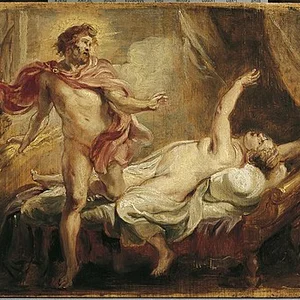

Semele is a princess of Thebes in Greek mythology, daughter of Cadmus and Harmonia. Loved by Zeus, she becomes the mother of Dionysus, god of wine. She perishes struck by lightning after asking to see Zeus in all his divine splendor.
Semele
Semele
6 min read
Frequently asked questions
Key Facts
- Daughter of Cadmus, founder of Thebes, and of the goddess Harmonia
- Loved by Zeus, she conceives the child who will become the god Dionysus
- Deceived by the jealous Hera, she demands that Zeus reveal himself in his divine form and dies struck by lightning
- Zeus saves the unborn child by sewing it into his thigh until full term
- According to some traditions, Dionysus brings her back from the Underworld and raises her to Olympus under the name Thyone
Works & Achievements
The earliest surviving text that presents Semele as the mortal mother of Dionysus. It establishes her place in Greek divine genealogy.
A major tragedy in which Semele's smoking tomb opens the play and justifies Dionysus's revenge against Thebes.
The most famous Latin account of Juno's trick and the death of Semele. It passed the myth on to all of Western culture.
A vast Greek epic that dwells at length on the love affair between Zeus and Semele and the birth of Dionysus.
An English musical work inspired by the myth, which turns her into an ambitious heroine seduced by divine splendor.
An exuberant Symbolist painting depicting the dazzling apparition of Zeus to Semele. It illustrates the 19th century's fascination with this myth.
Anecdotes
To destroy her rival, the goddess Hera disguises herself as an old nurse named Beroë and pays a visit to Semele. She sows a seed of doubt: what if her lover was not really Zeus? She advises her to ask the god to show himself in all his splendor, as proof. The trap is set.
Before learning Semele's request, Zeus had sworn to her, upon the waters of the Styx, that he would grant any wish. And this oath was inviolable, even for the king of the gods. Bound by it, Zeus appears surrounded by his thunderbolts: the princess's mortal body cannot withstand this divine radiance and is instantly consumed.
Semele was six months pregnant when she died. Zeus snatches the unborn child from the flames and sews it into his own thigh until the end of the pregnancy. From this episode comes the expression “born from Jupiter's thigh,” still used today to describe someone who believes they are of prestigious origin.
Once he has become a god, Dionysus does not forget his mortal mother. He descends to the Underworld to wrest her away and brings her up to Olympus among the immortals. There she receives a new name, Thyone, and so passes from the status of a thunderstruck princess to that of a deity.
At Thebes, the ruins of the chamber struck by lightning were still shown in the classical era, regarded as a sacred and forbidden place. Euripides opens his tragedy The Bacchae by evoking this tomb “still smoking” from the flame of Zeus.
Primary Sources
Semele, the daughter of Cadmus, united in love with Zeus, bore him an illustrious son, Dionysus who brings joy: a mortal, she gave birth to an immortal.
Here I am, son of Zeus, in the land of the Thebans, I, Dionysus, whom the daughter of Cadmus, Semele, once brought forth, delivered by the fire of the lightning. Near the palace I see the tomb of my mother, struck down by the thunderbolt, and the smoking ruins of her dwelling.
Her mortal body could not endure the tumult of the ether and was consumed by this nuptial gift.
Deceived by Hera, Semele asked Zeus to come to her just as he had appeared to Hera. Unable to refuse, the god came on a chariot amid lightning and thunder, and hurled the thunderbolt; seized with terror, Semele died.
Key Places
City in Boeotia founded by her father Cadmus, where Semele was born, lived, and died struck by lightning. It is the heart of the Theban cycle of Greek mythology.
A sacred space built on the ruins of her chamber struck by lightning, which remained off-limits to all. Pausanias still recorded its existence in the 2nd century AD.
A wooded mountain near Thebes, a major center of the worship of Dionysus and his Bacchantes. The domain of Semele's son spreads across its slopes.
The realm of the dead where Semele's soul dwelt after her death. Her son Dionysus descended there to bring her back.
The abode of the gods where Dionysus brought his mother, now made immortal. There Semele received the divine name Thyone.
Typical Objects

Zeus's weapon, made of lightning forged by the Cyclopes. It is what consumes **Semele** when the god reveals himself in all his power.

The place where Zeus sews the child snatched from the flames to complete its gestation. This is the origin of the expression “born from Jupiter's thigh.”

A staff topped with a pine cone and wrapped in ivy, the attribute of **Dionysus**, the son of Semele, and of his followers.

Symbols of wine and of **Dionysus**, born of Semele. The vine recalls the divine domain that the son of the Theban princess will bring to humankind.

An evergreen plant associated with the Dionysian cult. It adorns the crowns and the thyrsus in memory of the god born of Semele.

A mark of Semele's royal rank as the daughter of King **Cadmus**. It signals her status as a mortal of very high birth, loved by a god.

A monument raised over the thunderstruck chamber, which became a forbidden place of worship. It embodies the memory of Semele at the heart of the city.
School Curriculum
Vocabulary & Tags
Key Vocabulary
Daily Life
Morning
A princess in the palace of Cadmus, Semele wakes in the women's quarters (the gynaeceum). The morning passes with careful grooming, prayers to the gods who protect the household, and the supervision of the servants who spin wool and prepare the meal.
Afternoon
The afternoon is devoted to the noble domestic crafts: weaving fine cloth, embroidery, and tending to perfumes and oils. Semele also takes part in the religious festivals of Thebes, a city devoted to many cults.
Evening
In the evening, the royal palace hosts banquets where the king receives his guests. Highborn women join in certain festivities, listening to the bards sing of the deeds of gods and heroes, before withdrawing to their chambers.
Food
People eat barley cakes and wheat bread, olives, figs, goat cheese, and honey. Meat—above all the meat from sacrifices—and fish round out the meals; wine cut with water accompanies the feasts.
Clothing
Semele wears the long peplos of wool or linen, fastened at the shoulders with brooches and cinched with a belt. A veil over her head, gold jewelry, a diadem, and bracelets mark her rank as a king's daughter.
Housing
She lives in the palace (megaron) of Cadmus, a vast stone-walled dwelling arranged around a great hall with a central hearth. An inner courtyard, wooden columns, and separate quarters for men and women make up its space.
Historical Timeline
Period Vocabulary
Liens externes & ressources
Références
Œuvres
Théogonie d'Hésiode
VIIIe siècle av. J.-C.
Les Bacchantes d'Euripide
v. 405 av. J.-C.
Métamorphoses d'Ovide (livre III)
v. 8 apr. J.-C.
Dionysiaques de Nonnos de Panopolis
Ve siècle apr. J.-C.
Semele, oratorio de Georg Friedrich Haendel
1744
Jupiter et Sémélé de Gustave Moreau
1895