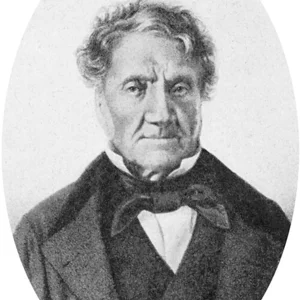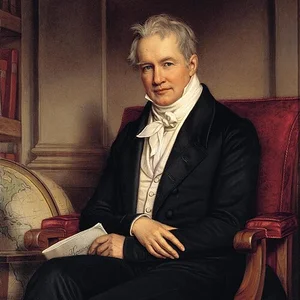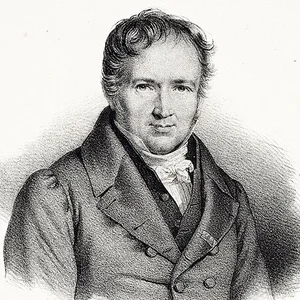

French mathematician and physicist (1781-1840), student of Laplace and Lagrange. He contributed to celestial mechanics, electrostatics, and probability theory, lending his name to the Poisson distribution.
Siméon Denis Poisson(1781 — 1840)
Siméon Denis Poisson
France
8 min read
Frequently asked questions
Key Facts
- 1781: born in Pithiviers
- 1798: enters the École polytechnique, student of Laplace and Lagrange
- 1812: publishes his foundational work on definite integrals
- 1837: publishes 'Recherches sur la probabilité des jugements', introducing the Poisson distribution
- 1840: dies in Sceaux
Works & Achievements
A reference textbook unifying statics and dynamics within a rigorous analytical framework, adopted at the École Polytechnique. Its expanded second edition of 1833 remained a pedagogical standard for several decades in France and abroad.
A major contribution to celestial mechanics in which Poisson demonstrates the approximate stability of the solar system to second order in the planetary masses. This result extended and refined Laplace's foundational work on planetary stability.
A founding text of mathematical physics in which Poisson establishes the Poisson equation (∇²V = −ρ/ε₀), generalizing Laplace's equation. This memoir laid the foundations of theoretical electrostatics and influenced Maxwell half a century later.
A synthesis of Poisson's work on heat propagation, a rival to Fourier's treatise. He develops an original analytical approach to radiant heat and conduction in solids and fluids.
A work in which Poisson applies probability theory to criminal juries and introduces the distribution that bears his name, describing the occurrence of rare events. It is his most celebrated work, with applications today spanning biology, physics, and computer science.
Anecdotes
As a child, Siméon Denis Poisson was first apprenticed in surgery by his father, a provincial health officer. During an unsuccessful stint at his uncle's medical practice, he injured himself so often with the instruments that he was sent home — and finally devoted himself to mathematics, much to the satisfaction of his teachers.
Admitted in 1798 to the École Polytechnique with the highest ranking in his class, Poisson astonished his masters Laplace and Lagrange with his genius. They personally intervened to have him appointed as a répétiteur before he had even finished his studies — an exceptional favor granted solely on the basis of his merit.
Poisson is credited with the now-famous saying: “Life is good for only two things: doing mathematics and teaching mathematics.” The phrase faithfully reflects an entire existence devoted to research and teaching, without interruption from his entry to the Polytechnique until his death in 1840.
The Poisson distribution was first conceived as a simple limiting case of the binomial distribution to model judicial errors, published in 1837 in his Recherches sur la probabilité des jugements. It went on to enjoy unexpected success: today it applies to any rare, repeated phenomenon — from workplace accidents to radioactive emissions to telephone calls.
Appointed a peer of France in 1837 by Louis-Philippe, Poisson was one of the very few scientists of his era to receive a noble title for his scientific work. He sat in the Chamber of Peers until his death, embodying the exceptional prestige accorded to the sciences under the July Monarchy.
Primary Sources
This treatise sets out the principles of statics and dynamics with unprecedented analytical rigor. Poisson brings together and expands upon the work of Lagrange and Laplace to form a body of knowledge accessible to students at the École Polytechnique.
In this memoir, Poisson demonstrates that the secular inequalities of the major axes of planetary orbits cancel out to second order in the masses, contributing to the establishment of the approximate stability of the solar system.
This memoir establishes the mathematical theory of electrostatics. Poisson introduces the equation that bears his name — ∇²V = −ρ/ε — relating the electric potential to the charge density at every point in space.
Poisson develops a probability law for rare events, now known as the Poisson distribution, and applies probability theory to the analysis of judicial decisions in order to evaluate their statistical reliability.
Following in Fourier's footsteps, Poisson develops a comprehensive theory of heat propagation in solids and fluids, refining and challenging certain results put forward by his contemporary.
Key Places
Poisson's birthplace, where he was born on June 21, 1781. His father, a medical officer, practiced there; it was in this provincial setting that young Siméon received his early education before moving to Paris.
Founded in 1794 on the Montagne Sainte-Geneviève in Paris, this institution was the setting for Poisson's entire career: first as a student, then as a tutor, and finally as a professor for forty years. He trained generations of engineers and scientists who spread his methods throughout the world.
Poisson was elected a member in 1812 and presented the majority of his 300 memoirs there. The Académie was the foremost institution of scientific recognition under the Empire and the Restoration, and the principal forum for exchange among European scholars.
An institution established in 1795 to coordinate French navigation and astronomy. Poisson was appointed assistant astronomer there in 1808 and collaborated with the leading astronomers of his time on ephemerides and celestial mechanics.
A commune in the southern suburbs of Paris where Poisson lived in his later years. He died there on April 25, 1840, after a long illness, just weeks before his appointment as president of the Royal Council of Public Instruction.
Typical Objects

An indispensable calculation tool in the 19th century, logarithm tables allowed mathematicians to perform complex multiplications and divisions quickly. Poisson used them daily to verify his analytical results in celestial mechanics and probability theory.

Fundamental geometric instruments for tracing curves and constructing figures. In lectures at the École Polytechnique, they accompanied blackboard demonstrations to make differential equations visually tangible.

The primary scientific writing tool of the era, the quill pen was used to draft the memoirs presented to the Académie des sciences. Poisson wielded one across more than 300 publications throughout his career.

Widely adopted in the grandes écoles born of the Revolution, the blackboard was Poisson's central teaching tool. It allowed him to unfold his demonstrations step by step before his students at the École Polytechnique.

An annual publication containing astronomical ephemerides, edited by the Bureau des Longitudes of which Poisson was a member. He drew from it the observational data needed for his celestial mechanics calculations.

A measuring instrument used in physics experiments in the laboratories of the École Polytechnique. Poisson relied on it during his work on electricity and heat to test theory against experimental observation.
School Curriculum
Vocabulary & Tags
Key Vocabulary
Daily Life
Morning
Poisson rose early and devoted the first hours of the day to desk work: drafting memoirs, analytical calculations, and reading the latest academic communications. His desk, covered in sheets filled with equations, bore witness to uninterrupted intellectual activity from dawn onward, before any official obligations.
Afternoon
Afternoons were generally dedicated to teaching at the École Polytechnique, where Poisson delivered his lectures on mechanics and analysis to carefully selected cohorts of engineering students. He would then review the work of his teaching assistants and occasionally receive colleagues or young researchers who came to present their results.
Evening
In the evenings, Poisson regularly attended the weekly sessions of the Académie des sciences, where he presented his latest work or commented on that of his peers. He also attended scientific dinners hosted at Laplace's home or at the homes of other members of the Institut, informal settings for intense and productive intellectual exchange.
Food
In keeping with the Parisian bourgeoisie of his time, Poisson ate two main meals a day: a substantial lunch around noon (soup, meat, boiled vegetables) and an evening dinner. The food was simple and nourishing, without excess — typical of a scholar little concerned with the pleasures of the table.
Clothing
Poisson wore the standard dress of the scholar-civil servant of the Empire and Restoration periods: a dark tailcoat, buttoned waistcoat, high-tied white cravat, and top hat for official outings. At solemn sessions of the Académie or the Chamber of Peers, he wore the embroidered green coat of the members of the Institut de France.
Housing
In Paris, Poisson lived in a bourgeois apartment in the Latin Quarter, close to the École Polytechnique — typical lodging for a prosperous capital professor. In his later years, he resided in Sceaux, in a suburban house with a garden, escaping the growing bustle of Paris while remaining within reach of his academic duties.
Historical Timeline
Period Vocabulary
Liens externes & ressources
Références
Œuvres
Traité de mécanique
1811
Mémoire sur les inégalités séculaires des moyens mouvements des planètes
1809
Mémoire sur la distribution de l'électricité à la surface des corps conducteurs
1812
Théorie mathématique de la chaleur
1835
Recherches sur la probabilité des jugements en matière criminelle et en matière civile
1837