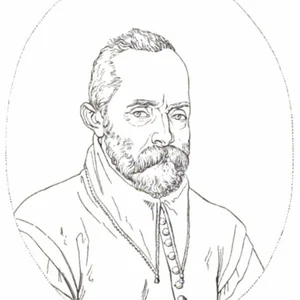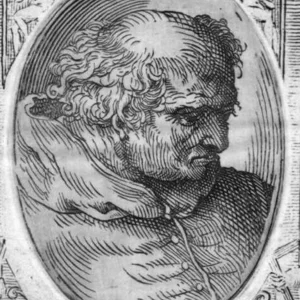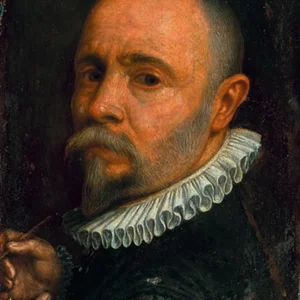

Italian Mannerist painter active in Milan during the second half of the 16th century. Claiming to be a pupil of Titian, he is best known for having trained the young Caravaggio, who was his apprentice from 1584 to 1588.
Simone Peterzano(1540 — 1599)
Simone Peterzano
république de Venise
9 min read
Frequently asked questions
Key Facts
- Born around 1535, probably in Bergamo or the Venetian region
- Trained under Titian in Venice and claimed that connection throughout his career
- Settled in Milan, where he produced frescoes, altarpieces, and devotional paintings
- Took on Michelangelo Merisi, the future Caravaggio, as an apprentice in 1584 for four years
- Died around 1599 in Milan, leaving a body of work influenced by Venetian colorism and Mannerism
Works & Achievements
A vast fresco cycle depicting the life of Christ and the Carthusian saints, adorning the nave of the Milanese charterhouse. A masterpiece by Peterzano, these paintings demonstrate his command of large-scale monumental formats and his Mannerist style infused with Venetian influences.
An altarpiece depicting the Virgin holding the dead body of Christ, preserved in Milan. This work reveals Peterzano's assimilation of the Titianesque model while asserting a personal Lombard Mannerist temperament.
A monumental composition illustrating the influence of Venetian colorism on Peterzano's palette. The spatial organization and treatment of draped figures demonstrate a solid academic mastery, reflecting a teaching approach he would later pass on to his apprentices.
An altarpiece signed "Symon Peterzanus Titiani discipulus pinxit," a valuable source for authenticating his claim of Titianesque lineage. The dramatic intensity of the scene and the quality of the flesh tones reveal a painter deeply concerned with religious emotion in keeping with post-Tridentine precepts.
A decorative ensemble created for the Franciscan church in Milan, one of his earliest major commissions in the city. This work allowed him to establish his local reputation and gain entry into the ecclesiastical patronage networks that would define the bulk of his career.
Anecdotes
In April 1584, a notarial contract was signed in Milan between Simone Peterzano and Lodovico Merisi, uncle of a certain Michelangelo Merisi, aged 12, from the town of Caravaggio. This official document, preserved in the State Archives of Milan, bound the young boy for four years in the master's workshop for 24 imperial lire per year. No one suspected then that this apprentice would become one of the most revolutionary painters in the history of Western art.
Peterzano liked to sign his canvases with the Latin inscription “Titiani discipulus”, proudly claiming to be a pupil of the great Titian. This claim, difficult to verify with certainty, gave him considerable prestige among Milanese patrons. It illustrates how, in the Italian Renaissance, the chain of transmission between masters and pupils was a commercial and artistic argument of the first order.
The frescoes of the Certosa di Garegnano, on the outskirts of Milan, represent Peterzano's masterpiece. Painted between 1578 and 1582, they cover the nave of the church with an impressive narrative cycle blending Venetian influences and Lombard Mannerism. It is in this type of monumental commission that the young Caravaggio undoubtedly observed his master at work and learned the fundamentals of large-scale composition.
A paradox of history: Peterzano, a respected and well-established painter in Milan, is today almost forgotten, while his most famous apprentice revolutionized Western painting. Peterzano's style, elegant and Mannerist, is at the opposite extreme from the dark and dramatic realism that Caravaggio would develop in Rome. Some historians believe that the master's sense of volume rendering and mastery of drapery nonetheless left a lasting mark on the formation of the young Merisi.
Peterzano's workshop was located in a central district of Milan, close to the great noble families and convents that commissioned him. Apprentices there mingled with clients, pigment merchants, and other craftsmen, forming the living microcosm of the artistic world of the late sixteenth century. It was in this daily bustle that the young Caravaggio honed his first skills during four crucial years, before setting off for Rome and immortality.
Primary Sources
Io Simone Peterzano pittore confesso haver ricevuto da messer Lodovico Merisi a conto de la imparanza del suo nepote Michelangelo... per anni quattro prossimi venturi.
Symon Peterzanus Titiani discipulus pinxit.
Al magnifico Simone Peterzano pittore, per le pitture del chiostro grande et della chiesa della Certosa di Garegnano...
A maestro Simone Peterzano pittore per la pala d’altare... lire quaranta imperiali.
Key Places
The city where Peterzano settled permanently around 1573 and where he spent his entire career. Under Spanish rule and the influence of Archbishop Charles Borromeo, Milan was then a vibrant artistic hub shaped by the Counter-Reformation, offering established painters a wealth of religious commissions.
A charterhouse on the outskirts of Milan where Peterzano executed his masterwork between 1578 and 1582: an ambitious fresco cycle covering the nave of the church. It is the most representative monument of his art and very likely the place where the young Caravaggio watched his master work on a grand scale.
The city where Peterzano is thought to have trained in Titian's colorist tradition before moving to Milan. The Venetian influence — warm light, chromatic richness — is clearly visible throughout his painted work and lends credibility to his claim of belonging to the great master's lineage.
The probable birthplace of Peterzano, and also the hometown of the Merisi family from whom Caravaggio takes his nickname. The fact that both master and apprentice were of Bergamasque origin may well have influenced the Merisi family's choice of this workshop.
A Franciscan church in Milan for which Peterzano painted several altarpieces. It illustrates the density of his religious commissions across the parish and convent network of the Lombard metropolis, and bears witness to his successful integration into the city's ecclesiastical circles.
Typical Objects

Oval or rectangular wooden board on which the painter blends pigments ground in linseed oil. Peterzano's palette reflects a chromatic range influenced by Titian, rich in reds, ochres, and muted greens characteristic of Lombard Mannerism.

Large preparatory drawing on heavy paper, pierced with small holes along the outlines, used to transfer the composition onto fresh plaster using the pouncing technique. Essential for large projects such as the Certosa di Garegnano, it allowed a composition developed in the workshop to be faithfully reproduced.

Colored powders of mineral or plant origin — lapis lazuli for blue, vermilion for red, yellow ochre for flesh tones — which apprentices had to grind and mix every morning. Some, such as lapis lazuli, were worth their weight in gold and were strictly counted by the master.

Official document signed before a notary establishing the terms of an apprentice's training in a master painter's *bottega*: duration, remuneration, and mutual obligations. The one binding Peterzano to Caravaggio's family (1584) is one of the most precious documents in the history of Baroque art, preserved in the State Archives of Milan.

Fundamental tools of the painter, made from marten hair fixed to a wooden or bone handle. Their daily upkeep — washing and reshaping the tip — was one of the first tasks entrusted to apprentices in the *bottega*.

Large painting on wood or canvas intended to adorn the back of a church altar, most often depicting a sacred scene. The *pala* was the prestige commission par excellence for a Milanese Mannerist painter like Peterzano, the subject of a detailed contract with the ecclesiastical patron.
School Curriculum
Vocabulary & Tags
Key Vocabulary
Daily Life
Morning
Peterzano begins his day very early, as natural light is indispensable to a painter's work. The apprentices, including the young Caravaggio, are already at work: grinding pigments, preparing mixtures of linseed oil and varnish, stretching canvases, and putting away the previous day's tools. The master inspects the work in progress, gives his instructions for the day, and reserves the most delicate passages — faces, hands, draperies — for his own hand.
Afternoon
In the afternoon, the bottega works in studious silence broken only by the sound of brushes and scrapers. Peterzano sometimes receives noble patrons or priests who come to check on the progress of an altarpiece or discuss a new commission. On major fresco projects such as the Certosa di Garegnano, the team moves to the site to paint on the fresh plaster of each day's giornata, in a precise order dictated by the drying process.
Evening
In the evening, Peterzano lingers over his preparatory drawings in three chalks or red chalk, consulting engravings that disseminate the great Roman and Florentine compositions — drawing inspiration from them without slavishly copying them. The apprentices clean brushes and utensils before closing up the shop. The master sometimes reads theoretical texts — Vasari, the treatises of Alberti — or receives fellow painters to discuss commissions and techniques.
Food
Like most prosperous craftsmen in Milan, Peterzano takes two main meals: a substantial lunch around midday (bread, Lombard cheese, meat in sauce or fish on lean days) and a lighter supper in the evening. White wheat bread is a marker of social status; more modest craftsmen eat dark bread. The regional wine, diluted with water, is consumed throughout the working day.
Clothing
Peterzano wears the dress of a prosperous craftsman: fine wool hose, a dark doublet, and a cape for outings and visits to patrons. In the workshop, he dons an apron or work smock to protect his clothes from pigment and varnish stains. Established master painters set themselves apart from their apprentices by the quality of their fabrics — a visible sign of their social standing.
Housing
Peterzano lives and works in the same large house-cum-workshop situated in a central district of Milan, close to the churches that form his main clientele. The bottega occupies the ground floor: a large, bright room with north-facing windows for consistent light, storage for materials, and space for canvases in progress. Apprentices often sleep on the premises, fed and housed in exchange for their daily work.
Historical Timeline
Period Vocabulary
Liens externes & ressources
Références
Œuvres
Baptême du Christ
vers 1580
Déposition de croix
vers 1570-1580
Cycle de fresques de Sant'Angelo in Milano
vers 1565-1575