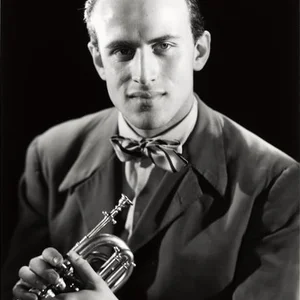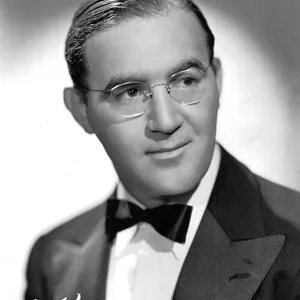

American clarinetist and bandleader (1909-1986), nicknamed “the King of Swing”. He helped bring jazz to mainstream white audiences and racially integrated his bands during the 1930s and 1940s.
Benny Goodman(1909 — 1986)
Benny Goodman
États-Unis
8 min read
Frequently asked questions
Famous Quotes
« If you don't like it, don't listen to it.»
Key Facts
- Born on May 30, 1909, in Chicago, into a family of Polish Jewish immigrants
- In 1935, his band ignited the “Swing Era” with a concert at the Palomar Ballroom in Los Angeles
- In 1938, he performed the first jazz concert at Carnegie Hall in New York, a landmark event in music history
- From 1936, he integrated his band with Black musicians (Teddy Wilson, Lionel Hampton), breaking the color barrier in the music industry
- Died on June 13, 1986, in New York
Works & Achievements
An arrangement of Louis Prima's composition, made legendary by Goodman with Gene Krupa's explosive drumming. This over eight-minute track was the first swing standard to become a mass phenomenon and remains one of the most celebrated pieces in American jazz.
The first jazz concert ever staged at America's most prestigious venue, before a sold-out crowd of 2,800. The recording, rediscovered in 1950, is ranked among the defining musical documents of the 20th century.
A work for clarinet, violin, and piano commissioned by Goodman from Hungarian composer Béla Bartók. That a jazz musician could commission one of the greatest living classical composers speaks to the exceptional prestige Goodman had achieved across musical boundaries.
An autobiographical account in which Goodman recounts his childhood in poverty, his passion for music, and the rise of swing. A valuable historical document on the musical life of America between the two world wars.
A pioneering ensemble bringing together Black and white musicians on stage at a time of widespread racial segregation. This quartet was one of the first public acts of integration in American show business.
Commissioned by the U.S. government, Goodman became the first jazz musician to undertake an official tour of the USSR, illustrating the role of swing as an instrument of cultural diplomacy and a showcase for American freedom during the Cold War.
Anecdotes
On January 16, 1938, Benny Goodman gave the first jazz concert ever held at Carnegie Hall in New York, a temple of classical music. That night, the hall was sold out and the audience, at first reserved, eventually began dancing in the aisles. The recording of this concert, rediscovered in 1950 in a closet, is today considered one of the most important musical documents of the 20th century.
In 1936, Goodman made a revolutionary move for the time: he hired Black pianist Teddy Wilson to perform alongside him on stage, in a country still shaped by racial segregation. He later added vibraphonist Lionel Hampton to the lineup, forming one of the first interracial bands to perform publicly in the United States.
Benny Goodman, the son of Polish Jewish immigrants, began studying the clarinet at the age of ten at Hull House, a social settlement in Chicago. His talent was so evident that he was playing in professional orchestras by the age of thirteen, helping support his very poor family of twelve children.
During his national tour in 1935, Goodman arrived exhausted and discouraged at the Palomar Ballroom in Los Angeles. To his great surprise, the audience — who had heard the orchestra on national radio — was calling for his most rhythmic arrangements. That evening of August 21, 1935 is often cited as the official birth of the Swing Era.
Hungarian composer Béla Bartók composed the work 'Contrasts' in 1938 specifically for Benny Goodman. This unexpected collaboration between the King of Swing and one of the greatest living classical composers spoke to the extraordinary respect the academic world had come to hold for the Chicago clarinetist.
Primary Sources
I was born Benjamin David Goodman on May 30, 1909, in Chicago. I was one of twelve children. Music was the way out for me, the way to get away from the poverty and the hardships of our neighborhood.
Swing held Carnegie Hall in its hot embrace last night. Benny Goodman and his orchestra gave the first jazz concert in the history of that august auditorium, and the audience responded with an enthusiasm that shook the rafters.
I don't think music should be segregated. If a man can play, he can play, regardless of his color. Teddy Wilson is among the finest piano players I have ever heard.
The Goodman band hit Los Angeles last night and the crowd went absolutely wild. Nobody had anticipated this kind of reaction out west, but these young people knew every arrangement by heart.
Key Places
Social center founded by Jane Addams in a working-class neighborhood of Chicago, where the young Benny Goodman learned clarinet for free at the age of ten. Without this access to quality music education, the future King of Swing would likely never have emerged.
Ballroom where, on August 21, 1935, Goodman and his orchestra scored an unexpected triumph that officially marked the beginning of the swing era in America. This event is often called "the night swing was born."
The most prestigious concert hall in the United States, where Goodman gave the first jazz concert in its history on January 16, 1938, definitively establishing jazz and swing as legitimate art forms.
The iconic New York residency of Goodman's orchestra throughout the 1930s and 1940s. Live radio broadcasts from this ballroom helped make Goodman a national star.
Benny Goodman's hometown and a major American musical crossroads in the 1920s, where Delta blues, New Orleans jazz, and the music of European immigrants all converged to shape Goodman's earliest influences.
Typical Objects

Goodman played a Boehm-system B-flat clarinet, which he mastered with exceptional virtuosity, blending classical technique with jazz improvisation. His pure, warm tone made him the most celebrated clarinetist of his era.

Goodman purchased arrangements from Black bandleader Fletcher Henderson, whose rhythmic and sophisticated style formed the backbone of his orchestra's repertoire. These scores were a decisive factor in the commercial success of swing.

The national radio program *Let's Dance* (NBC, 1934–1935) was the launchpad for Goodman's fame, bringing his orchestra into living rooms across America. The studio microphone stands as a symbol of radio's foundational role in popularizing swing.

Goodman's recordings on 78 rpm discs for Columbia and Victor Records reached millions of Americans. "Sing, Sing, Sing" (1937) remains one of the most iconic records of the entire swing era.

On stage, Goodman invariably wore a tuxedo or an elegant dark suit paired with his trademark round glasses, a stark contrast to the flamboyance of some of his contemporaries. This understated style reflected his musical exacting standards and professional seriousness.

As director of his sixteen-piece big band, Goodman conducted from his music stand while simultaneously playing clarinet, combining the roles of virtuoso soloist and demanding leader renowned for his rigor.
School Curriculum
Vocabulary & Tags
Key Vocabulary
Tags
Daily Life
Morning
Benny Goodman rose early and devoted his mornings to intensive classical clarinet practice: scales, technical exercises, and works by Mozart or Weber. A perfectionist well known to his musicians, he maintained a level of virtuosity worthy of the finest classical concert soloists.
Afternoon
Afternoons were given over to rehearsals with the orchestra — often long and grueling, as Goodman had a reputation for being a fearsome taskmaster. He would correct the slightest imprecision in intonation or rhythm, going over the same passages again and again until they met his exacting standard.
Evening
Evenings were spent performing in ballrooms, luxury hotels, or theaters. After shows, Goodman sometimes took part in informal jam sessions with other musicians, but he generally headed home early, showing little interest in the dissolute nightlife that consumed some of his contemporaries.
Food
Having grown up in a poor Ashkenazi Jewish family, Goodman remained attached to the simple dishes of his childhood. Even after becoming famous and prosperous, he frequented good New York restaurants with restraint, eschewing the ostentation his wealth could easily have afforded.
Clothing
On stage, Goodman invariably wore a tuxedo or dark suit paired with his trademark round glasses — markers of his professional seriousness. In everyday life he dressed in a classic, understated way, reflecting a reserved personality that his musicians often described as aloof.
Housing
At the height of his fame, Goodman lived in an elegant Manhattan apartment, far from the working-class Chicago neighborhood where he had grown up. He occasionally hosted classical musicians and composers such as Bartók or Stravinsky there, illustrating the growing permeability between jazz and art music.