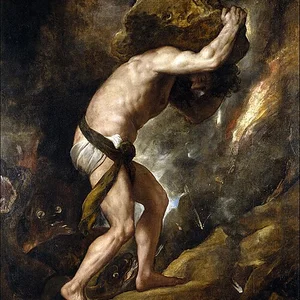

Legendary king of Corinth, Sisyphus is famous for having outsmarted the gods on several occasions. Condemned by Zeus to the Underworld, he must eternally push a boulder to the top of a mountain, from which it rolls back down endlessly.
Sisyphus
Sisyphus
8 min read
Frequently asked questions
Key Facts
- Mythical founder and first king of Corinth
- Renowned for his cunning, he tricked Thanatos (Death) and chained Hades
- Condemned by Zeus to eternally roll a boulder to the top of a mountain
- The boulder rolls back down each time it reaches the summit, dooming Sisyphus to endless toil
- Reinterpreted by Albert Camus in 1942 in *The Myth of Sisyphus* as a symbol of the absurd
Works & Achievements
Sisyphus is credited with founding Ephyra, which would become Corinth, one of the major cities of the ancient Greek world. This founding act makes him as much a civilizing hero as a tragic figure.
A legendary feat by which Sisyphus managed to neutralize Death itself, upending the cosmic order for a time. This act is cited as one of the boldest things a mortal ever dared against the divine powers.
Sisyphus convinced the queen of the Underworld to let him return to the world of the living under false pretenses. This rhetorical feat allowed him to extend his life by several more years, defying fate a second time.
Three great authors of classical Athens each composed a play devoted to Sisyphus, all of which are now lost. Their existence attests to the importance of this figure in Greek tragic culture.
A landmark philosophical essay that reinterprets the myth as a symbol of the human condition in the face of the absurd. Camus argues that one must imagine Sisyphus happy, transforming the ancient condemned man into a figure of lucid revolt.
Anecdotes
Sisyphus once managed to chain up Thanatos, the god of Death, preventing him from carrying out his function. During this time, no one could die on Earth, which threw Olympus into consternation. Ares, god of war, eventually freed Thanatos from his chains — for without death, his battles lost all meaning.
Condemned to descend to the Underworld, Sisyphus had beforehand instructed his wife Merope to offer him no funeral rites. Claiming to Persephone that he needed to return to the surface to correct this 'oversight,' he obtained a pass to leave… and never came back, living many more years before the gods finally caught up with him.
Sisyphus was renowned as the most cunning of mortals, so much so that he managed to deceive Zeus himself by revealing to Asopus the hiding place of his daughter, who had been abducted by the king of the gods — in exchange for a freshwater spring for his city of Ephyra. This betrayal of the divine word earned him an endless punishment in the Underworld.
The French philosopher Albert Camus published in 1942, in the midst of the Second World War, an essay titled The Myth of Sisyphus. For Camus, Sisyphus embodies mankind confronting the absurd: perfectly aware of the futility of his task, he nonetheless repeats it endlessly. Camus concludes that one must imagine Sisyphus happy, for in lucid revolt there lies a form of victory.
According to mythology, Sisyphus was the son of Aeolus, god of the winds, which would explain his elusive and unpredictable nature. He founded the city of Ephyra, which would become the powerful Corinth, one of the most prosperous cities in the Greek world thanks to its strategic position between the Ionian Sea and the Aegean Sea.
Primary Sources
I saw Sisyphus too, condemned to endless agony, pushing a massive boulder with both hands. Bracing with feet and hands, he would heave it up the slope; but just as he was about to roll it over the crest, an irresistible force drove it back, and the pitiless stone came crashing down to the plain.
Sisyphus, the most cunning of men, who knew how to cheat death itself and delay by his wiles the sentence of the gods.
Sisyphus Aeolides saxum sublime volutat: he ceaselessly pushes his heavy boulder, ever on the verge of triumph, ever defeated by the weight of the stone as it rolls back down.
It is said that Sisyphus founded Ephyra, which was later called Corinth, and that by his wife Merope he had a son named Glaucus, who was himself the father of the hero Bellerophon.
I leave Sisyphus at the foot of the mountain! His boulder is always found again. But Sisyphus teaches the higher fidelity that negates the gods and raises rocks. He too considers that all is well. This universe henceforth without a master seems to him neither sterile nor futile. One must imagine Sisyphus happy.
Key Places
A city founded, according to legend, by Sisyphus, which became one of the most powerful city-states in ancient Greece. Located on the isthmus between the Ionian and Aegean Seas, it owed its prosperity to its exceptional commercial and maritime position.
The mythical realm in the depths of the Earth where Sisyphus endures his eternal punishment. Tartarus is the deepest part of the Underworld, reserved for the gravest sinners condemned by the Olympian gods.
A promontory on the Peloponnese considered by the ancient Greeks to be one of the entrances to the underworld. Several heroes descended to the Underworld through this passage, and it is said that Hermes brought Sisyphus back through here to face his punishment.
The home of the Olympian gods, including Zeus, who pronounced Sisyphus's condemnation. It was from Olympus that the gods decided on an exemplary punishment to pay him back for his hubris and repeated acts of deceit.
Typical Objects

The central symbol of the myth, this massive block of stone that Sisyphus must push endlessly embodies divine punishment and futile effort. Its inevitable return to the bottom of the slope has become the universal symbol of the absurd and of the human condition.

Sisyphus used chains to bind Thanatos, the god of Death, in order to escape his fate. This object symbolizes the extreme cunning of the king of Ephyra and his radical refusal to submit to the divine order.

As a legendary king, Sisyphus wielded the scepter, a sign of his authority over the city that would become Corinth. It represents his status as an exceptional mortal, straddling the line between human greatness and punishable *hubris*.

Sisyphus negotiated a miraculous spring for his city from the river god Asopus, in exchange for informing on Zeus. This spring symbolizes the audacious bargaining of mortals with the gods — and its terrible consequences.

Sisyphus had expressly forbidden his wife Merope from performing his funeral rites. The absence of this ritual was the clever pretext he used to persuade Persephone to allow him to temporarily return among the living.
School Curriculum
Vocabulary & Tags
Key Vocabulary
Daily Life
Morning
In his eternal punishment in Tartarus, Sisyphus begins each cycle by gripping his enormous boulder at the bottom of the slope. He gathers all his legendary strength, braces himself with hands and feet, and sets off on the endless climb up the infernal mountain beneath the impassive gaze of the shades.
Afternoon
As the ascent goes on, the effort becomes superhuman. The closer Sisyphus gets to the summit, the more the slope gives way beneath his feet. At the very moment he believes he has finally triumphed, the boulder slips from his grasp, thunders back down the slope, and inexorably returns to its starting point.
Evening
Sisyphus then slowly makes his way back down to the foot of the mountain. It is in this time of return — silent, clear-eyed, inevitable — that the philosopher Albert Camus located the true greatness of the figure: fully aware of his fate, he goes back anyway, without illusion or despair.
Food
As the legendary king of Ephyra, Sisyphus ate as sovereigns of the heroic age did: roasted meats at royal banquets, barley bread, fish caught between the two seas of the isthmus, and wines from Corinth. In the Underworld, the shades neither eat nor drink — only endless suffering remains.
Clothing
As king, Sisyphus wore a fine linen chiton covered by a *himation* of purple wool, a color reserved for rulers. A royal diadem adorned his head at ceremonies, and he carried arms — spear, shield, and bronze sword — in military and ritual contexts.
Housing
Sisyphus resided in the royal palace of Ephyra, richly decorated to the standards of the heroic age: stone columns, colorful wall frescoes, carved wooden furniture, and an inner courtyard open to the sky. His city, built on the Isthmus of Corinth, was an exceptional commercial crossroads, poised between two seas and two worlds.
Historical Timeline
Period Vocabulary
Liens externes & ressources
Références
Œuvres
Fondation d'Éphyra (future Corinthe)
Temps mythiques
L'enchaînement de Thanatos
Temps mythiques
La tromperie de Perséphone
Temps mythiques
Sisyphe — tragédies perdues d'Eschyle, Sophocle et Critias
Ve siècle av. J.-C.
Le Mythe de Sisyphe — Albert Camus
1942