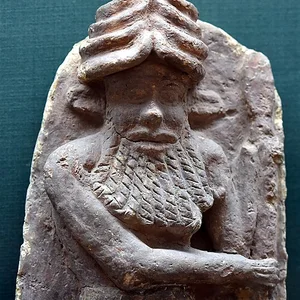

Legendary figure from the Epic of Gilgamesh, created by the gods to be the companion of King Gilgamesh. Born wild and raised among animals, he becomes the hero's inseparable friend before his death triggers the quest for immortality.
Enkidu
Enkidu
9 min read
Frequently asked questions
Key Facts
- Enkidu is a creation of the goddess Aruru, fashioned from clay to be the equal of Gilgamesh (c. 2100 BCE)
- He first lives among wild animals in the steppe, unaware of human civilization
- The sacred prostitute Shamhat initiates him into civilized life, marking his transition from nature to culture
- His friendship with Gilgamesh begins after a fierce fight; together they slay the giant Humbaba and the Bull of Heaven
- His death, a punishment from the gods for killing the Bull of Heaven, drives Gilgamesh to seek immortality
Works & Achievements
Masterpiece of Mesopotamian literature attributed to the scribe Sin-leqi-unninni, considered the oldest literary text in the world. Enkidu is the central character of the first seven tablets, and his death forms the dramatic turning point of the entire epic.
One of the five original Sumerian poems featuring Enkidu. In this text, Enkidu descends into the underworld to retrieve objects belonging to Gilgamesh and is unable to return — a founding theme later revisited in the twelfth Babylonian tablet.
A Sumerian narrative describing Enkidu's death and Gilgamesh's lamentations. This poem is one of the oldest known texts in human history devoted to grief and male friendship.
Intermediate versions of the epic held in two American university collections. They provide significant variants concerning Enkidu's civilizing by Shamhat and his relationship with Gilgamesh.
Translations and adaptations of the Epic of Gilgamesh in the Hittite language, discovered in central Anatolia (present-day Turkey). They demonstrate the international spread of the Enkidu myth throughout the ancient Near East.
Anecdotes
Enkidu was not born of a mother: the goddess Aruru shaped him from clay, in the image of the god Anu, to be the double and rival of King Gilgamesh. Covered in hair like a beast, he lived in the steppe, drinking at watering holes alongside gazelles and aurochs, knowing nothing of the world of men.
The civilizing of Enkidu is one of the most celebrated episodes in the epic: the priestess Shamhat spent six days and seven nights with him in the steppe. When he returned to the animals, they fled from him. Enkidu realized he was no longer the same — he had gained reason but lost his wild instinct.
Enkidu and Gilgamesh first met in single combat at the gates of Uruk. They fought with such ferocity that the city walls shook, before stopping, exhausted and evenly matched. This struggle immediately gave way to a deep friendship — one of the earliest great friendships in world literature.
After slaying the demon Humbaba and the Bull of Heaven sent by the goddess Ishtar, the gods decreed that one of the two heroes must die. Enkidu was chosen. He died of a mysterious illness, first cursing Shamhat for tearing him away from his wild life, then blessing her again at the advice of the god Shamash.
Enkidu's death shattered Gilgamesh. He refused at first to accept his friend's passing, weeping for seven days and seven nights by his side. This inconsolable grief was the catalyst for his quest for immortality, transforming the narrative into a meditation on the human condition and the inevitability of death.
Primary Sources
Aruru washed her hands, took a pinch of clay and cast it into the steppe. In the steppe she created valiant Enkidu, born of silence, fashioned by the power of Ninurta.
Enkidu opened his mouth and said to Gilgamesh: 'My friend, the great gods have assembled in council. Anu said: one of them must die. Enlil said: let it be Enkidu. Gilgamesh shall not die.'
Enkidu opened his mouth and spoke, saying to Gilgamesh: 'My lord, you have not seen the Cedar; you have not looked upon its mountain. I have seen that place and I know the way.'
Enkidu, who knew neither the land nor its people, dressed as they did, and learned to eat bread and drink strong beer.
For Enkidu, his friend, Gilgamesh wept bitterly, wandering the steppe: 'I too shall die — shall I not be like Enkidu? Grief has entered my belly.'
Key Places
Great Sumerian city-state of which Gilgamesh was king. It is at the gates of Uruk that Enkidu first battles Gilgamesh, and it is in this city that he learns to live among men after his encounter with Shamhat.
Wild territory between the two rivers where Enkidu spent his life as a primordial creature, running with the gazelles and drinking from the same watering holes as the animals. The steppe symbolizes the uncivilized world, set against the walled city.
Mythic place guarded by the monster Humbaba, servant of the god Enlil. Enkidu and Gilgamesh traveled there to cut down the sacred cedars and slay Humbaba — a feat that would earn Enkidu the wrath of the gods and ultimately his death.
Major religious center of Sumerian Mesopotamia where the earliest cuneiform poems recounting the adventures of Enkidu and Gilgamesh were written down. The tablets discovered at Nippur are among the oldest known sources of the epic.
Assyrian capital where the library of King Ashurbanipal preserved the tablets of the Epic of Gilgamesh. Rediscovered in 1849 by British archaeologists, these Nineveh copies are the principal source through which the story of Enkidu is known today.
Mythological subterranean realm of Mesopotamian belief where souls dwell in darkness and dust. After his death, Enkidu's shade briefly rises to reveal to Gilgamesh the bleak reality of the land of the dead.
Typical Objects

Weapon of Mesopotamian heroes, Enkidu wields the axe in battles against Humbaba and the Bull of Heaven. It symbolizes the warrior strength he places in service of his friendship with Gilgamesh.

Before being civilized, Enkidu wears animal skins — his only clothing on the steppe. This wild garment contrasts with the woven clothes of Uruk's inhabitants and marks his status as a being on the boundary between animal and human.

The physical medium on which Enkidu's story has been preserved for more than three thousand years. Babylonian scribes carved cuneiform signs with a reed stylus on fresh clay tablets, which were then fired.

Symbolic foods of Mesopotamian civilization that Enkidu receives from Shamhat to enter the human world. Eating bread and drinking beer are cultural acts that now set him apart from animals.

Weapon used by Enkidu during military expeditions alongside Gilgamesh. It represents his transition from wild hunter to a king's companion-in-arms, mastering the techniques of human warfare.

Enkidu's tutelary animal during his wild life: he lived among herds of aurochs and gazelles, drinking at the same watering holes. The aurochs is also the emblematic animal of the city of Uruk, depicted on its Ishtar Gate.
School Curriculum
Vocabulary & Tags
Key Vocabulary
Tags
Lieu
Daily Life
Morning
In his wild life, Enkidu awoke at dawn in the open steppe, among gazelles and aurochs. He had no home: the earth was his bed, the sky his roof. His first activity of the day was to drink at watering holes with the herds, before running with them through the tall grass.
Afternoon
After his civilization by Shamhat and his settlement in Uruk, Enkidu spent his afternoons training in combat alongside Gilgamesh. He accompanied the king in his royal activities, gradually learning the customs and ways of the city — articulated speech, religious rites, and the relationships between men.
Evening
In the evening, Enkidu feasted in the palace of Uruk with Gilgamesh and the city's notables. After a life of eating grass and drinking spring water, he learned to savor barley bread and strong beer, the fundamental foods of Mesopotamian civilization, symbolizing his integration into the human world.
Food
Before his civilization, Enkidu fed exclusively like an animal: wild grasses and plants, water from rivers and ponds. Shamhat taught him to eat bread (divine food according to the Mesopotamians) and to drink fermented barley beer. This radical dietary change symbolically marks his definitive passage from nature to culture.
Clothing
Enkidu lived naked in the steppe, covered only by his abundant body hair, which made him resemble an animal. After his encounter with Shamhat, she gave him part of her own clothing to cover his body. In Uruk, he was dressed like a free man — a wool or linen tunic, sandals — a transformation in dress that sealed his entry into civilization.
Housing
His original dwelling was the Mesopotamian steppe itself — a wild and boundless space, without borders or walls. After his civilization, Enkidu lived in the royal palace of Uruk alongside Gilgamesh. The epic describes Uruk as a city with imposing fired-brick ramparts, its tiered temples (ziggurats), gardens, and storehouses — the absolute antithesis of the infinite steppe.
Historical Timeline
Period Vocabulary
Liens externes & ressources
Références
Œuvres
Épopée de Gilgamesh — version standard babylonienne (12 tablettes)
vers 1300-1200 av. J.-C.
Poème sumérien : 'Gilgamesh, Enkidu et le Monde souterrain'
vers 2100-2000 av. J.-C.
Poème sumérien : 'La Mort d'Enkidu'
vers 2000 av. J.-C.
Tablettes paléo-babyloniennes de Pennsylvanie et de Yale
vers 1800 av. J.-C.
Tablettes hittites de Bogazköy
vers 1400-1200 av. J.-C.