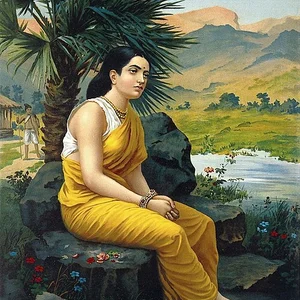

Central heroine of the Ramayana, the Sanskrit epic of the Hindu tradition, Sita is the wife of Rama and the adopted daughter of King Janaka. Born of the earth according to tradition (her name means "furrow"), she embodies purity, faithfulness, and virtue in Indian culture.
Sita
Sītā
8 min read
Frequently asked questions
Famous Quotes
« "Wherever you go, I shall follow, for a wife must accompany her husband like his shadow." (words attributed to Sita by the Ramayana tradition)»
« "Fire itself cannot consume me, for my heart is pure." (words attributed to her during the trial by fire, according to tradition)»
Key Facts
- Daughter of the Earth (Bhūmi Devi) according to tradition, she emerged from a furrow during the ritual plowing of King Janaka's field — a story passed down through oral tradition and later written in the Ramayana
- Wife of Rama, avatar of Vishnu, she is abducted by the demon Ravana and taken to Lanka — the central episode of Valmiki's Ramayana (c. 5th–2nd century BCE)
- She undergoes the "agni pariksha" (trial by fire) to prove her purity after her rescue, an episode that has become a foundational symbol in Hindu culture
- Venerated as a goddess in her own right in certain regions of India, particularly in Bihar (Janakpur, her legendary birthplace, now located in Nepal)
- Her story has inspired countless adaptations (Tulsidas's Ramayana, 16th century; Bharatanatyam dance traditions; Diwali celebrations)
Works & Achievements
A Sanskrit epic of 24,000 couplets divided into seven books, in which Sita is the central female protagonist. It is the founding text of the entire tradition surrounding this character.
A devotional retelling of the Ramayana in Awadhi by the poet Tulsidas, which amplifies Sita's spiritual dimension. A landmark text of bhakti (devotion) that made Sita a figure of popular veneration throughout northern India.
A lyric poem by Tulsidas celebrating the marriage of Sita and Rama at Mithila. This text is still sung during wedding ceremonies in Hindu families across northern India.
A Sanskrit play dealing with Sita's second exile and her final descent into the earth. Bhavabhuti develops Sita's psychology with an emotional depth unprecedented in earlier treatments.
A Tantric variant of the Ramayana in which Sita takes on a terrifying warrior form to defeat a thousand-headed Ravana that Rama cannot overcome. This text reveals the shakta dimension of the character — her nature as divine feminine power.
A collection of annual ritual theatrical performances staged across northern India since the Mughal era, enacting the story of Sita. The Ram-Lila of Varanasi has been inscribed on UNESCO's Intangible Cultural Heritage list since 2008.
Anecdotes
Sita was born from a furrow in the earth: King Janaka discovered her as an infant while plowing a sacred field before a sacrifice. This founding story gives the goddess her name — "sita" means "furrow" in Sanskrit — and makes her a daughter of Mother Earth, Bhumi Devi.
To win Sita's hand in marriage, her suitors had to lift and string the enormous bow of Shiva, which no one had ever been able to move. Rama not only lifted it, but broke it in two, thereby claiming Sita before the entire court of Mithila.
Abducted by the demon Ravana and held captive in Lanka, Sita flatly refused to marry her captor despite his threats and promises. She remained faithful to Rama by placing a single leaf between herself and Ravana during each encounter, a symbol of her unshakeable purity.
Upon her return from captivity, Sita was made to undergo a trial by fire — the agni pariksha — to prove her purity before the people. The fire god Agni shielded her from the flames and returned her unharmed to Rama, bearing witness to her innocence before all.
Exiled a second time by Rama, who yielded to his people's whispers, Sita found refuge in the hermitage of the sage Valmiki. There she raised her twin sons, Lava and Kusha, alone — the very boys who would one day recite the Ramayana before their father, not knowing they were singing their own story.
Primary Sources
Sita, seated beneath the ashoka tree, responds to the messenger Hanuman: 'I am Sita, wife of the virtuous Rama. Tell him that if he does not rescue me within a month, I shall no longer live.'
King Janaka recounts: 'While plowing the sacrificial field, my plow struck something. I dug down and found a radiant little girl, rising from the earth. I named her Sita, daughter of the soil.'
Agni, god of fire, took Sita's hand and declared to Rama: 'Rama, your Sita is pure. Neither in thought, nor in word, nor in deed has she faltered. Receive her.'
Here Sita is presented not merely as a human wife but as the primordial Shakti, divine power made flesh to accompany Vishnu in his avatar as Rama.
Tulsidas writes in Awadhi: 'Sita is the mother of the universe, the source of all virtues; Rama is her lord, the sovereign of the three worlds.'
Key Places
Capital of the kingdom of King Janaka, Sita's adoptive father, where the svayamvara was held at which Rama broke Shiva's bow and won her hand in marriage. The city of Janakpur is home today to the Janaki Mandir temple dedicated to Sita.
Capital of Rama's kingdom, where Sita lived as queen before the exile and where she was ultimately banished during her second exile. Ayodhya is one of the most sacred pilgrimage sites in Hinduism.
A vast forest where Sita, Rama, and Lakshmana spent fourteen years in exile. It was in this forest that Ravana abducted Sita, disguising himself as a wandering monk.
The island fortress of the demon king Ravana, where Sita was held captive in the Ashokavana garden. She endured her captivity for months, sustained by her faith in Rama.
The ashram of the sage Valmiki, author of the Ramayana, where Sita found refuge after her second banishment. It was here that she raised her sons Lava and Kusha, who learned the epic of their father without knowing his identity.
Typical Objects

A colossal divine weapon that only Rama could lift during the svayamvara, the tournament held to choose Sita's husband. Breaking this bow was the founding heroic act of their union.

When Ravana approached her during her captivity, Sita would place a sacred blade of grass between herself and him to embody her absolute refusal. This gesture has become a symbol of her inviolable moral purity.

An ornament Sita gave to Hanuman as a token of authenticity for Rama, proving that the messenger had found her alive in Lanka. This jewel is mentioned in the Sundara Kanda of the Ramayana.

During her second exile in the forest, Sita wore the simple clothing of ascetics, signifying her detachment from royal wealth and her serene acceptance of her ordeal.

An iconographic symbol of Sita in Hindu sculpture, the lotus represents the purity that rises unstained from the mud — a metaphor for her virtue remaining intact despite all the suffering she endured.

The instrument by which King Janaka discovered Sita in the earth during a ritual plowing. The plow appears in depictions of her miraculous birth and recalls her original connection to the fertility of the earth.
School Curriculum
Vocabulary & Tags
Key Vocabulary
Tags
Daily Life
Morning
Sita rose before dawn to perform the morning puja — a ritual bath in the river, offerings of flowers and water to the rising sun, and recitation of Vedic prayers. In the forest of exile, she gathered wild flowers and fruits for the offerings made to the sages who visited the hermitage.
Afternoon
Afternoons were devoted to the tasks of the ashram: weaving flower garlands, preparing ritual offerings, and spinning simple cloth. Sita conversed with the sages and their wives, listening to passages from the Vedas and Upanishads, thus gaining deep spiritual knowledge.
Evening
At dusk, Sita took part in the aarti — the oil lamp ceremony — singing devotional hymns with the other residents of the hermitage. Evenings ended listening to Rama recite sacred texts by the light of a wood fire, in the serenity of the sleeping forest.
Food
Sita's diet in the forest was strictly vegetarian and ascetic: wild fruits, roots, berries, edible leaves, and grains offered by the sages. This simple food followed the rules of hermitage life and symbolized her detachment from royal pleasures.
Clothing
At the court of Mithila, Sita wore rich silk saris in vibrant colors, adorned with gold embroidery and many jewels: necklaces, bracelets, earrings, and the mangalsutra (sacred marriage necklace). In the forest of exile, she wore garments of bark and brown cotton, like the ascetics.
Housing
In the palaces of Mithila and then Ayodhya, Sita lived in the royal women's quarters (antahpura), richly decorated with floral frescoes, silk hangings, and lotus pools. In exile in the forest, she lived in a hut of bamboo and palm leaves built by Rama and Lakshmana beside a river.
Historical Timeline
Period Vocabulary
Visual Style
Style des miniatures indiennes Pahari et Rajput, avec des teintes chaudes d'or, de vermillon et de vert forêt, une ornementation finement détaillée et une sérénité divine caractéristique.
Sound Ambience
Atmosphère sonore de la forêt sacrée indienne : chants védiques, crépitement du feu rituel et murmure de la nature luxuriante qui entoure les ermitages où vécut Sita.
Liens externes & ressources
Références
Œuvres
Ramayana de Valmiki
Ve-IIe siècle av. J.-C.
Ramcharitmanas — Tulsidas
1574
Janaki Mangal — Tulsidas
XVIe siècle
Uttararamacharita — Bhavabhuti
VIIIe siècle
Adbhuta Ramayana
v. XIVe-XVe siècle
Prières et hymnes du Ram-Lila
XVIe siècle et suivants