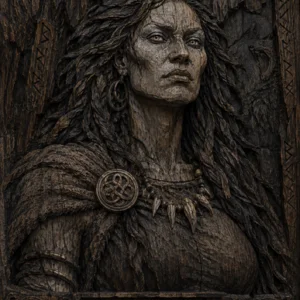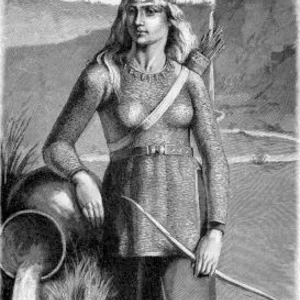

Skadi is a giantess (jötunn) from Norse mythology, goddess of winter, hunting, and mountains. Daughter of the giant Þjazi, she is known for negotiating her place among the Aesir gods after her father's death. Her figure illustrates the boundary between the world of the gods and that of the giants in Viking cosmology.
Skadi
Skadi
8 min read
Frequently asked questions
Key Facts
- Daughter of the giant Þjazi, she demands compensation from the Aesir gods after they kill her father — an episode recounted in the Prose Edda (c. 1220)
- She chooses her husband from among the gods by looking only at their feet: she hopes for Baldr but ends up with Njörðr, god of the sea
- Her marriage to Njörðr fails because of the incompatibility between the mountains she loves and the sea he prefers — a metaphor for the opposition between natural forces
- Her name is often linked to the Old Norse *skaði* ('harm', 'shadow') and may be at the origin of the word 'Scandinavia'
- She is associated with skiing and winter hunting, and is among the rare giantesses to gain a place in the Aesir pantheon
Works & Achievements
Skadi negotiated alone, fully armed, for reparations from the Aesir gods following her father's death. This act of courageous diplomacy earned her a place in the Norse pantheon — an exceptional status for a giantess.
By becoming the wife of Njörðr, Skadi crossed the cosmological boundary between the jötnar and the Aesir. She is one of the rare figures of giant origin to receive the title of goddess, symbolizing the reconciliation between the forces of nature and the civilizing gods.
Following the death of Baldr, Skadi took part in the punishment of Loki by placing a serpent above him so that its venom would drip onto his face. This act of vengeance is recounted in the Lokasenna and reflects her unyielding nature.
One of the oldest attested Norse texts, this poem recounts the adventures of her father Þjazi and represents the earliest written record of the mythological cycle to which Skadi belongs.
The primary codified account of Skadi's life: her arrival at Ásgarðr, her marriage to Njörðr, and their eventual separation. This text is the most complete and accessible source on the goddess of the mountains.
Anecdotes
After the death of her father Þjazi, slain by the Aesir gods, Skadi donned her armor and traveled to Ásgarðr to demand vengeance. Rather than fighting, she negotiated a settlement: the right to choose a husband from among the gods, but only by looking at their feet. She hoped to choose the beautiful Baldr, but mistakenly chose Njörðr, fooled by his elegant feet.
The marriage of Skadi and Njörðr was a resounding failure: she could not stand the cry of seagulls and the warmth of the shoreline at Nóatún, Njörðr's domain, while he could not endure the howling of wolves and the bitter cold of the mountains of Þrymheimr. They parted on good terms, each returning to their natural environment.
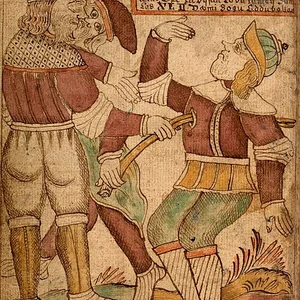
To make Skadi laugh during the peace negotiations, the trickster god Loki tied his beard to a goat's leg, drawing comical cries from both sides. It was the only moment Skadi had smiled since her father's death. The gods considered this laughter a sufficient gesture of peace.
Óðinn paid a final tribute to Þjazi, Skadi's father, by casting his eyes into the sky to make them two stars. This act, recounted in the Gylfaginning, shows the respect that even the Aesir could show to their defeated enemies, and served as an additional symbolic compensation for Skadi.
Skadi is one of the few giantesses (jötnar) to be fully integrated into the Aesir pantheon, earning the title of 'goddess of skis' (öndurguð). Her name may be the origin of the word 'Scandinavia', according to some linguists, making her a tutelary figure for the entire North.
Primary Sources
Skadi, daughter of the giant Þjazi, took up her weapons and went to the Æsir to avenge her father. They offered her compensation: to choose a husband from among them, seeing only their feet.
Þrymheimr is the sixth: there dwelt Þjazi the mighty giant; now Skadi, radiant bride of the gods, inhabits the ancient home of her father.
The poems evoke Skadi's icy mountains and skis as symbols of the Nordic wilderness, a realm of hunting and eternal winter.
This 9th-century skaldic poem recounts the abduction of Iðunn's apples by Þjazi and his death, the prelude to Skadi's grief and her march toward Ásgarðr.
In this exchange of flyting, Skadi reminds Loki that he will never receive a kind word from her, for it was he who brought about the death of her father Þjazi.
Key Places
Skadi's icy mountain domain, inherited from her father Þjazi. Mentioned in the Grímnismál, it is a place of snow-capped peaks, forests, and nordic winds, where Skadi returned to live after her separation from Njörðr.
The city of the Aesir gods, where Skadi arrived in full armor to demand reparations for her father's death. It was here that she joined the Norse pantheon, crossing the symbolic boundary between giants and gods.
The coastal domain of Njörðr, god of the sea, where Skadi briefly lived as his wife. She could not bear the noise of the waves and the seagulls — a symbol of the incompatibility between mountain and sea in Norse cosmology.
It was in medieval Iceland that the myths of Skadi were first written down, most notably by Snorri Sturluson at Reykholt. The island is the primary source for the preservation of Norse mythology.
According to some linguists, Skadi's name may be the origin of the word 'Scandinavia' (Scadinavia in medieval Latin). She is thus symbolically linked to the entire Nordic territory, embodying its mountainous and wintry landscapes.
Typical Objects

Skadi is nicknamed öndurguð (goddess of skis) and öndurdís (lady of skis). Her skis allowed her to traverse snow-covered mountains at superhuman speed while hunting.

Skadi's emblematic weapon during her hunts through snowy forests and mountains. It symbolizes her role as a hunting deity and mistress of the wild.

When she traveled to Ásgarðr to avenge her father, Skadi wore full armor, showing she was ready for battle. This gesture impressed the Aesir and led to negotiation.

As a deity of winter and the mountains, Skadi is typically depicted wearing heavy wolf or bear furs — essential protection against the extreme temperatures of high peaks.

The mountain domain inherited from her father Þjazi, referenced in the Grímnismál. This icy place, perched high in the mountains, represents Skadi's natural home — in stark contrast to the warm shores favored by Njörðr.

Though not an object belonging to her directly, the stars created by Óðinn from her father Þjazi's eyes stand as a symbolic tribute closely tied to her figure and her grief.
School Curriculum
Vocabulary & Tags
Key Vocabulary
Tags
Lieu
Daily Life
Morning
Skadi rises before dawn in her hall of Þrymheimr, where the cold is so fierce that breath hangs visible in the air. She straps on her öndur (skis) and sets out to hunt as soon as the grey light of dawn filters between the snow-capped peaks, bow slung across her shoulder.
Afternoon
Her afternoons are devoted to tracking large game — elk, wolves, and bears through the frozen pine forests. She covers immense distances on her skis, navigating valleys and mountain passes inaccessible to others. Her knowledge of the mountain terrain is absolute.
Evening
In the evening, she returns to Þrymheimr with her kills, preparing the meat and furs beside a roaring fire. Sometimes she gazes up at the stars of the northern sky — including those formed from the eyes of her father Þjazi, placed there as a tribute by Óðinn — before sleeping in the silence of the high mountains.
Food
Skadi's diet consists almost entirely of wild game she hunts herself: forest animals of the Nordic wilderness and fish from mountain streams. She eats little grain or seafood, in stark contrast to Njörðr — a difference that symbolized their fundamental incompatibility.
Clothing
She wears thick layers of fur — wolf, bear, and reindeer — over a tunic and coarse woolen leggings. A breastplate of metal or bone protects her chest during warrior expeditions. Waterproofed hide boots complete her huntress's outfit.
Housing
Þrymheimr is a hall of stone and heavy timber, perched high in the mountains, inherited from her father Þjazi. The walls are insulated with furs, and a large central hearth provides warmth. Hunting trophies adorn the walls, and stores of dried meat hang from the rafters to last through winter.
Historical Timeline
Period Vocabulary
Visual Style
Esthétique viking épique : géante guerrière en fourrures et armure dans un paysage de montagnes arctiques, avec aurores boréales et forêts de pins sous un ciel hivernal.
Sound Ambience
Ambiance sonore des montagnes scandinaves en hiver : vents glacials, loups au loin, silence des hauteurs enneigées et crissement des skis sur la neige dure.
Liens externes & ressources
Références
Œuvres
Négociation de la paix avec les Ases
Temps mythique
Intégration au panthéon des Ases
Temps mythique
Participation au châtiment de Loki
Temps mythique (Ragnarök approchant)
Haustlöng — poème scaldique de Þjóðólfr
vers 900
Gylfaginning (Edda en prose) — Snorri Sturluson
vers 1220