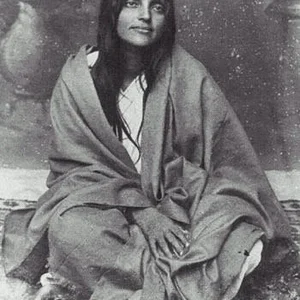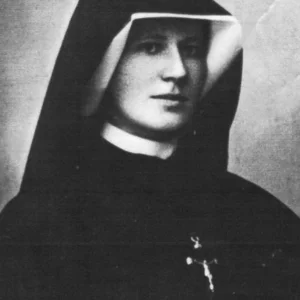

Polish nun and mystic, a saint of the Catholic Church. A visionary, she originated the devotion to the Divine Mercy, popularized by her spiritual diary. She was canonized by John Paul II in 2000.
Sister Faustina Kowalska(1905 — 1938)
Faustina Kowalska
Deuxième République de Pologne
5 min read
Frequently asked questions
Famous Quotes
« Jesus, I trust in You»
Key Facts
- Born on 25 August 1905 in Głogowiec, in Russian Poland, into a humble peasant family
- Entered the Congregation of the Sisters of Our Lady of Mercy in 1925
- From 1934 onward, wrote her Diary, recounting her visions of the merciful Christ
- Died of tuberculosis on 5 October 1938 in Kraków
- Canonized on 30 April 2000 by John Paul II, who established the feast of Divine Mercy
Works & Achievements
Her major work: a spiritual diary that became one of the most widely read Catholic texts of the 20th century, the foundation of the Divine Mercy devotion.
A depiction of Christ designed according to her instructions and painted by Eugeniusz Kazimirowski in Vilnius, later spread throughout the world.
A popular prayer associated with her spirituality, recited by millions of the faithful.
A spiritual movement born from her message, organized after her death by her spiritual director Father Sopoćko and officially recognized by the Church.
A liturgical feast celebrated on the Sunday after Easter, established by John Paul II at her canonization, in continuity with her message.
Anecdotes
Born Helena Kowalska into a poor peasant family, she attended school for only a few short years. After becoming a nun, she held humble positions: cook, gardener, doorkeeper. Yet it was to this uneducated woman that spiritual visions, now famous throughout the world, were attributed.
Faustina kept a personal diary between 1934 and 1938, in which she recorded her inner experiences. This notebook, written in simple and sometimes awkward Polish, became after her death one of the most widely read Catholic spiritual texts of the 20th century, translated into dozens of languages.
According to her account, she asked a painter to depict an image of Christ with two rays, one red and the other pale. The first version, painted by Eugeniusz Kazimirowski in 1934, reportedly disappointed her because she felt it did not do justice to her vision.
Having died of tuberculosis at only 33, she was almost unknown during her lifetime outside her convent. Her diary was even set aside for a time by the Vatican because of translation errors, before being rehabilitated thanks notably to the Polish cardinal Karol Wojtyła, the future John Paul II.
She was canonized in the year 2000 by John Paul II, who on that occasion established the Feast of Divine Mercy, celebrated on the Sunday after Easter. She was the first saint canonized in the third millennium.
Primary Sources
Jesus, I trust in You.
Paint an image according to the pattern you see, with the inscription: Jesus, I trust in You.
The two rays denote blood and water; the pale ray stands for the water which makes souls righteous, the red ray stands for the blood which is the life of souls.
I strive to carry out faithfully everything that has been entrusted to me concerning this work of Mercy.
Key Places
Faustina's native village, where she was born in 1905 into a large, poor peasant family.
Convent where, in 1931, Faustina experienced the founding vision of Christ that gave rise to the image of the Divine Mercy.
City where Faustina lived from 1933 to 1936 and where the first image of the Divine Mercy was painted.
Polish capital where Helena entered the convent of the Sisters of Our Lady of Mercy in 1925.
Convent where Faustina died in 1938 and where her tomb lies, now a major site of international pilgrimage.
Typical Objects

Handwritten notebook in which Faustina recorded her spiritual experiences between 1934 and 1938. It has become a classic of Catholic spirituality.

Depiction of Christ from whom two rays stream forth, one red and one pale, bearing the inscription “Jesus, I trust in You.” Painted according to Faustina's instructions.

A prayer recited on an ordinary rosary, whose wording was said to have been dictated to Faustina during a vision in 1935.

Black dress, veil and wimple worn by the nuns of her congregation. Faustina wore it from the time she received the habit in 1926.

A cross bearing the body of Christ, the central object of Faustina's prayer and meditation on the Passion.

Everyday writing instruments with which Faustina wrote her diary in the evening, after her duties at the convent.
School Curriculum
Vocabulary & Tags
Key Vocabulary
Daily Life
Morning
Like all nuns, Faustina rose very early for prayer and morning Mass. The day began in silence with meditation and the first devotions in the chapel choir.
Afternoon
The afternoon was devoted to manual tasks assigned by the community: cooking, gardening, or watching the convent door. Humble work was regarded as a form of prayer.
Evening
In the evening, after the offices and the shared meal, Faustina devoted her few free moments to writing in her diary. By the light of a lamp, she recorded her prayers and her inner experiences there.
Food
The convent's diet was simple and frugal, consisting of soups, bread, vegetables from the garden, and porridge. Weakened by tuberculosis, Faustina ate little during her final years.
Clothing
She wore the black habit of her congregation: a long robe, a belt, a white wimple around her face, and a veil. A crucifix and a rosary completed this attire of a consecrated woman.
Housing
She lived in the convents of the Sisters of Our Lady of Mercy, in Warsaw, Vilnius, Płock, and then Kraków. The cells were modest rooms, furnished with a simple bed, a table, and a crucifix.
Historical Timeline
Period Vocabulary
Liens externes & ressources
Références
Œuvres
Petit Journal — La Miséricorde divine dans mon âme
1934-1938
Image de la Divine Miséricorde
1934
Chapelet de la Divine Miséricorde
1935
Diffusion du culte de la Divine Miséricorde
années 1930 et postérité
Institution de la fête de la Divine Miséricorde
2000