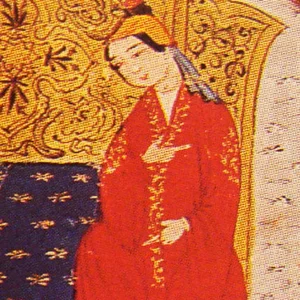

Mongol princess, daughter-in-law of Genghis Khan and wife of Tolui. Mother of four sons, including the emperors Möngke and Kublai Khan and the Ilkhan Hulagu, she exerted a decisive political influence on the succession of the Mongol Empire in the 13th century.
Sorghaghtani Beki(1190 — 1252)
Sorgaqtani
Empire mongol
6 min read
Frequently asked questions
Key Facts
- Born around 1190, daughter of a Kerait chief and daughter-in-law of Genghis Khan
- Married Tolui, youngest son of Genghis Khan, and administered his appanage after his death in 1232
- A Nestorian Christian by faith, she protected several religions (Buddhism, Islam, Christianity)
- Maneuvered to have her son Möngke elected Great Khan in 1251, sidelining the line of Ögödei
- Mother of Möngke, Kublai (founder of the Yuan dynasty) and Hulagu; died in 1252
Works & Achievements
After her husband's death, she single-handedly administered a vast domain spanning the steppe and northern China, combining moderate taxation with protection of the peasantry to make it a prosperous territory.
She trained Möngke, Kublai, Hülegü and Ariq Böke in politics, languages and governance, preparing a generation of rulers who would dominate Eurasia.
A Nestorian Christian, she funded mosques, Quranic schools and Buddhist institutions, establishing a model of coexistence that her sons carried throughout the empire.
Through her alliances with Batu's Golden Horde, she shifted supreme power from the line of Ögödei to that of Tolui, reshaping the Mongol succession.
Her sons Kublai and Hülegü founded the Yuan dynasty in China and the Ilkhanate of Persia respectively, extending her political legacy across two continents.
Against the Mongol temptation to turn Chinese lands into pastures, she encouraged the preservation of agriculture and cities, a lasting source of revenue for the empire.
Anecdotes
Sorghaghtani Beki was a Keraite princess and a Nestorian Christian, yet she protected every religion in the empire: she funded mosques and Quranic schools for her Muslim subjects while remaining faithful to her own creed. This shrewd tolerance earned her the respect of many very different peoples.
When her husband Tolui died around 1232, the great khan Ögedei offered to have her marry his own son Güyük. Refusing such an offer was risky, but she politely declined, saying she had to devote herself to raising her four sons — a choice that let her keep full control of her vast appanage.
Although she herself probably could neither read nor write, she made sure her sons learned several languages and surrounded themselves with scholars from across the empire. Two of them, Möngke and Kublai, became great khans, and a third, Hulagu, founded the Ilkhanid dynasty of Persia.
The Persian historian Rashid al-Din described her as “extremely intelligent and capable, surpassing all the women in the world.” Foreign observers such as the friar William of Rubruck noted the considerable influence of the great Mongol ladies at court.
In 1251, it was largely thanks to her political maneuvering and her alliances that her eldest son Möngke was elected great khan, shifting supreme power from the line of Ögedei to that of Tolui. This political coup reshaped the history of the Mongol Empire for generations to come.
Primary Sources
She was extremely intelligent and capable, and rose above all the women of the world through her skill in governing.
In managing her affairs and governing her subjects, she surpassed the most prudent of men, and no one would have dared to contradict her decisions.
The ladies of the Mongol court have their own camps, their own herds, and their own servants, and their authority there is great.
Key Places
Vast grasslands where the nomadic Mongols lived and where Sorghaghtani managed her appanage and her herds. This is where alliances between clans were forged.
Capital of the Mongol Empire founded under Ögedei, the center of power where the quriltai (assemblies) were held. There, Sorghaghtani championed the candidacy of her son Möngke.
Chinese territories attached to the family appanage that she administered after Tolui's death. There she promoted agriculture and protected the settled populations.
The homeland of her Nestorian Christian tribe, in present-day central Mongolia. This is where her faith and her first family alliances took root.
A region of northwestern China where tradition places her tomb, in a Nestorian Christian church. Her Christian burial bears witness to a faith she kept until the end.
Typical Objects

Tall ceremonial headdress worn by noble Mongol women, made of bark and felt and adorned with silk, feathers and precious stones. It signaled the high rank of the woman who wore it.

Official seal used to authenticate the orders and decrees governing the lands and peoples of her domain. It embodied the legitimate authority she exercised in her family's name.

Christian cross specific to the Church of the East (Nestorian), the faith of the Kerait tribe from which she came. She wore it as a symbol of her religion while protecting the other faiths.

Round, collapsible tent made of a wooden lattice and felt, the dwelling of the nomadic Mongols. A princess's yurt was vast, richly carpeted and carried on wagons when the camp moved.

Short bow made of wood, horn and sinew, the emblematic weapon of the empire's horsemen and of the troops of her appanage. Its range and power were the foundation of Mongol military dominance.

Bowl or cup used to drink kumis, fermented mare's milk, the ritual and everyday beverage of the Mongols. Sharing kumis sealed alliances during court banquets.
School Curriculum
Vocabulary & Tags
Key Vocabulary
Daily Life
Morning
At dawn, in her camp, Sorghaghtani received reports from her stewards on the state of the herds and harvests of her appanage. She would read through the messages arriving from Karakorum and the other courts of the empire.
Afternoon
The afternoon was devoted to administration: audiences, judgments, negotiations with clan chiefs and Chinese or Persian officials. She also oversaw the education of her sons, who were surrounded by learned tutors.
Evening
In the evening, beneath the great yurt, banquets were held where kumis flowed and alliances were forged. It was an occasion to listen to storytellers and foreign envoys, and to discuss the affairs of the empire.
Food
The Mongol diet was based on meat (mutton, horse, game) and dairy products, including kumis, fermented mare's milk. A princess's court added to this dishes brought from China and Persia by the caravans.
Clothing
She wore loose robes (*deel*) of imported silk and brocade, fastened at the side and cinched with a belt. On great occasions, she displayed the tall *boqta* headdress adorned with feathers and precious stones, a sign of her rank.
Housing
She lived in vast, richly decorated felt yurts, mounted on carts drawn by oxen during the seasonal migrations. Her camp formed a veritable itinerant court with servants, guards, and herds.
Historical Timeline
Period Vocabulary
Liens externes & ressources
Références
Œuvres
Gestion de l'apanage de Tolui
1232-1252
Éducation des quatre fils
années 1230-1240
Politique de tolérance religieuse
années 1230-1250
Élévation de Möngke au rang de grand khan
1251
Fondation indirecte des dynasties Yuan et Ilkhanide
à partir de 1260
Soutien à l'agriculture sédentaire
années 1230-1240