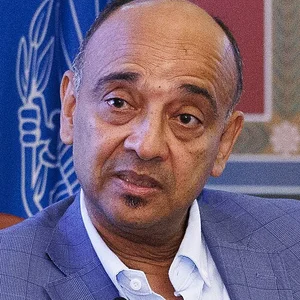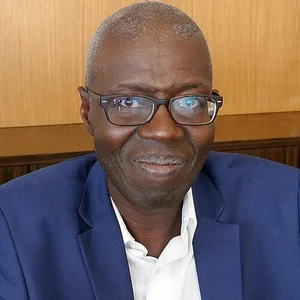

Senegalese philosopher and historian of science born in 1955, professor at Columbia University. A specialist in Islamic philosophy, the history of mathematics, and African thought, he is a leading figure in intercultural dialogue and in translation as a philosophical method.
Souleymane Bachir Diagne(1955 — ?)
Souleymane Bachir Diagne
Sénégal
6 min read
Frequently asked questions
Key Facts
- Born on November 21, 1955, in Saint-Louis (Senegal)
- A former student of the École normale supérieure and agrégé in philosophy (1978)
- Professor of philosophy at Columbia University (New York) from 2008, where he directs the Institute of African Studies
- Author of numerous works, including *The Ink of the Scholars: Reflections on Philosophy in Africa* (2013) and *De langue à langue. L'hospitalité de la traduction* (2022)
- Winner of the Édouard Glissant Prize (2011) and a leading figure of the “lateral universal” movement
Works & Achievements
Essay based on his thesis on the logic of George Boole, showing his early interest in mathematics and the foundations of computer science.
A work that rediscovers the Muslim philosopher Iqbal and defends the idea of an Islam capable of reforming itself and thinking freely.
A major book that retraces the long tradition of rational thought in the Muslim world, from al-Kindi to the modern era.
A study showing how African and Muslim thinkers used Bergson's philosophy to rethink their own culture; awarded the Édouard Glissant Prize.
A plea to recognize the existence of a genuine African philosophy, both written and oral, against the prejudices inherited from colonization.
An essay that turns translation into a philosophical method and a model of openness to other cultures, with no hierarchy between languages.
Anecdotes
Born in Saint-Louis, Senegal, in 1955, Souleymane Bachir Diagne grew up between two worlds: the French school system and Senegalese Muslim culture. This dual belonging became the heart of all his thinking, which seeks to bring cultures into dialogue rather than set them against one another.
A brilliant student, he went to study in Paris and in 1978 passed the highly competitive *agrégation* examination in philosophy, at just 23 years old. His first great passion was not politics but mathematical logic: he devoted his thesis to the algebra of the English mathematician **George Boole**, the very algebra that today underpins how computers work.
For Diagne, translation is not a mere classroom exercise: he sees it as the most important philosophical act of our time. He likes to point out that no language can claim to express what it means to be human better than the others, and that moving from one language to another is a form of hospitality toward the stranger.
Having become a professor at the prestigious **Columbia University** in New York, he long directed the Institute of African Studies. He defends the idea that there truly is an African philosophy, both written and oral, at a time when many in the West still doubted it in the 20th century.
He rediscovered and brought to wider attention the thought of the Muslim poet and philosopher **Muhammad Iqbal**, for whom Islam had to remain a religion of movement and creativity, capable of reforming itself. Diagne sees in this a model of dialogue between faith and freedom of thought.
Primary Sources
To translate is, first and foremost, to experience that there is no language that is the language of all the others, one that would say better than the rest what every language has to say.
The ink of the scholars is worth more than the blood of the martyrs: the aim is to recall that Africa has a tradition of knowledge, writing and reflection, and not merely a supposedly primordial orality.
Both Senghor and Iqbal read Bergson in order to rethink intuition, emotion and the movement of life afresh, against a reason that claimed to be the sole mistress of the world.
The question is not whether one can philosophize in Islam, but rather to rediscover the long tradition of thought that, from al-Kindi to Iqbal, made reason a friend of faith.
Key Places
Historic town in northern Senegal, a former colonial capital, where Souleymane Bachir Diagne was born in 1955.
Capital of Senegal, where he taught philosophy for many years at Cheikh Anta Diop University.
Prestigious Parisian institution where he pursued his advanced studies in philosophy during the 1970s.
American university where he is a professor and where he directed the Institute of African Studies.
University in the Chicago area where he taught in the early 2000s before joining Columbia.
Typical Objects

The philosopher's primary working tool, which he reads, annotates and writes. Diagne has published many of them, translated into several languages.

A teaching surface in the university lecture hall, on which the professor writes concepts and formulas. Diagne taught logic and mathematics there for many years.
The sacred text of Islam, a central object of study for his reflection on Islamic philosophy and on the place of reason within faith.

A work that sets two languages side by side, a symbol of his work on translation as hospitality between cultures.

The everyday tool of the contemporary scholar for writing, giving lectures remotely and accessing digital libraries around the world.

Works on algebra and formal logic, such as those of George Boole, which were the subject of his thesis and link him to the history of computing.
School Curriculum
Vocabulary & Tags
Key Vocabulary
Daily Life
Morning
Like any university professor, Souleymane Bachir Diagne often devotes his mornings to reading and writing, in quiet, before classes. He prepares his philosophy seminars and works on his books and articles.
Afternoon
His afternoons are paced by lectures and seminars given to his students at Columbia, as well as by meetings with the doctoral candidates he supervises. He also takes part in conferences and public debates.
Evening
In the evening, he continues his reading, answers his international correspondence, and prepares his appearances in the media or at academic conferences. The life of a world-renowned intellectual is filled with many travels and exchanges.
Food
Living between Senegal, France, and the United States, he is familiar with very varied cuisines. His diet may follow the dietary rules of Islam, without pork and with halal meat, blending Senegalese dishes such as thieboudienne with international cuisine.
Clothing
He most often dresses in Western suits, the usual attire of university professors. On certain occasions, he may wear the boubou, a traditional West African garment.
Housing
A professor in New York, he lives in an urban apartment near the university, surrounded by books. He keeps strong ties with Senegal, where he returns regularly.
Historical Timeline
Period Vocabulary
Liens externes & ressources
Références
Œuvres
Boole, l'oiseau de nuit en plein jour
1989
Islam et société ouverte. La fidélité et le mouvement dans la pensée de Muhammad Iqbal
2001
Comment philosopher en islam ?
2008
Bergson postcolonial. L'élan vital dans la pensée de Senghor et de Mohamed Iqbal
2011
L'encre des savants. Réflexions sur la philosophie en Afrique
2013
De langue à langue. L'hospitalité de la traduction
2022