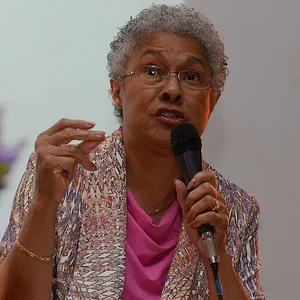

An American sociologist and feminist, Patricia Hill Collins is one of the leading theorists of Black feminist thought. She developed the concept of intersectionality as applied to the relationships between race, gender, and social class.
Patricia Hill Collins(1948 — ?)
Patricia Hill Collins
États-Unis
9 min read
Frequently asked questions
Famous Quotes
« Black feminist thought rests on two central claims: first, that Black women constitute an oppressed social group; second, that the ideas produced by this group have a distinctive value.»
Key Facts
- Born in 1948 in Philadelphia, Pennsylvania.
- Published 'Black Feminist Thought' in 1990, a foundational work in Black feminist thought.
- First African American woman to serve as president of the American Sociological Association (2008–2009).
- Distinguished Professor at the University of Maryland.
- Developed and deepened the concept of intersectionality alongside Kimberlé Crenshaw.
Works & Achievements
Collins's masterwork, this book systematizes Black American feminist thought into a coherent theoretical framework for the first time. It introduces the concept of the 'matrix of domination' and has permanently transformed sociology, feminist studies, and African American studies.
A university textbook that has become one of the most widely used in American social science courses. It brings together foundational texts on intersectionality and has introduced millions of students to the analysis of overlapping inequalities.
In this book, Collins responds to critics of her work and deepens the question of situated knowledge, exploring how Black women can produce legitimate knowledge despite their marginalized position in academia.
Collins analyzes how Black Americans' sexuality is stereotyped, instrumentalized, and controlled by the media and institutions. This work is essential for understanding the intersection of racism, sexism, and the control of bodies.
Collins examines the role of media as a parallel educational system, analyzing how television, music, and the internet shape racial and gender representations, often to the detriment of young Black Americans.
A collection of essays in which Collins reflects on the political responsibility of the intellectual and argues that academic rigor and social engagement are not opposites — they reinforce each other.
The first textbook devoted entirely to the concept of intersectionality, this book traces its history, clarifies its applications across different disciplines, and discusses the debates it has generated. Translated into numerous languages, it has become the international reference on the subject.
Anecdotes
Patricia Hill Collins grew up in a working-class neighborhood in Philadelphia in a modest African American family. This twofold experience — being Black and poor in 1950s America — shaped her conviction that race, gender, and class could not be analyzed separately: they interlock and reinforce one another in everyday life.
Her landmark work, *Black Feminist Thought* (1990), won the prestigious C. Wright Mills Award from the Society for the Study of Social Problems upon its publication. The jury recognized a work that finally gave theoretical voice to the experiences of Black women, long ignored by both white feminism and male-dominated antiracist movements.
In 2009, Patricia Hill Collins became the first Black woman elected president of the American Sociological Association, the leading professional organization for sociologists in the United States. In her presidential address, she called on the discipline to engage more directly with social struggles, arguing that sociology must "serve the public" and not merely academic journals.
Collins developed the concept of the "matrix of domination" to show that individuals simultaneously occupy positions of both the oppressed and the dominant depending on context: a Black woman may be marginalized because of her race and gender, yet hold privileges tied to her social class or sexual orientation. This idea profoundly renewed the social sciences.
Despite a distinguished academic career, Collins consistently insisted that Black feminist thought was born not in libraries but in kitchens, churches, and hair salons — spaces where Black women exchanged knowledge that the academy systematically ignored. Her entire body of work was built to legitimize these "situated knowledges.
Primary Sources
Black feminist thought consists of ideas produced by Black women that clarify a standpoint of and for Black women. Several assumptions underlie this definition. First, the definition assumes that Black women have a unique standpoint on, or perspective of, their own experiences and that there will be certain commonalities of perception shared by Black women as a group.
U.S. Black women's experiences have been shaped by intersecting oppressions of race, gender, class, sexuality, and nation. For Black women, these systems of oppression are not additive but interlocking — they form a matrix of domination.
Intersectionality is a way of understanding and analyzing the complexity in the world, in people, and in human experiences. The events and conditions of social and political life and the self can seldom be understood as shaped by one factor.
The true liberatory knowledge that can empower African-American women and other subordinated groups will only emerge through sustained dialogue among groups that are differentially positioned within existing systems of power.
Doing public sociology does not mean abandoning scholarship. It means using our training to make visible the social realities that are hidden, distorted, or naturalized within current social arrangements.
Key Places
Birthplace of Patricia Hill Collins, born in 1948 in a working-class African American neighborhood. Her childhood in post-war, segregated Philadelphia was the seedbed for all her thinking on racial and class inequality.
Collins earned her bachelor's degree here in 1969. Founded in 1948 by the American Jewish community in response to antisemitic quotas at major universities, Brandeis had a strong tradition of fighting discrimination — a setting well-suited to Collins's critical thinking.
Collins defended her doctoral dissertation in sociology here in 1984. Gaining entry to one of the world's most elite institutions as a Black woman from a modest background deepened her awareness of power dynamics at the very heart of knowledge production.
Collins taught here for many years before being named Distinguished Professor. It was in this setting that she developed and taught her theory of Black feminist thought to a generation of American students.
The final post of her career, where Collins was named Distinguished University Professor Emerita. This large public university gave her a platform to reach beyond academia and engage in American public debate.
Typical Objects

Collins produced a substantial body of work — academic articles and theoretical books alike. The typewriter, and later the computer, were her everyday tools of intellectual production, central to a career entirely devoted to writing and argumentation.

Collins read and published in journals such as *Signs*, *Gender & Society*, and *Social Problems*. These specialized publications were both her working sources and the arenas where she defended her ideas before the scholarly community.

A dedicated teacher at the University of Cincinnati and later the University of Maryland, Collins built her courses around discussion and diagrams. She used these surfaces to help students visualize the "matrices of domination."

A highly sought-after speaker, Collins delivered hundreds of addresses at universities around the world. For her, public speaking was as much a political act as an academic one.

Although primarily a theorist, Collins drew on interviews and observations in African American communities. The field notebook symbolizes her commitment to never severing theory from lived reality.

Collins drew heavily from the Black American intellectual tradition. Her annotated copies of Du Bois's *The Souls of Black Folk* and the writings of Ida B. Wells bear witness to a lineage she claimed and commented on page after page.
School Curriculum
Vocabulary & Tags
Key Vocabulary
Tags
Daily Life
Morning
Patricia Hill Collins starts her days early, reading the national press and academic journals to stay connected to ongoing debates, both on the streets and in universities. Like many American professors, she prepares her courses and writes in the morning, a period she considers most conducive to intellectual concentration.
Afternoon
The afternoon is devoted to seminars, department meetings, and discussions with the doctoral students she supervises. Collins is known for her accessibility to her students, particularly Black students and first-generation college students, to whom she offers attentive mentorship.
Evening
In the evenings, Collins frequently takes part in public lectures, roundtables, or community events. She has always held that the intellectual's responsibility does not stop at the university's doors, and she remains active in African-American and feminist networks and organizations.
Food
As an East Coast American woman with roots in Southern African-American culture, Collins grew up with soul food — chicken, greens, corn, sweet potatoes. As an adult, like many academics attuned to food inequalities, she also developed an interest in food justice issues.
Clothing
Collins favors a sober and polished academic style: a suit or professional ensemble for her lectures and classes, in dark or neutral tones. She readily incorporates elements of contemporary African-American style — understated jewelry, warm colors — not for show, but as a deliberate expression of cultural identity.
Housing
Collins has lived in residential neighborhoods close to the university campuses where she taught, first in Cincinnati and then in the Washington D.C. area (College Park, Maryland). She has always favored environments where she could remain connected to African-American communities, refusing to retreat into academic enclaves cut off from the real world.
Historical Timeline
Period Vocabulary
Liens externes & ressources
Références
Œuvres
Black Feminist Thought: Knowledge, Consciousness, and the Politics of Empowerment
1990
Race, Class, and Gender: An Anthology (codirigé avec Margaret Andersen)
1992
Fighting Words: Black Women and the Search for Justice
1998
Black Sexual Politics: African Americans, Gender, and the New Racism
2004
Another Kind of Public Education: Race, Schools, Media, and Democratic Possibilities
2009
On Intellectual Activism
2013
Intersectionality (avec Sirma Bilge)
2016