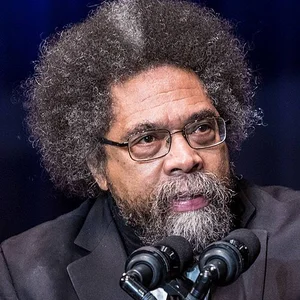

American philosopher, theologian, and public intellectual, a major figure of African-American pragmatism. A professor at Harvard and Princeton, he brings together philosophical thought, social critique, and a commitment to racial justice.
Cornel West(1953 — ?)
Cornel West
États-Unis
6 min read
Frequently asked questions
Famous Quotes
« Justice is what love looks like in public.»
Key Facts
- Born in 1953 in Tulsa, Oklahoma, in the United States
- Published 'Race Matters' in 1993, a major work on the question of race in America
- Published 'Democracy Matters' in 2004
- Professor of philosophy and African-American studies at Harvard and Princeton
- Ran as an independent candidate in the 2024 U.S. presidential election
Works & Achievements
First major work in which West grounds his prophetic Christian philosophy in the service of liberation.
A major reappraisal of American pragmatism, from Emerson to Dewey, that established his scholarly reputation.
A collection of essays that became a best-seller and an essential reference on the question of race in the United States.
An album blending committed speech and music, extending his philosophy beyond the written word.
An essay on the threats facing American democracy and the need for Socratic courage.
An autobiography in which West retraces his journey as an intellectual and an activist.
A work celebrating the Black prophetic tradition, from Frederick Douglass to Martin Luther King.
Anecdotes
Cornel West entered Harvard University after skipping grades and earned his degree in just three years, magna cum laude, in 1973 — at a time when very few African American students gained access to these prestigious campuses.
In 2003, the philosopher appeared on the big screen: he played Councillor West in Matrix Reloaded and Matrix Revolutions. Seeing a Harvard professor in a science-fiction blockbuster is surprising, but West saw it as a way to reach a far wider audience than the lecture halls.
A music lover, West recorded albums blending spoken word, soul, and hip-hop, including *Sketches of My Culture* in 2001. For him, the blues and jazz are not mere entertainment but a genuine way of philosophizing about suffering and hope.
In October 2014, at the age of 61, West was arrested by police during the Ferguson protests in Missouri, following the death of Michael Brown. Faithful to the civil disobedience of Martin Luther King, he embraced putting himself on the line for his ideas.
You can recognize West at first glance: a black three-piece suit, white shirt, afro, and salt-and-pepper beard. This unchanging outfit has become his signature, a way of presenting himself as a “fighter” always at the ready, both elegant and grave.
Primary Sources
Nihilism is to be understood here not as a philosophical doctrine holding that there is no rational basis for legitimate standards, but rather as the lived experience of confronting a life of meaninglessness, hopelessness, and—above all—lovelessness.
We simply cannot enter the twenty-first century at each other's throats.
American pragmatism is a diverse and continuous cultural tradition whose moral core lies in wagering on the power of ordinary people to shape the course of History for themselves.
It takes a certain Socratic courage to examine one's own life and that of one's society in the light of justice and truth.
Key Places
Cornel West's birthplace in 1953, a city marked by a long history of racial tension in the United States.
The city where West grew up; here he discovered activism and the African American culture of his youth.
West earned his degree here in three years, and would later teach philosophy and African American studies.
The site of his doctorate and then many years of teaching, notably after his departure from Harvard.
The theology institute where West teaches, an emblematic site of his prophetic Christian thought.
The scene of the 2014 protests against police violence, where West was arrested for civil disobedience.
Liens externes & ressources
Références
Œuvres
Prophesy Deliverance! An Afro-American Revolutionary Christianity
1982
The American Evasion of Philosophy
1989
Race Matters
1993
Sketches of My Culture
2001
Democracy Matters
2004
Brother West: Living and Loving Out Loud
2009
Black Prophetic Fire
2014