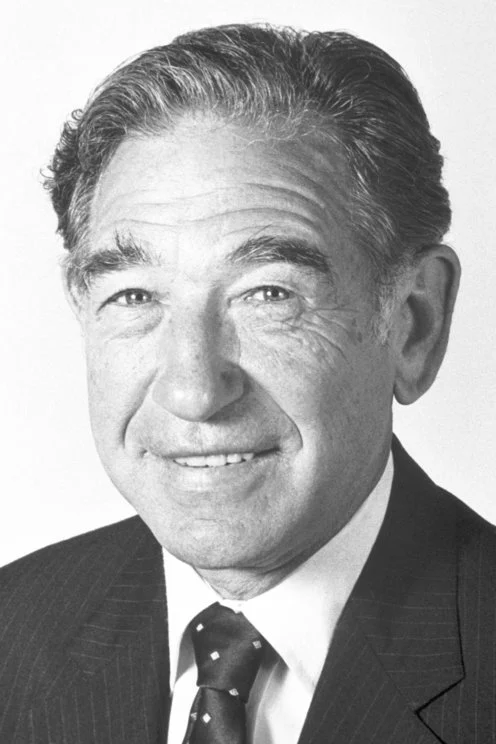
Stanley Cohen (1922-2020) was an American biochemist. Together with Rita Levi-Montalcini, he discovered growth factors, notably epidermal growth factor (EGF), proteins essential to the development and repair of cells. This work earned him the Nobel Prize in Physiology or Medicine in 1986.
Stanley Cohen(1922 — 2020)
Stanley Cohen
États-Unis
5 min read
Frequently asked questions
Key Facts
- Born on November 17, 1922, in Brooklyn (New York), died on February 5, 2020
- Discovers nerve growth factor (NGF) with Rita Levi-Montalcini in the 1950s
- Identifies epidermal growth factor (EGF) in 1962
- Conducts most of his research at Vanderbilt University (Tennessee)
- Receives the Nobel Prize in Physiology or Medicine in 1986 with Rita Levi-Montalcini
Works & Achievements
Together with Rita Levi-Montalcini, Cohen identifies a protein that stimulates the growth of nerve fibers, the first of a new class of signaling molecules.
Cohen purifies EGF from mouse salivary glands and demonstrates its role in the development of epithelial cells.
His work helps explain how EGF binds to a membrane receptor, laying the foundations for the study of cell signaling.
A synthesis of his research presented at the Nobel Prize ceremony, retracing the discovery and importance of EGF.
Anecdotes
When Stanley Cohen joined Rita Levi-Montalcini's laboratory at Washington University in St. Louis, they formed an unlikely duo: she, an Italian neurobiologist, he, an American biochemist. She said of him that he had “golden hands” for purifying proteins, and their collaboration would become one of the most famous in 20th-century biology.
To isolate epidermal growth factor (EGF), Cohen used an unexpected source: the salivary glands of male mice, which are particularly rich in this protein. He had noticed that injecting extracts from these glands made baby mice open their eyes and cut their teeth earlier than normal.
Cohen and Levi-Montalcini received the Nobel Prize in Physiology or Medicine in 1986, more than thirty years after their discoveries in the 1950s. The Nobel committee honored their identification of growth factors, molecules that revolutionized the understanding of cellular development and, later, cancer research.
Cohen's work on EGF had major medical repercussions that he had not anticipated: understanding how cells receive growth signals made it possible to develop anticancer therapies targeting these receptors, such as certain treatments for breast or lung cancer.
Discreet and devoted to his bench work, Cohen continued to teach and frequent his laboratory at Vanderbilt University long after his Nobel Prize. He played the clarinet and the recorder, and remained committed to fundamental research rather than fame.
Primary Sources
A protein extracted from the mouse submaxillary gland causes, when injected into newborn animals, early eruption of the incisors and early opening of the eyelids.
The discovery of epidermal growth factor arose from the observation of unexpected biological effects, which guided step by step the purification of the molecule responsible.
A factor isolated from tumors dramatically stimulates the growth of nerve fibers in the sympathetic and sensory ganglia.
Key Places
New York borough where Stanley Cohen was born in 1922 into a family of immigrants. He grew up there during the Great Depression.
University where Cohen earned his doctorate in biochemistry in 1948, laying the foundations for his career as a researcher.
Laboratory where Cohen joined Viktor Hamburger and Rita Levi-Montalcini in 1953 and discovered nerve growth factors.
Institution where Cohen carried out most of his career from 1959 onward, isolated EGF, and remained active into old age.
City where Stanley Cohen lived most of his adult life and where he died in 2020 at the age of 97.
Typical Objects

A precision instrument for drawing up and transferring small volumes of liquid during protein purification. An everyday tool of the biochemist at the bench.

A device that spins at high speed to separate the components of a mixture according to their density. Essential for isolating proteins such as EGF.

An instrument that measures how much light a solution absorbs in order to quantify and characterize purified proteins. It allows the concentration of a molecule to be tracked.

A tool for observing cells and tissues, used to measure the effect of growth factors on nerve fibers or epithelial cells.

Biological tissue that is a source of epidermal growth factor, especially abundant in the male mouse. An unexpected raw material behind Cohen's discoveries.

A record in which the researcher writes down protocols, observations, and results day by day. The written memory and proof of the experiments carried out.
School Curriculum
Vocabulary & Tags
Key Vocabulary
Tags
Daily Life
Morning
Cohen arrived early at his laboratory at Vanderbilt and spent his mornings at the bench, preparing his protein purification experiments. He liked to work with his own hands rather than merely directing his students.
Afternoon
His afternoons were split between continuing the experiments, analyzing the results, and discussions with his collaborators and doctoral students. He carefully recorded every observation in his laboratory notebook.
Evening
In the evening, Cohen returned home to Nashville, where he loved music: he played the clarinet and the recorder. He enjoyed a simple life, far from academic social circles.
Food
Like a twentieth-century American academic, his diet was ordinary, mixing home cooking with meals taken near the campus. Nothing extravagant marked his habits.
Clothing
Cohen wore the understated attire of the researcher: shirt, trousers, and the white laboratory coat essential to biochemistry work. His appearance reflected his modesty.
Housing
He lived in an ordinary house in the Nashville area, where he resided for decades. His home reflected a quiet way of life devoted to scientific work.
Historical Timeline
Period Vocabulary
Liens externes & ressources
Références
Œuvres
Découverte du facteur de croissance nerveuse (NGF)
1954
Isolement et caractérisation du facteur de croissance épidermique (EGF)
1962
Identification du récepteur de l'EGF (EGFR)
années 1970-1980
Conférence Nobel « Epidermal Growth Factor »
1986