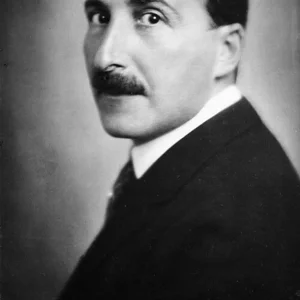

An Austrian writer in the German language, Stefan Zweig was one of the most widely read authors of the interwar period. A master of the novella and of biography, he embodies the cosmopolitan humanism of a Europe shattered by the two World Wars.
Stefan Zweig(1881 — 1942)
Stefan Zweig
Autriche, Cisleithanie
6 min read
Frequently asked questions
Key Facts
- Born in 1881 in Vienna into a wealthy Jewish family of the Austro-Hungarian Empire
- Published his great novellas in the 1920s (Amok, Confusion of Feelings)
- His books were burned and banned by the Nazis from 1933 onward; he went into exile (England, then Brazil)
- Wrote Chess Story and his memoir The World of Yesterday at the end of his life
- Took his own life with his wife Lotte in 1942 in Petrópolis (Brazil), in despair over the war
Works & Achievements
A dizzying novella about a consuming passion, revealing his mastery of psychological tension.
A deeply moving tale of a love kept secret for a lifetime, one of his most famous texts.
A novella about a sudden, blazing passion, a model of his command of compressed time and emotion.
A tale of a student's ambiguous admiration for his professor, an exploration of hidden passions.
A collection of “historical miniatures” depicting decisive instants of History, widely read in schools.
A best-selling biography that showcases his talent for bringing the great figures of the past back to life.
His final novella, a parable about the resistance of the mind against Nazi barbarism, published after his death.
A testamentary autobiography that portrays the end of a cosmopolitan Europe swallowed up by the wars.
Anecdotes
Stefan Zweig was a passionate collector of autograph manuscripts: he owned scores by Mozart and Bach, corrected pages by Goethe and Balzac, and even Beethoven's writing desk. For him, to touch the crossed-out draft of a genius was to catch creation in the act of being made.
In 1933, the Nazis burned his books during the great book-burnings and banned his work from being read in Germany. Yet when the composer Richard Strauss wanted to stage an opera in 1935 for which Zweig had written the libretto, he refused to erase the name of his Jewish librettist: the regime allowed the work to be performed three times before banning it.
In September 1939, in London, it was Zweig who delivered in German the eulogy for his friend Sigmund Freud, who had died in exile. The two men had corresponded at length, and Zweig admired the father of psychoanalysis as an explorer of the human soul.
During the 1920s and 1930s, Zweig was one of the most translated and most widely read writers in the world. His brief, intense novellas, which probe secret passions, won him an immense readership from Vienna all the way to Buenos Aires.
On 22 February 1942, in despair over the apparent triumph of Nazism and the destruction of the humanist Europe he loved, Zweig took his own life in Petrópolis, Brazil, alongside his wife Lotte. They were found side by side; he had left a farewell letter thanking Brazil for its hospitality.
Primary Sources
When I try to find a convenient formula to sum up the era before the First World War, the one in which I grew up, I hope I am most expressive in saying: it was the golden age of security.
Against my will, I have been the witness to the most terrible defeat of reason and the most savage triumph of brutality in the chronicle of the ages.
I send my greetings to all my friends. May they yet see the dawn after the long night! As for me, I am too impatient, and I go before them.
Key Places
Zweig's birthplace and the vibrant cultural capital of the late Austro-Hungarian Empire, where he grew up and studied philosophy.
The villa where Zweig lived and worked from 1919 to 1934; it became a meeting place for European intellectuals before he fled Nazism.
The English spa town where Zweig settled after his exile from Austria, in the late 1930s, before leaving for the Americas.
A stop on his exile in the New World, where he stayed before seeking refuge in South America.
A small town in the hills near Rio where Zweig spent his final months and where he took his own life with his wife Lotte in February 1942.
Typical Objects

The writer's everyday instruments, with which Zweig wrote his short stories and biographies by hand before having them typed up.

A tool of the writer's trade in the 20th century, used to produce clean copies of texts and correspondence before publication.

Zweig assembled one of the finest private collections of original manuscripts: scores by Mozart and Bach, pages by Goethe and Balzac, and even Beethoven's desk.

A game of chess at the heart of his last novella, The Royal Game, in which the match becomes a weapon of mental resistance against barbarism.

A document that became vital for the writer, first exiled and then stateless; Zweig knew the bitter experience of having to prove, again and again, his right to exist somewhere.

The medium for his short stories and biographies, distributed in millions of copies and translated into dozens of languages during the interwar period.
School Curriculum
Vocabulary & Tags
Key Vocabulary
Daily Life
Morning
Mornings were devoted to writing, in the quiet of his study in Salzburg. Zweig drafted, crossed out and rewrote at length, for he aimed at short, perfectly chiselled texts.
Afternoon
In the afternoon, he read, answered an immense correspondence with writers from all over the world, and tended to his precious collection of manuscripts. He also enjoyed walking and hosting intellectual friends.
Evening
Evenings often took him to the concert hall, the opera or the café, where literary conversations took shape. Vienna and Salzburg offered him an intense cultural life that he cherished above all else.
Food
Zweig shared the tastes of the Viennese bourgeoisie: the culture of coffee, pastries and the long hours spent at the *Kaffeehaus*, a true salon where one read newspapers and magazines from around the world.
Clothing
He dressed with the understated elegance of a cultivated bourgeois of the early 20th century: a three-piece suit, a stiff-collared shirt, a tie and a pocket watch.
Housing
In Salzburg, he lived in a large villa on the heights of the Kapuzinerberg, spacious and welcoming. Exile then reduced him to more modest lodgings, in London, Bath, New York, and finally in Petrópolis.
Historical Timeline
Period Vocabulary
Liens externes & ressources
Références
Œuvres
Lettre d'une inconnue
1922
Vingt-quatre heures de la vie d'une femme
1927
La Confusion des sentiments
1927
Les Très Riches Heures de l'humanité
1927
Marie-Antoinette
1932
Le Joueur d'échecs
1942