
British theoretical physicist and cosmologist (1942–2018), Stephen Hawking revolutionized our understanding of black holes and cosmology. Diagnosed with amyotrophic lateral sclerosis at age 21, he went on to have an exceptional scientific career despite severe disability.
Stephen Hawking(1942 — 2018)
Stephen Hawking
Royaume-Uni
8 min read
Frequently asked questions
Famous Quotes
« Intelligence is the ability to adapt to change.»
« While there is life, there is hope.»
« Look up at the stars and not down at your feet.»
Key Facts
- 1942: Born in Oxford, England
- 1963: Diagnosed with amyotrophic lateral sclerosis (ALS) at age 21
- 1974: Theoretical formulation of Hawking radiation, a quantum phenomenon emitted by black holes
- 1988: Publication of *A Brief History of Time*, which sold over 10 million copies
- 2018: Death in Cambridge, after 55 years living with ALS
Works & Achievements
A masterpiece of popular science that sold over 10 million copies, this book explains the Big Bang, black holes, and spacetime to a general audience. It remains one of the recommended reference works in secondary school physics education.
A groundbreaking paper demonstrating that black holes are not completely black but emit thermal radiation due to quantum effects at their event horizon. This discovery, never yet confirmed experimentally, is considered one of the most important in twentieth-century theoretical physics.
Mathematical work establishing that if general relativity is correct, the universe necessarily began with a singularity (the Big Bang) and that singularities exist at the heart of black holes. These results earned Penrose the Nobel Prize in Physics in 2020.
A popular science book exploring the great questions of existence: why does the universe exist, are there other universes, and can physics do without a creator? Hawking argues that the laws of physics alone are sufficient to explain the origin of the universe.
An illustrated companion to A Brief History of Time, presenting developments in theoretical physics since 1988: superstrings, M-theory, and multiple universes. The book received the Aventis Prize for the best science books.
An international initiative aimed at sending laser-propelled nano-probes to the Alpha Centauri system within twenty years. Hawking co-founded this project with Yuri Milner to pave the way for the search for habitable exoplanets within interstellar reach.
Anecdotes
When Stephen Hawking received his diagnosis of amyotrophic lateral sclerosis (ALS) at age 21, doctors gave him two years to live. Not only did he survive for more than fifty years, but during that time he produced scientific work that revolutionized physics. This extraordinary resilience remains an example cited in many textbooks.
In 1997, Hawking and his colleague Kip Thorne bet against physicist John Preskill that black holes permanently destroyed the information they absorbed. Seven years later, Hawking publicly admitted he had lost the bet and presented Preskill with a baseball encyclopedia — a symbol of a great scientist's ability to acknowledge his mistakes and revise his own theories.
In 2007, at age 65 and completely paralyzed, Stephen Hawking experienced weightlessness aboard a specially adapted aircraft over the Atlantic Ocean. Floating freely for the first time in decades, he declared the experience “wonderful.” His next dream was a trip to space, which he hoped to accomplish with Virgin Galactic.
Hawking long refused to change the synthetic voice in his communication software, even as more natural-sounding versions became available. That slightly robotic voice — generated by an American system from the 1980s — had become a true sonic identity for him: “It's my voice now,” he would explain.
Despite his severe disability, Hawking was renowned for his sharp wit and active social life. He made guest appearances in television series such as The Simpsons, Star Trek, and The Big Bang Theory, always playing himself. He believed that the popularity of scientific culture in the media was essential for drawing young people toward the sciences.
Primary Sources
A black hole is a region of space-time whose gravitational curvature is so intense that nothing — not even light — can escape from it. Yet I discovered that they are not completely black.
This thesis examines the properties of isotropically expanding universes within the framework of Einstein's general relativity, exploring the initial conditions of the cosmos.
It seems that any black hole will create and emit particles such as neutrinos or photons at just the rate that one would expect if the black hole was a body with a temperature.
The singularity theorems demonstrate that under very general conditions, space-time must contain singularities — points where curvature becomes infinite — both inside black holes and at the Big Bang.
My fingers could no longer hold the chalk. So I began thinking about equations differently, visualizing them in my head. In a way, the disability forced me to develop new geometric intuitions.
Key Places
Stephen Hawking's birthplace, born on 8 January 1942. His parents had temporarily left London during the Blitz to take refuge there. He spent his childhood in Oxford before moving to Cambridge.
Hawking completed most of his postgraduate studies here and conducted his earliest research in cosmology. He later returned as a fellow and maintained lifelong ties with the college.
Hawking's primary workplace for more than forty years, where he developed his theories on black holes and supervised his doctoral students. He held the Lucasian Chair of Mathematics there from 1979 to 2009.
Hawking collaborated regularly with physicists at Caltech, most notably Kip Thorne and John Preskill. He made several extended visits there and presented his work on the information paradox.
Hawking was interred here on 15 June 2018, between the graves of Isaac Newton and Charles Darwin — an exceptional honour reserved for the greatest intellectual figures in British history. A commemorative stone is now engraved there with an equation from Hawking radiation.
Typical Objects

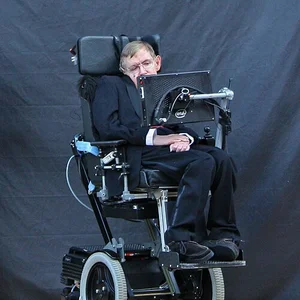
Hawking's electric wheelchair, controlled by a facial sensor detecting his cheek movements, was his sole means of mobility from the 1970s onward. Progressively upgraded over the decades, it became one of the most recognizable visual symbols in world science.

Connected to his wheelchair and operated by a single cheek muscle, this software converted words selected by Hawking into synthesized speech. He always refused to change its slightly robotic American accent, having embraced it as an integral part of his identity.

Before illness took the use of his hands, Hawking loved working in chalk on large blackboards. The blackboard from his Cambridge office, photographed and preserved, reveals his habit of thinking in geometric images rather than formal calculations.

In his final years, Hawking communicated exclusively through an eye-tracking system mounted on his glasses. The device allowed him to select words on a screen and produce up to one sentence per minute — the pace at which he nonetheless delivered lectures around the world.

This popular-science book, published in 1988 and often signed or annotated by Hawking as a personal dedication, became the best-selling physics book in history. It appears in school libraries worldwide and is regularly recommended to secondary students as an introduction to cosmology.

Presented by Barack Obama in 2009, this honorary distinction symbolizes the international recognition of Hawking's work beyond the academic world. He also received the Prince of Asturias Award and numerous honorary doctorates from universities across the globe.
School Curriculum
Vocabulary & Tags
Key Vocabulary
Tags
Daily Life
Morning
Every morning, Stephen Hawking required the assistance of two nurses or care workers to get up, wash, and dress — a routine that could take over an hour. Once settled in his motorized wheelchair with his voice synthesizer activated, he would check his emails and messages before heading to his office at the DAMTP in Cambridge.
Afternoon
His afternoons were devoted to research: he dictated his ideas word by word using the facial sensor on his wheelchair, an extremely slow process that required him to mentally construct his arguments before expressing them. He also supervised his doctoral students in weekly meetings, known for his unsettling questions and relentless critical thinking.
Evening
Hawking was renowned for his active social life and love of parties. He enjoyed attending dinners, concerts, and social events, firmly believing that isolation was fatal to scientific creativity. He regularly watched cricket matches and had a fondness for the music of Wagner.
Food
As the disease progressed, swallowing became increasingly difficult and dangerous for Hawking. In his later years, he was fed through a tube, with his meals carefully prepared by his medical team. In his youth, he enjoyed traditional British cuisine and wine.
Clothing
Dressed each morning by his care workers, Hawking typically wore comfortable clothing suited to wheelchair use: jumpers, jackets, and loose-fitting trousers. For conferences and formal ceremonies, he would sometimes wear a jacket and tie, but generally preferred comfort over formality.
Housing
Hawking lived in Cambridge for virtually his entire career, in a house adapted for his wheelchair with ramps, widened doorways, and permanent medical equipment. His home was constantly staffed by a team of carers working in rotating day and night shifts.
Historical Timeline
Period Vocabulary
Liens externes & ressources
Références
Œuvres
Une brève histoire du temps
1988
Théorie du rayonnement de Hawking (article)
1974
Théorèmes de singularité (avec Roger Penrose)
1970
La Grande Conception (avec Leonard Mlodinow)
2010
L'Univers dans une coquille de noix
2001
Projet Breakthrough Starshot (co-fondateur)
2016