
Surtr is a fire giant from Norse mythology, guardian of the realm of Muspelheim. He wields a blazing sword and will play a central role during Ragnarök, destroying the world in flames.
Surtr
Surtr
9 min read
Frequently asked questions
Key Facts
- Surtr has dwelt in Muspelheim, the primordial realm of fire, since the beginning of the world
- He is mentioned in the Prose Edda by Snorri Sturluson (c. 1220) and in the Poetic Edda
- During Ragnarök, he leads the sons of Muspel against the gods
- He slays the god Freyr in the final battle of Ragnarök
- After the battle, he sets the entire world ablaze, consuming both sky and earth
Works & Achievements
A foundational Eddic poem describing Norse cosmogony and eschatology. Surtr is explicitly mentioned as the agent of final destruction at Ragnarök, wielding a sword brighter than the sun.
A section of Snorri's Prose Edda that provides the most complete and systematic account of the Norse cosmos. Surtr is described as the guardian of Muspelheim and the agent of the all-consuming fire.
A battle of wits between Odin and the giant Vafþrúðnir, which provides valuable information about Ragnarök and the role of the sons of Muspell, led by Surtr, in the final destruction.
A handbook of skaldic rhetoric that mentions Surtr in poetic kennings: gold is called 'the fire of Surtr,' attesting to his central place in the poetry and symbolic language of the Norse.
The final opera of the Der Ring des Nibelungen cycle, directly inspired by the Norse Ragnarök. The figure of Surtr and the final cosmic conflagration are transposed into a major nineteenth-century musical work, bringing the myth to a broad European audience.
Anecdotes
The name 'Surtr' means 'the Black' or 'the Dark One' in Old Norse — a paradoxical name for an entity associated with flames and universal conflagration. Philologists believe this name refers to the blackness of lava and volcanic ash, familiar to the inhabitants of medieval Iceland.
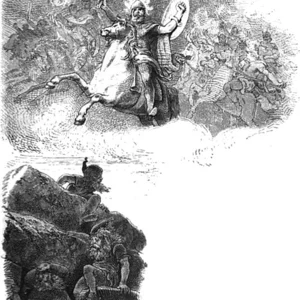
In the Völuspá, the seeress describes Surtr arriving from the south, brandishing a sword whose light eclipses that of the sun. He rides at the head of the sons of Muspell, fire beings who cross Bifröst, the rainbow bridge, causing it to collapse under their weight.
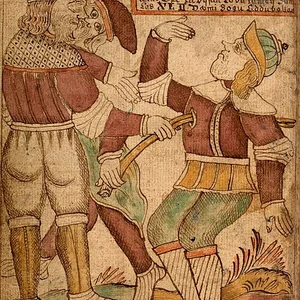
During Ragnarök, Surtr faces Freyr, god of fertility and sunshine. Tragically, Freyr had given away his magical sword — capable of fighting on its own — to his servant Skírnir in exchange for the hand of the giantess Gerðr. Without this weapon, Freyr is defeated and slain by Surtr. This battle illustrates the Norse theme of inescapable fate and the price paid for one's choices.
After the battle of Ragnarök, Surtr engulfs the entire world in flames, consuming Yggdrasil, the World Tree, and all the realms. Paradoxically, according to some versions of the Völuspá, the earth then rises anew and green from the waters, populated by surviving gods and a human couple. Surtr is therefore both a destroyer and the unwitting agent of cosmic renewal.
Snorri Sturluson, in the Gylfaginning, notes that the sons of Muspell are among the only beings who do not perish during Ragnarök. Surtr himself appears to survive — or at least his devastating fire does — making him one of the most formidable powers in the Norse cosmos, one that predates even the Aesir gods.
Primary Sources
Surtr comes from the south with the scourge of branches aflame; the sun of the war-gods shines from his sword; mountains collapse, giantesses stumble, men tread the road to Hel, and the sky is rent asunder.
To the north and below lies Niflheim, and in the middle is a place called Hvergelmir, but Muspell is above and burns and blazes. Surtr sits at the edge of Muspell to defend it, and at the end of the world he will advance and ravage and burn the entire world with fire.
The sons of Muspell will sail across the sea; Naglfar will be their ship; the demons will advance with Loki; the monsters will come with all the wolves of the world alongside them; and the brother of Byleist will march with them.
Swords gleam as Surtr and the gods meet on the battlefield, when the gods do battle with the giants.
Gold is called the fire of Surtr, and on this basis skalds compose many poetic kennings.
Key Places
The realm of primordial fire located south of Ginnungagap in Norse cosmology. Surtr is its eternal guardian, seated at its borders with his flaming sword, awaiting Ragnarök since the dawn of time.
The vast plain where the battle of Ragnarök takes place according to the Prose Edda. It is here that Surtr faces and slays Freyr, and from where he spreads his flames across the entire cosmos.
The multicolored bridge connecting Midgard (the world of men) to Ásgard (the home of the gods). Its crossing by Surtr and the sons of Muspell causes it to collapse, heralding the destruction of Ragnarök.
It was in Iceland, a land of volcanoes and geysers, that skalds and scholars committed the Norse myths to writing. Iceland's volcanic landscape almost certainly influenced and amplified depictions of Surtr and Muspelheim.
The celestial city of the Norse gods that Surtr and his armies seek to destroy during Ragnarök. Its destruction by Surtr's flames marks the end of the age of the gods.
Typical Objects

Surtr's primary attribute is his sword, whose flame is described in the Völuspá as brighter than the sun. It is with this weapon that he engulfs the world in fire during Ragnarök and slays Freyr.

Surtr is intrinsically bound to the primordial fire of Muspelheim. Molten rocks symbolize his nature and destructive power, echoing the volcanic landscapes of Iceland that fueled the imagination of Norse storytellers.

This funeral ship, built from the nails and toenails of the dead, carries the forces of chaos during Ragnarök. The sons of Muspell, of whom Surtr is one, use it to launch their final assault against the gods.

Surtr rules over Muspelheim, the realm of primordial fire located in the south of the Norse cosmos. This fire existed before the creation of the world and endures as an autonomous cosmic force, guarded by Surtr since the beginning of time.

During Ragnarök, Surtr and the sons of Muspell cross Bifröst, the rainbow bridge connecting Midgard to Asgard, causing it to collapse under the heat and their weight. Its destruction symbolizes the final severing of the bonds between worlds.

After the final battle, Surtr's fire consumes Yggdrasil, the immense cosmic ash tree that supports the nine realms. The destruction of this world-tree embodies the absolute scale of Surtr's power.
School Curriculum
Vocabulary & Tags
Key Vocabulary
Tags
Daily Life
Morning
Surtr, a primordial being unconstrained by human cycles, has stood at the southern border of Muspelheim since the beginning of time. Every 'dawn' in this realm is a wave of intense heat: the glowing rock walls light up with a lava-like luminescence, and Surtr surveys the boundaries of his domain, sword in hand, unchanging in his vigil as he awaits Ragnarök.
Afternoon
Throughout the age of the gods, Surtr commands the sons of Muspell — entities of fire and destruction — who inhabit Muspelheim. He presides over the tending of the primordial flames, the very fires that, in Norse cosmology, existed before the creation of the world, and whose heat helped melt the ice of Niflheim to give rise to life.
Evening
Night does not exist in Muspelheim, the realm of perpetual fire. Surtr meditates on his inescapable fate: the Norns themselves have woven his role as the final destroyer into the threads of time. He sharpens his sword and waits, stoic, for the signal of Ragnarök, knowing that he will be the instrument of the world's end — and perhaps the beginning of another.
Food
As a fire jötunn, Surtr has no need for food in the human sense. He 'feeds' on the primordial heat of Muspelheim, absorbing the volcanic and igneous energy that makes up his natural environment. Fire is at once his habitat, his substance, and his fuel.
Clothing
Surtr is not described as wearing clothing in any conventional sense. His very body appears to be made of volcanic rock and fire. Medieval sources portray him as a vast, dark figure — 'the Black One' — whose only adornment is his formidable flaming sword, at once a weapon and a symbol of his cosmic power.
Housing
Surtr dwells at the southernmost edge of the cosmos, at the gates of Muspelheim — the realm of fire and primordial heat, the polar opposite of Niflheim, the world of cold and mist. His 'palace' is an expanse of lava, burning rock, and eternal flame: a place hostile to all other forms of life and perfectly suited to his nature as a fire giant.
Historical Timeline
Period Vocabulary
Visual Style
Géant de feu imposant et sombre se découpant contre un ciel en flammes, dans un style épique nordique alliant l'iconographie Viking médiévale à une esthétique cosmique dramatique dominée par les oranges, rouges et noirs des volcans.
Sound Ambience
Ambiance sonore de Muspelheim et du Ragnarök : éruptions volcaniques grondantes, lave en fusion, craquements du grand incendie cosmique et fracas de la bataille finale des dieux et des géants.
Liens externes & ressources
Références
Œuvres
Völuspá (La Prophétie de la Voyante)
vers 960-1000 (mis par écrit vers 1270)
Gylfaginning (L'Hallucination de Gylfi) — Snorri Sturluson
vers 1220
Vafþrúðnismál (Les Dits de Vafþrúðnir)
vers 900-1000 (manuscrit vers 1270)
Skáldskaparmál (Langage de la Poésie) — Snorri Sturluson
vers 1220